












Summary:
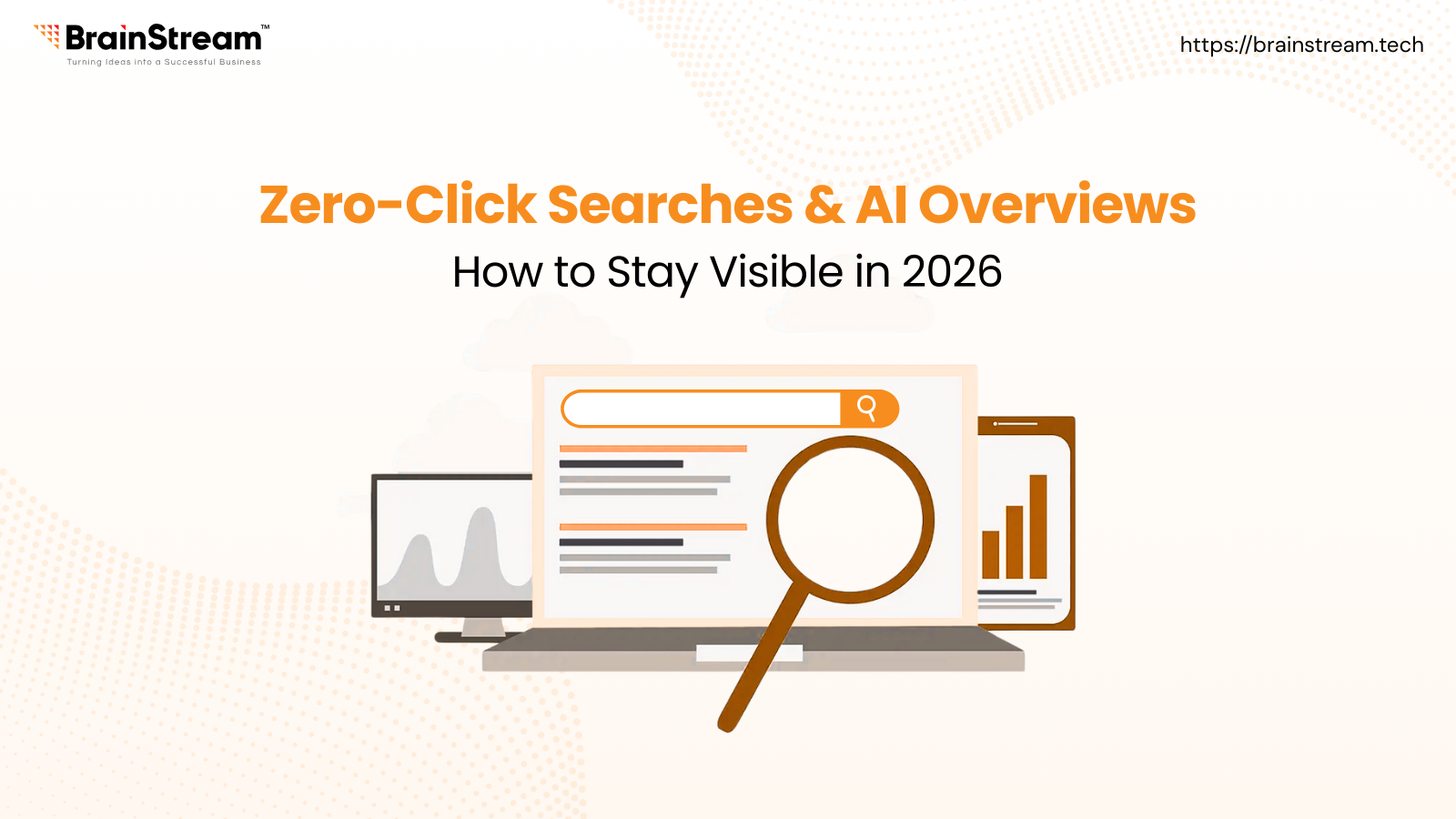
Zero-click searches and AI Overviews are transforming how users interact with search results in 2026. Instead of clicking websites, users now get instant answers directly from AI-powered summaries. To stay visible, brands must shift from click-focused SEO to authority-driven content that AI trusts. Clear explanations, strong EEAT signals, and consistent topical expertise are now the key to search visibility.
January 12, 2026
Search is changing faster than most businesses realise.
If you’re still measuring success only by clicks, rankings, or traffic volume, 2026 might feel uncomfortable. Because the truth is simple: users no longer need to click to get answers.
Google, Bing, and AI-driven search engines now provide instant answers directly on the results page. AI Overviews, featured snippets, knowledge panels, and conversational search results are replacing the traditional “10 blue links.”
This is what we call zero-click searches.
And they’re not a threat, unless you ignore them.
What Are Zero-Click Searches (And Why They’re Exploding)
A zero-click search happens when a user finds the answer without clicking any website.
For example, someone searches:
“best time to post on LinkedIn”
and Google immediately shows an AI-generated summary with key insights.
The user gets value.
Google keeps them on the platform.
And your website? Invisible, unless you’re part of that answer.
AI Overviews have accelerated this trend. Instead of showing one featured snippet, Google now synthesises information from multiple trusted sources and presents it as a single, conversational response.
By 2026, this will be the default search experience, not the exception.
Why Traditional SEO Metrics Are Becoming Misleading
Here’s the uncomfortable truth.
You might be ranking #1… and still losing visibility.
Clicks are declining, even for high-ranking pages. But impressions, brand mentions, and authority signals are increasing for websites that understand the new rules.
SEO is no longer about:
“How do I get the click?”
It’s now about:
“How do I become the source AI trusts?”
That shift changes everything.
AI Doesn’t Rank Pages - It Selects Sources
This is the most important concept to understand.
AI Overviews don’t rank content the way traditional search does. They select sources based on trust, clarity, authority, and relevance.
In other words:
AI isn’t asking “Who optimised keywords best?”
It’s asking “Who explains this topic most clearly and reliably?”
That’s why some smaller websites are appearing in AI summaries while larger sites are disappearing.
Content in 2026 Must Answer, Not Attract
Old SEO content was written to pull users in.
New SEO content must be written to be extracted.
That means your content needs to be:
- Clear enough to quote
- Structured enough to understand
- Authoritative enough to trust
AI prefers content that feels like an expert calmly explaining something, not content aggressively trying to rank.
This is why paragraph-based content works better than long lists or keyword stuffing.
The Rise of "Answer Ownership"
In 2026, visibility is not about owning keywords.
It’s about owning answers.
When AI summarises a topic, it pulls from sources that consistently explain the same concept well across multiple pages.
If your website repeatedly explains:
- a concept clearly
- with consistency
- using real-world context
AI starts associating your brand with that topic.
This is how you stay visible even when users don’t click.
Why EEAT Is No Longer Optional
Google’s EEAT (Experience, Expertise, Authoritativeness, Trustworthiness) isn’t just a guideline anymore.
It’s the filter.
AI Overviews are extremely cautious.
They avoid pulling information from websites that:
- lack of author identity
- have thin content
- show no real-world experience
In 2026, anonymous content will struggle.
AI prefers:
- Real authors
- Clear credentials
- Industry-specific expertise
- Consistent topical coverage
If your content doesn’t signal “I know this because I do this,” AI won’t trust it.
How to Structure Content for AI Overviews
You don’t need complicated SEO tricks.
You need clarity.
Each section of your blog should answer a single question in 3–5 short paragraphs. Not bullets. Not fluff. Just a direct explanation.
AI scans content looking for:
- Definitions
- Explanations
- Cause-and-effect logic
- Practical insight
Think of every paragraph as a potential quote.
If AI can lift it and drop it into a summary without editing, you’re doing it right.
Long-Form Content Still Wins - If It’s Focused
Many marketers think AI prefers short content.
That’s wrong.
AI prefers a comprehensive understanding, not short answers.
Long-form content works when:
- It stays on one core topic
- Each section builds on the previous one
- There’s no filler
A 1,500-word blog that deeply explains a concept has more chances to be referenced than ten shallow posts.
Depth is the new keyword density.
Brand Mentions Matter More Than Backlinks Alone
Backlinks still matter.
But in 2026, brand mentions across the web matter just as much.
AI looks for consistency.
If your brand is:
- Mentioned in blogs
- Referenced in discussions
- Cited across platforms
It reinforces trust.
That’s why PR-style SEO, thought leadership, and high-quality guest content will outperform spammy link building.
Why Clicks Are a Bonus, Not the Goal
Here’s the mindset shift.
Visibility is the goal.
Clicks are the bonus.
When your brand appears inside AI Overviews:
- Users see your name repeatedly
- Trust builds subconsciously
- Branded searches increase
Later, when they need a service, they search for you.
That’s how zero-click visibility still drives revenue.
The Power of Branded Search in an AI World
AI-driven search heavily favours brands that users already recognise.
The more people search your brand name, the more AI trusts your relevance.
This creates a loop:
Better content -> AI visibility -> Brand awareness -> More branded searches -> Even more AI visibility
This is why content marketing and SEO can no longer be separated.
Why Generic Content Will Disappear
If your content sounds like:
- “Here are 10 tips for…”
- “Ultimate guide to…”
- “Best practices for…”
AI will ignore it.
Why?
Because thousands of pages say the same thing.
AI is trained to avoid redundancy.
What it wants is unique framing, real experience, and original explanation – even if the topic itself isn’t new.
The Future of SEO Is Teaching, Not Selling
The brands that win in 2026 won’t sound like marketers.
They’ll sound like teachers.
- They won’t push CTAs aggressively.
- They won’t over-optimise headlines.
- They’ll simply explain things better than anyone else.
AI rewards clarity.
Users reward trust.
Sales follow naturally.
Final Thoughts: Adapt or Disappear Quietly
Zero-click searches aren’t killing SEO.
They’re killing lazy SEO.
In 2026, staying visible means:
- Writing for understanding, not clicks
- Building authority, not just links
- Optimising for AI extraction, not just rankings
If your content educates, clarifies, and demonstrates real expertise, AI will find you.
And when AI finds you, users will too.
FAQs
1. What are zero-click searches?
Zero-click searches occur when users get their answers directly on the search results page without clicking on any website. AI Overviews, featured snippets, and knowledge panels are the main drivers of this trend.
2. Do zero-click searches reduce website traffic?
Yes, traditional clicks may decrease, but visibility increases. Brands featured in AI Overviews gain trust, recognition, and more branded searches, which often lead to higher-quality conversions later.
3. How do AI Overviews choose content sources?
AI Overviews selects content based on clarity, relevance, authority, and trustworthiness. Content that explains topics simply, shows real expertise, and comes from credible sources is more likely to be included.
4. Is SEO still important in 2026?
Absolutely. SEO has evolved from keyword optimisation to answer optimisation. Websites that focus on education, topical authority, and structured content remain highly visible in AI-driven search results.
5. How can businesses stay visible in zero-click search results?
By creating in-depth, well-structured content, strengthening EEAT signals, building brand authority, and consistently answering user questions better than competitors.

Bhavesh Chipa 

Bhavesh is a digital marketing expert and seasoned blog writer with a passion for SEO, content strategy, and online growth. He helps businesses boost their digital presence through data-driven strategies and engaging content.
Share :


Related Blog
SEO
FinTech SEO: Trust Signals That Boost Conversions in 2026
FinTech SEO is different. In FinTech, SEO is not just about ranking on Google. It’s about convincing users to trust your platform with their money, personal data, and financial decisions. That’s why FinTech SEO behaves very differently from SaaS, eCommerce,...
Digital Marketing
How to Use AI to Personalize Every Stage of Your Marketing Funnel for Maximum Conversions
Personalization isn’t a "nice-to-have" anymore; it’s a must-have. Today’s audiences expect experiences tailored to their needs, preferences, behavior, and even mood. The problem? Most businesses still treat personalisation as an add-on rather than a core strategy. AI changes all of...
Digital Marketing
GTM Updates 2026: Essential Year-End Checklist for Marketers
In the technologically exciting world of AI tools and data-intensive marketing platforms, Google Tag Manager (GTM) may seem outdated. However, this shouldn't detract from the fact that even in 2026, GTM will remain one of the most powerful tools in...


Keep up-to-date with our newsletter.
Sign up for our newsletter to receive weekly updates and news directly to your inbox.