

















Summary:
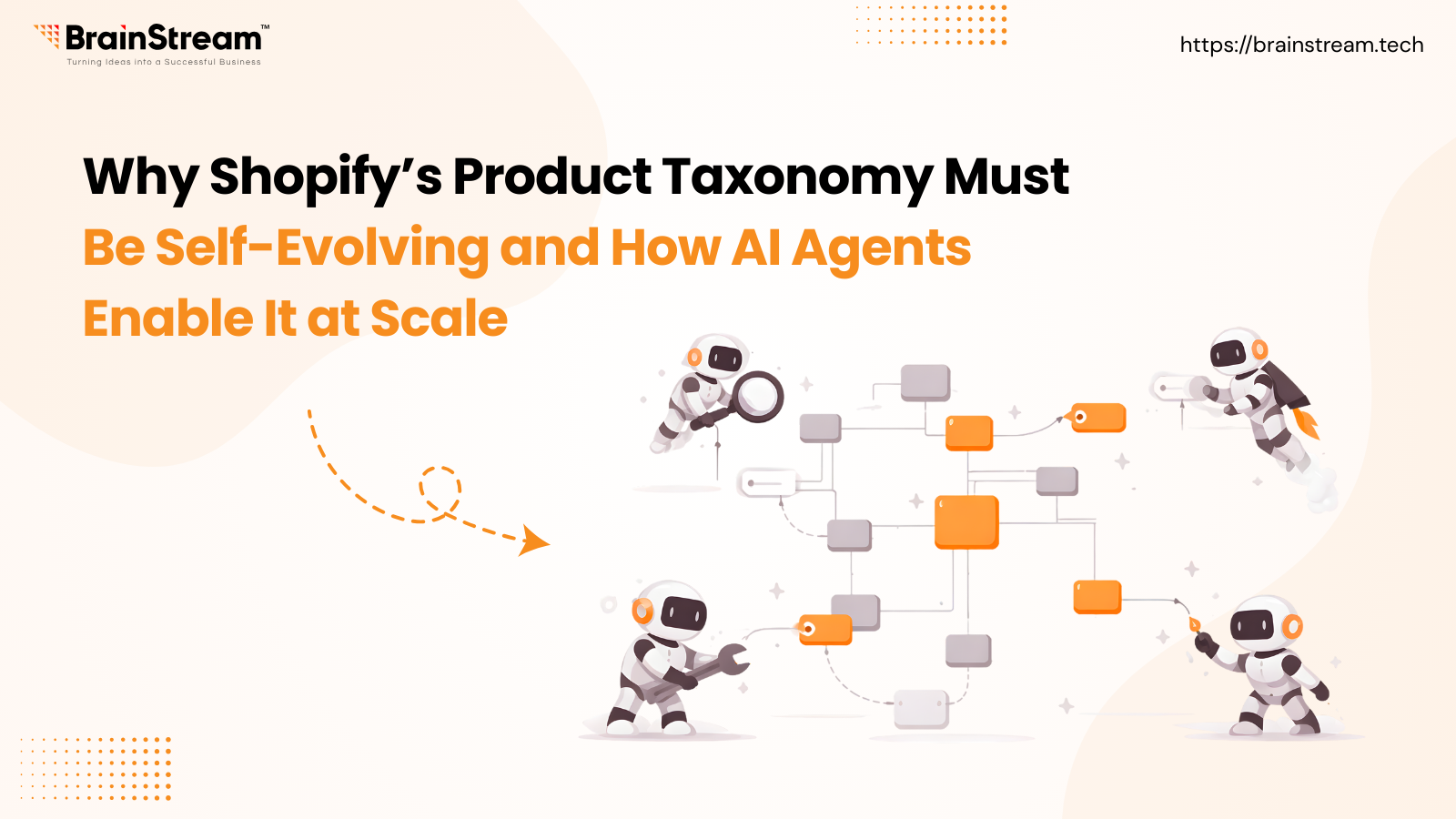
Shopify’s product taxonomy powers search, discovery, and classification across millions of merchant listings. But at a global scale, static taxonomies can’t keep up with evolving products, merchant behaviour, and customer expectations. This article explores why Shopify’s taxonomy must be self-evolving, and how specialised AI agents enable continuous, high-quality taxonomy evolution without sacrificing consistency or merchant flexibility.
December 23, 2025
Shopify’s product taxonomy is one of the most critical yet least visible systems powering the platform. It defines how millions of merchants describe their products and how customers discover them through search, filters, recommendations, and analytics.
At Shopify’s scale, taxonomy is not just a classification layer; it is core commerce infrastructure.
And like all infrastructure operating at a global scale, it cannot remain static.
The Role of Product Taxonomy in Shopify’s Ecosystem
Shopify’s taxonomy supports:
- 10,000+ product categories
- 2,000+ attributes
- Tens of millions of classification decisions every day
This shared structure enables consistency across:
- merchant product listings
- storefront discovery
- search and filtering
- downstream intelligence systems
But as commerce evolves, the taxonomy that powers these systems must evolve as well without disrupting merchants or degrading platform intelligence.
Why Static Taxonomies Break at Shopify’s Scale
Commerce Evolves Faster Than Manual Updates
New product types appear continuously:
- emerging hardware categories
- sustainability-driven product variations
- niche accessories with new compatibility rules
Each new product type introduces requirements that the taxonomy may not yet support. Manual updates inevitably lag behind real merchant behaviour, creating gaps between how products are sold and how they are modeled.
At Shopify’s scale, reactive taxonomy management is not sustainable.
Domain Expertise Does Not Scale Linearly
Designing a high-quality taxonomy requires deep industry knowledge.
The attributes that matter for electronics are entirely different from those required for:
- apparel
- beauty and personal care
- musical instruments
- industrial equipment
No single taxonomy team can maintain expert-level understanding across every vertical Shopify supports. Without scalable support, inconsistencies emerge, and those inconsistencies directly reduce classification quality and merchant confidence.
Inconsistency Weakens Platform Intelligence
As Shopify’s taxonomy grew organically, subtle issues accumulated:
- duplicated attributes with different names
- uneven category depth
- similar concepts modelled inconsistently across verticals
These issues don’t just affect the organisation; they degrade the accuracy of search, recommendations, and analytics systems that depend on a coherent taxonomy.
Reframing Shopify’s Product Taxonomy as a Living System
The fundamental shift was conceptual.
Instead of treating taxonomy as a static structure that requires periodic manual curation, Shopify began treating it as a living system one that can observe, reason, and improve continuously.
This required a new approach: AI agents designed specifically for taxonomy evolution, not just product classification.
How AI Agents Power Shopify’s Self-Evolving Taxonomy
Shopify’s approach relies on multiple specialised AI agents, each focused on a different dimension of taxonomy improvement.
No single model can capture all necessary perspectives.
Structural Analysis Agents
These agents analyse Shopify’s taxonomy itself:
- category hierarchies
- parent–child relationships
- naming conventions
- attribute reuse and consistency
Their goal is to maintain structural integrity as the taxonomy grows, identifying gaps, redundancies, and architectural inconsistencies before they cause downstream issues.
Product-Grounded Analysis Agents
Other agents analyse real merchant product data across Shopify:
- product titles
- descriptions
- merchant-defined categorisation patterns
These agents identify mismatches between how merchants describe products and how the taxonomy represents them, surfacing missing attributes or outdated category boundaries.
This ensures taxonomy evolution remains grounded in actual commerce behaviour, not abstract assumptions.
Synthesis Agents
Structural insights and product insights often conflict.
Synthesis agents reconcile these perspectives by:
- resolving contradictions
- eliminating redundant proposals
- merging compatible improvements
The result is a globally consistent set of taxonomy changes that still reflect merchant reality.
Equivalence Discovery Agents
Shopify merchants organize catalogs in different ways, and the platform must respect that flexibility.
One merchant may use a dedicated category.
Another may rely on broader categories combined with attributes.
Equivalence agents detect when:
- a specific category
- and a broader category filtered by attributes
represent the same product set.
This allows Shopify’s systems to understand product relationships without forcing merchants into a single organisational model.
Automated Quality Assurance for Taxonomy Changes
Self-evolving does not mean uncontrolled.
Every proposed taxonomy change is evaluated by specialised AI judges that apply:
- domain-specific knowledge
- taxonomy design principles
- duplication and conflict checks
Different judges assess different types of changes, whether they involve attributes, categories, or relationships,s ensuring rigour at scale.
Only high-confidence proposals advance to human review.
Impact on Shopify’s Commerce Platform
Faster, Safer Taxonomy Evolution
AI agents can evaluate entire taxonomy branches in parallel, work that would take weeks manually without sacrificing consistency or quality.
Improved Classification and Discovery
By aligning taxonomy more closely with merchant language and real product data, Shopify improves:
- classification accuracy
- search relevance
- filter usability
All while preserving merchant autonomy.
From Reactive Fixes to Proactive Design
Instead of waiting for merchants to encounter taxonomy limitations, Shopify can proactively identify gaps and address them before they impact discoverability or conversions.
What This Means for Shopify’s Future
Shopify’s product taxonomy is no longer a static dependency. It is an adaptive system that evolves alongside global commerce.
As AI reasoning continues to improve, Shopify is exploring:
- deeper domain-aware analysis
- regional and cultural taxonomy variations
- tighter feedback loops between classification performance and taxonomy evolution
The long-term goal is clear: reduce friction for merchants while increasing intelligence across the platform.
Conclusion
At Shopify’s scale, static taxonomies are no longer viable.
By combining:
- specialised AI agents
- automated quality assurance
- and human strategic oversight
Shopify has transformed its product taxonomy into a self-evolving system.
This approach doesn’t replace human expertise; it scales it to meet the pace of modern commerce.
In a world where products change daily, Shopify’s taxonomy now changes with them.


Manish Khilwani 

Co-Founder at BrainStream Technolabs, he focuses on building people-first, scalable eCommerce and digital products that help brands grow with clarity and innovation.
Share :


Related Blog
Shopify
Top 10+ Shopify Wholesale Apps in 2026
Ultimate Guide to the Best B2B & Wholesale Solutions for Your Shopify Store Wholesale functionality allows Shopify merchants to sell products in large quantities, offer tiered pricing, manage business customers, and streamline bulk order workflows, all without running a separate...
Shopify
Shopify POS App: Features, Benefits, Integrations & Comparison Guide (2026)
In today’s retail world, integrating in-store and online sales is a game-changer. Whether you’re running a brick-and-mortar store, a pop-up stand, or an omnichannel business, having a point-of-sale system that syncs seamlessly with your online store is essential. Shopify POS...
Shopify
Beginner’s Guide to Setting Up a Shopify Fashion and Apparel Store in 2026
If you’re a fashion business owner planning to take your brand online, choosing the right eCommerce platform is the foundation of your success. With multiple platforms available, deciding where to build your fashion store can feel overwhelming. However, Shopify continues...


Keep up-to-date with our newsletter.
Sign up for our newsletter to receive weekly updates and news directly to your inbox.