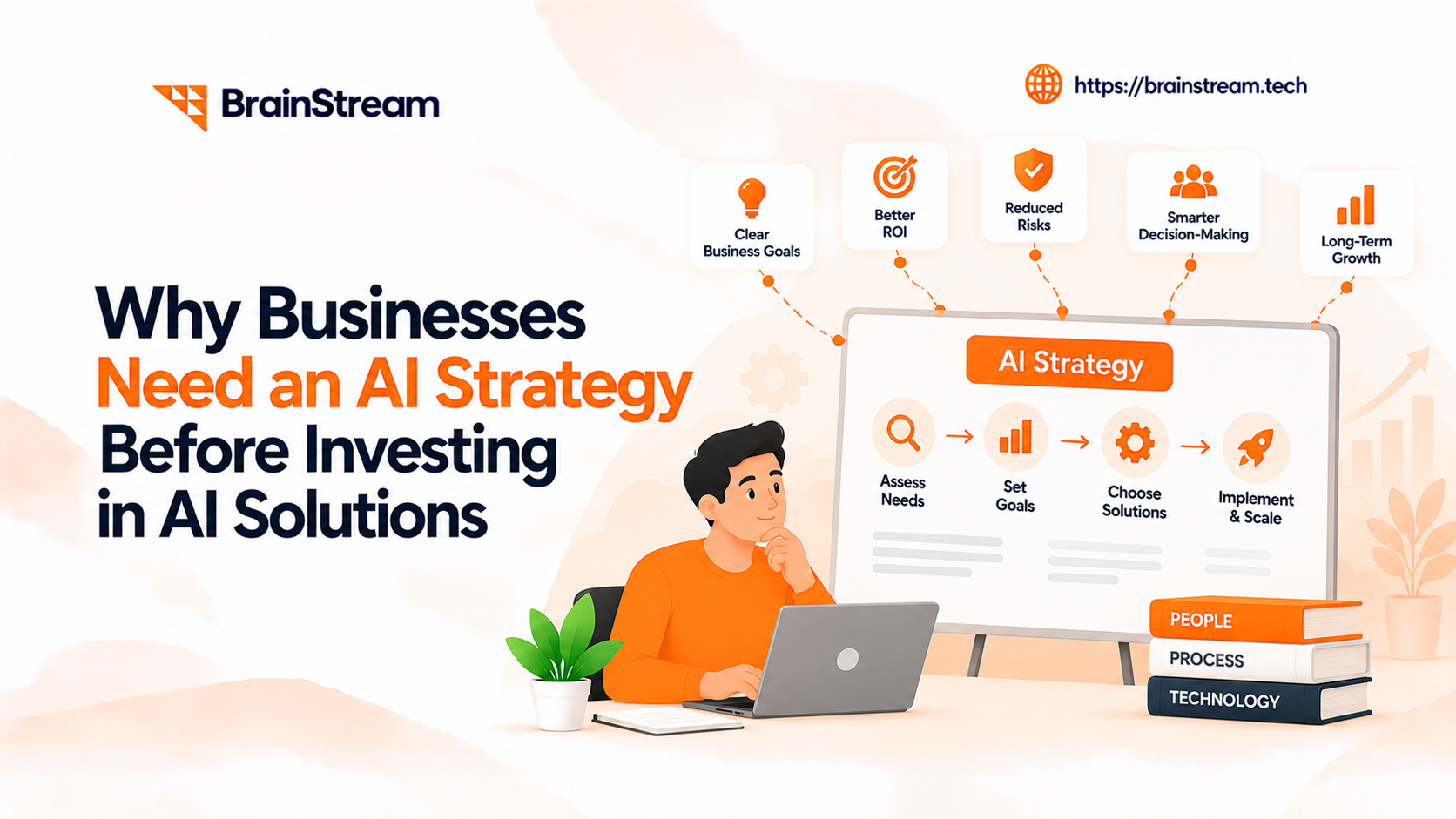
Why Businesses Need an AI Strategy Before Investing in AI Solutions
An AI strategy for business is a plan that ties every AI investment to a measurable business goal, the data it needs, and the order in which projects get funded. Without one, companies often buy AI tools before defining the problem, which wastes budget and delays results.
However, rushing into AI often leads to disappointing results.
Many companies spend thousands of dollars on AI tools without solving real business problems. Some invest in complex technologies before understanding how AI fits into their operations. Others launch AI projects that never deliver measurable value.
The problem is not AI itself.
The real problem is the lack of a clear AI strategy.
Before investing in any AI solution, businesses need a roadmap that connects technology decisions with business goals. A well-defined AI strategy helps organizations identify opportunities, reduce risks, and maximize return on investment.
In this guide, we will explore why an AI strategy matters and how businesses can build one successfully.
What Is an AI Strategy?
An AI strategy is a structured plan that defines how a business will use artificial intelligence to achieve specific objectives.
Instead of focusing on technology first, an AI strategy focuses on business outcomes.
It helps answer important questions such as:
- What problems should AI solve?
- Which processes need automation?
- What data is available?
- What resources are required?
- How will success be measured?
Therefore, businesses can make informed decisions rather than chasing technology trends.
Why Is Investing in AI Without a Strategy Risky?
Many organizations adopt AI because competitors are doing it.
However, technology investments without clear objectives often fail.
Lack of Business Alignment
AI projects should support business goals.
For example, a retailer may want to improve customer retention, while a logistics company may want to optimize delivery routes.
Without alignment, AI becomes an expensive experiment rather than a business asset.
Wasted Resources
AI projects require:
- Budget
- Time
- Data
- Technical expertise
Without a strategy, businesses often invest in solutions that provide little value.
As a result, costs increase while outcomes remain unclear.
Unrealistic Expectations
Some organizations expect AI to solve every challenge instantly.
In reality, successful AI adoption requires planning, testing, and continuous improvement.
A realistic roadmap helps set achievable goals and expectations.
Key Benefits of Having an AI Strategy
Better Return on Investment
An AI strategy identifies projects that offer the highest business value.
Instead of implementing AI everywhere, businesses can prioritize initiatives with measurable impact.
Therefore, investments generate stronger returns.
Faster Decision-Making
A clear roadmap reduces uncertainty.
Teams understand:
- Project priorities
- Technology requirements
- Resource allocation
- Success metrics
This accelerates decision-making across the organization.
Reduced Implementation Risks
AI projects involve technical, operational, and compliance risks.
A strategy helps identify challenges early.
Consequently, businesses can address issues before they become costly problems.
Businesses operating in Europe should consider data protection requirements under GDPR and assess whether their AI use cases fall within the scope of the EU AI Act.
Companies serving international markets should also review applicable local regulations, data residency requirements, and vendor data-processing practices before selecting an AI platform. Compliance requirements depend on the use case, data involved and business location.
Improved Scalability
Many businesses start with a small AI initiative and expand later.
A strategic approach ensures future AI projects can scale efficiently.
Essential Components of an AI Strategy
Business Objectives
Start by identifying business challenges.
Ask questions such as:
- How can AI improve efficiency?
- Where are operational bottlenecks?
- Which customer experiences need improvement?
Business goals should always drive AI initiatives.
Data Readiness Assessment
AI depends on quality data.
Organizations should evaluate:
- Data availability
- Data quality
- Data security
- Data governance
Without reliable data, AI systems struggle to deliver accurate results.
Technology Evaluation
Different business problems require different AI solutions.
Examples include:
| Business Goal | AI Solution |
|---|---|
| Customer Support | AI Chatbots |
| Demand Forecasting | Predictive Analytics |
| Workflow Automation | AI Agents |
| Sales Insights | Machine Learning Models |
| Content Creation | Generative AI |
For educational institutions, AI adoption can begin with practical use cases such as exam paper checking software, which combines document recognition, grading workflows, and human verification to support academic assessments.
Choosing the right technology prevents unnecessary spending.
As businesses adopt more connected AI tools, understanding the idea of ChatGPT OS can help teams explore how conversational interfaces may connect with CRM, ERP, and other business applications.
For growing teams, a small business CRM with AI features can be a practical starting point for better sales insights, lead management, and automation. Choosing the right CRM is often more useful than investing immediately in complex AI systems.
Before selecting technologies, it helps to understand the broader AI trends in 2026, including agentic AI, domain-specific models, and emerging automation approaches.
Implementation Roadmap
An AI roadmap outlines:
- Project phases
- Timelines
- Required resources
- Budget expectations
- Success indicators
This keeps projects organized and measurable.
Common AI Adoption Mistakes Businesses Make
Starting With Technology Instead of Problems
Many organizations purchase AI tools first.
Then they search for ways to use them.
Successful businesses take the opposite approach.
They identify business challenges first and select technology second.
Ignoring Data Quality
Even advanced AI systems fail when data is incomplete or inaccurate.
Data preparation should always be a priority.
Lack of Internal Buy-In
AI affects multiple teams.
Without stakeholder support, adoption becomes difficult.
Therefore, organizations should involve leadership and employees early.
Focusing Only on Short-Term Gains
AI should support long-term business growth.
A strategic roadmap balances immediate improvements with future opportunities.
How to Build an AI Strategy for Business in 6 Steps
Step 1: Define Business Goals
Identify measurable objectives.
For example:
- Reduce operational costs
- Improve customer satisfaction
- Increase productivity
- Enhance decision-making
Step 2: Assess Current Technology
Review existing systems and infrastructure.
Determine whether current technology can support AI initiatives.
Step 3: Evaluate Data Readiness
Analyze available data sources and identify gaps.
Step 4: Prioritize Use Cases
Select projects with the highest potential impact.
Start small and expand gradually.
Step 5: Create an AI Roadmap
Develop a phased implementation plan.
Include milestones, budgets, and success metrics.
Step 6: Monitor and Optimize
Track results continuously.
Adjust strategies based on performance and business needs.
How to Create a Future-Proof AI Strategy for Your Business
An effective AI strategy should evolve with your business, technology, and customer expectations. Companies should review their AI roadmap regularly instead of treating it as a one-time plan.
Review Your AI Roadmap Regularly
Review AI initiatives every quarter or when major business priorities change. Measure project performance against defined KPIs, identify implementation gaps and adjust investment priorities when necessary.
Choose Flexible and Vendor-Neutral Technology
Avoid building your entire AI infrastructure around one provider. Consider modular architecture, interoperable systems and flexible integrations. This approach makes it easier to adopt new AI models and tools without rebuilding the entire technology stack.
Strengthen Data Governance
Define how business data is collected, stored, accessed and used by AI systems. Establish clear ownership, access controls, data quality standards, and processes for protecting sensitive information.
Invest in Employee Skills
Technology alone cannot make an AI strategy successful. Train employees to use AI tools responsibly, understand their limitations, and integrate them into existing workflows. Involve business and technical teams throughout implementation.
How to Prioritize AI Investments
Businesses should not implement every AI idea at the same time. The best approach is to compare potential use cases based on business impact, implementation effort and data readiness.
Use the following framework to evaluate possible AI investments:
| Use Case | Business Impact | Feasibility / Data Readiness |
|---|---|---|
| Customer support automation | Faster responses and reduced manual workload | High when support conversations and FAQs are available |
| Sales forecasting | Better demand and revenue planning | Medium to high when historical sales data is reliable |
| Document processing | Less manual data entry and faster processing | High when documents are accessible and consistent |
| AI-powered workflow automation | Reduced repetitive tasks across teams | Medium when workflows and integrations are clearly defined |
| Predictive maintenance | Earlier identification of equipment issues | Medium when sufficient sensor and maintenance data exists |
These are illustrative examples. Actual feasibility depends on each company’s systems, data quality, budget and technical requirements.
Start With One to Three AI Initiatives
Begin with one to three high-priority initiatives rather than funding a large number of projects immediately. Choose use cases with clear business owners, measurable outcomes and available data.
Run a pilot, measure its performance and collect feedback from employees. Expand investment when the pilot demonstrates practical value and the business is ready to support wider implementation.
Why Do Businesses Work With AI Advisory Experts?
Building an AI strategy requires both technical expertise and business understanding.
Many organizations partner with AI consultants to:
- Assess AI readiness
- Identify opportunities
- Build roadmaps
- Reduce implementation risks
- Align AI investments with business goals
Additionally, experienced advisors help businesses avoid costly mistakes during adoption.
Organizations looking to build a successful AI roadmap often benefit from professional AI advisory services and technology leadership support.
How to Create a Future-Proof AI Strategy for Your Business
AI adoption will continue growing across industries.
However, successful businesses will not be the ones that simply invest in AI.
They will be the organizations that invest strategically.
Future AI initiatives will focus on:
- AI agents
- Predictive analytics
- Intelligent automation
- Personalized customer experiences
- Data-driven decision-making
Therefore, having a clear AI strategy will become a competitive advantage rather than an option.
FAQs
1. What is an AI strategy for business?
An AI strategy for business is a structured plan for using artificial intelligence to achieve measurable business goals. It defines suitable use cases, data requirements, technology choices, investment priorities and success metrics. It helps companies adopt AI in a planned way instead of purchasing tools without understanding their business value.
2. Why is an AI strategy important?
An AI strategy helps businesses connect technology investments with operational and financial goals. It supports better project selection, data readiness, resource planning and risk management. Without a clear strategy, companies may invest in tools that do not solve important problems or integrate effectively with existing business processes.
3. How do businesses create an AI strategy?
Businesses can create an AI strategy by defining measurable goals, assessing existing technology, reviewing data readiness and identifying suitable AI use cases. They should then prioritize initiatives, create an implementation roadmap and track performance through relevant KPIs. Regular reviews help keep the strategy aligned with changing business needs.
4. How many AI initiatives should a company focus on first?
Most businesses should begin with one to three carefully selected AI initiatives. The right number depends on available budget, data readiness, team capacity and technical requirements. Starting with a small number of measurable projects makes it easier to test value, manage risks and learn before expanding AI adoption.
5. What is an AI roadmap?
An AI roadmap is a phased plan that explains how a business will implement its selected AI initiatives. It typically includes project priorities, timelines, technology requirements, budgets, responsibilities and success metrics. A roadmap helps teams understand what to implement first and how future AI projects will build on earlier work.
6. Should small businesses have an AI strategy?
Yes. Small businesses can benefit from an AI strategy because it helps them focus limited resources on practical opportunities. They can start with simple use cases such as customer support automation, document processing or workflow improvements. The strategy should reflect their budget, available data and actual business priorities.
Conclusion
Artificial intelligence offers enormous opportunities. However, technology alone does not guarantee success.
Businesses need a clear AI strategy before investing in AI solutions.
A well-defined roadmap helps organizations align AI initiatives with business goals, reduce implementation risks, improve ROI, and build a foundation for long-term growth.
Instead of asking, “Which AI tool should we buy?” businesses should first ask, “What problem are we trying to solve?”
The answer to that question often determines the success of every future AI investment.
Need help deciding which AI projects to fund first?
Book a free AI strategy consultation with BrainStream’s AI advisory team. We can help you assess business readiness, identify practical AI opportunities, and plan your next steps.

Manish Khilwani
Author
Co-Founder at BrainStream Technolabs, he focuses on building people-first, scalable eCommerce and digital products that help brands grow with clarity and innovation.
Table of contents
BLOGS
Learn & Grow with Us
Get the latest updates on trends and strategies that shape the business world. Our insights are here to keep you informed and inspired.
2026 Generative AI Playbook: A Strategic Guide for Business Leaders
The digital landscape has officially crossed a Rubicon. If 2023…
Agentic Commerce in 2026: How AI Agents Are Changing Online Shopping
Agentic commerce is online shopping where AI agents discover, compare,…
AI Advisory & Roadmap Services: How Businesses Build Smarter AI Strategies?
Artificial intelligence is changing how businesses operate. However, many companies…
AI Agent Security: How to Control Access, Data and Autonomous Actions
AI agents can do more than answer questions. They can…