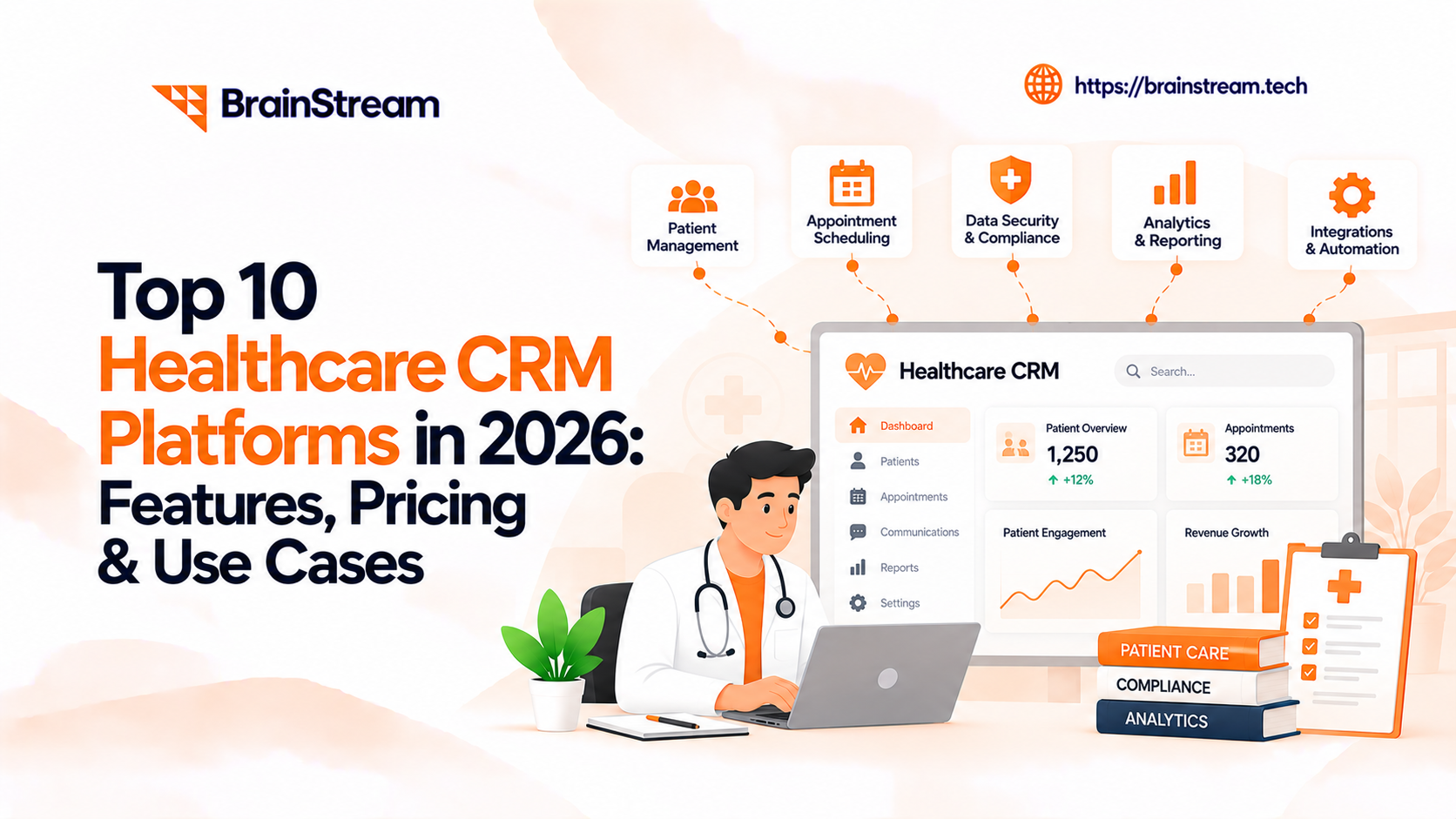
Best CRM Software for Healthcare in 2026: Top 10 Compared (Features & Pricing)
The best CRM software for healthcare in 2026 depends on the size of your organization and how you manage patient engagement. Salesforce Health Cloud is a strong option for large hospitals, HubSpot and Zoho CRM are worth evaluating for smaller clinics, and Epic Cheers is particularly relevant to healthcare organizations already using Epic EHR.
The right choice depends on your requirements for patient communication, HIPAA or GDPR compliance, EHR integration, available budget, and data security.
Healthcare CRM software helps providers organize patient relationships, manage referrals, coordinate outreach, and improve administrative workflows. However, not every general-purpose CRM is suitable for storing protected health information.
In this guide, we compare ten healthcare CRM options, explain their features and limitations, and help clinics, practices, and hospitals decide when an off-the-shelf or custom CRM makes sense.
Comparison
| CRM | Best for | HIPAA / BAA | EHR integration |
|---|---|---|---|
| Salesforce Health Cloud | Large hospitals, health systems | Contract and configuration dependent | Integration options |
| HubSpot CRM | Patient acquisition and marketing | Eligible Enterprise configurations | Through integrations |
| Zoho CRM | Small and growing clinics | Verify vendor terms | Custom/integration dependent |
| LeadSquared | Patient engagement | Verify contract | Vendor-supported integrations |
| Pipedrive | Sales and referral pipelines | Verify before PHI use | Custom integrations |
| SugarCRM | Customizable CRM workflows | Verify contract and hosting | Custom integrations |
| Insightly | CRM and project workflows | Verify before PHI use | Integration dependent |
| Copper CRM | Google Workspace users | Verify before PHI use | Integration dependent |
| Zendesk | Patient support operations | Product and contract dependent | Integration dependent |
| Epic Cheers | Existing Epic health systems | Healthcare deployment-dependent | Native Epic ecosystem |
What Is Healthcare CRM & Why It Matters in 2026
A Healthcare CRM system is like a digital nerve centre for managing patient relationships, communications, and workflows. It combines clinical and administrative data to offer a unified view of the patient journey from scheduling appointments to post-care follow-ups and patient engagement.
Today’s healthcare CRMs also integrate with EHR/EMR systems, support HIPAA compliance, improve care coordination, and provide analytics to drive data-informed decisions.
1. Salesforce Health Cloud
Salesforce Health Cloud stands as one of the most comprehensive CRM solutions specifically tailored for the healthcare industry. Built on the Salesforce platform, it blends patient management with powerful automation, analytics, and integration tools.
Salesforce Health Cloud: Key Features
- 360° patient profiles and journey mapping
- Care team coordination and referral management
- Workflow automation
- Analytics and predictive insights
Pricing
Starts around $350 per user/month, with advanced enterprise plans costing more.
Best For
Large hospitals, health systems, and organizations that need deep customization and strong integration with other enterprise systems.
2. HubSpot CRM for Healthcare
HubSpot’s CRM caters especially to healthcare practices focused on patient acquisition and engagement. It’s known for being user-friendly and offers a free tier for basic usage.
Key Features
- Marketing automation for patient outreach
- Reporting dashboards
- Contact & lead management
- HIPAA-compliant features in paid plans
Pricing
Free basic CRM; paid plans start around $15*/user/month.
Best For
Small to medium practices, preventive care providers, and clinics need easy setup and marketing tools.
3. Zoho CRM for Healthcare
Zoho CRM offers a balanced mix of pricing and features, making it a strong choice for clinics and small healthcare businesses. It has healthcare-specific customizations and appointment scheduling.
Key Features
- Patient record management and analytics
- Scheduling and follow-up workflows
- Mobile access and integrations with third-party apps
Pricing
Starting around $14–$20 per user/month (with healthcare editions available).
Best For
Small to medium-sized practices looking for an affordable CRM with solid core capabilities.
4. LeadSquared Healthcare CRM
LeadSquared focuses on managing the full patient journey, from lead capture to engagement and retention, with strong automation features.
Key Features
- Automated patient outreach
- EHR integrations
- Personalized communication campaigns
Pricing
Depend upon plan, with trial options available.
Best For
Healthcare businesses that prioritise automated patient nurturing and outreach.
5. Pipedrive CRM Healthcare Edition
Pipedrive provides CRM with a visual pipeline approach, helping healthcare teams manage care journeys more intuitively.
Key Features
- Pipeline management
- Email and communication tracking
- Mobile support
- GDPR & HIPAA compliance
Pricing
Plans start around $14/user/month.
Best For
Smaller practices and wellness centers wanting simple visual management of patient workflows.
6. SugarCRM Healthcare Edition
SugarCRM offers flexible deployment options, from cloud to on-premise, with customizable workflows tailored to healthcare needs.
Key Features
- Custom healthcare workflows
- Advanced reporting and BI tools
- Mobile CRM capabilities
Pricing
Starts at around $59/user/month for cloud versions.
Best For
Organizations that need deep customization and control over healthcare workflows.
7. Insightly CRM for Healthcare
Insightly distinguishes itself by integrating project management with CRM, useful for complex care programs and patient care pathways.
Key Features
- Project & patient care plan tracking
- Email marketing and workflows
- Mobile access
Pricing
Starts at $29/user/month.
Best For
Care groups and research institutions managing coordinated care projects.
8. Copper CRM for Healthcare
Copper (formerly ProsperWorks) integrates natively with Google Workspace, making it ideal for practices already using Google tools.
Key Features
- Automated contact management
- Pipeline visualization
- Communication tracking
Pricing
Plans start from $12/user/month.
Best For
Google Workspace–centric clinics and practices.
9. Zendesk for Healthcare CRM
Zendesk combines customer support with CRM features, allowing healthcare teams to manage patient support tickets, knowledge bases, and automated workflows.
Key Features
- Unified agent workspace
- Analytics & custom roles
- AI-powered automation
Pricing
Starts from around $19/user/month (depending on chosen plan).
Best For
Support-centric healthcare providers and service teams emphasizing patient service.
10. Epic Cheers CRM
Epic Cheers is designed for providers within the Epic EHR ecosystem, streamlining communications and operations in large health systems.
Key Features
- Seamless EHR integration
- Call center operations support
- Provider finding and scheduling
Pricing
Contact vendor – typically enterprise pricing with no public tiers.
Best For
Large hospitals and healthcare systems are already utilizing Epic solutions.
Best CRM for Healthcare Marketing
Healthcare marketing CRM software helps clinics and hospitals manage patient inquiries, referrals, appointment requests, and communication campaigns.
HubSpot CRM may suit clinics focused on marketing campaigns, lead capture, and reporting. LeadSquared is another option for organizations that need patient acquisition workflows, lead distribution, and automated follow-ups.
When comparing healthcare marketing CRMs, look for:
- Patient inquiry and referral tracking
- Appointment-related communication workflows
- Email and SMS campaign management
- Consent and communication preference controls
- Marketing attribution and campaign reporting
- Integration with appointment scheduling and existing systems
Healthcare marketing requires additional care when handling patient information. Teams should evaluate privacy requirements, permitted communication channels, and consent practices before importing health-related data or launching campaigns.
The best CRM for healthcare marketing is one that supports your patient engagement goals without compromising security or regulatory obligations.
Is There a Free Healthcare CRM?
Some general-purpose CRM platforms offer free plans that smaller healthcare businesses can use for basic contact management, sales pipelines, and administrative workflows.
For example, HubSpot offers free CRM functionality. However, its free CRM should not be assumed suitable for storing HIPAA-protected patient health information.
Before using a free CRM in a healthcare setting, confirm whether the product supports your security, privacy, contractual, and data-processing requirements.
A free CRM may be suitable for managing general business relationships or non-sensitive administrative information. For patient records, protected health information, or connected clinical workflows, healthcare organizations should evaluate properly configured and contractually supported solutions.
Also consider future expenses such as paid users, integrations, automation, data migration, training, and technical support.
CRM for Healthcare Providers: Data Security and EHR Integration
CRM software for healthcare providers must support more than contact management. Clinics and hospitals often need secure patient communication, referral tracking, appointment workflows, and integration with electronic health record (EHR) systems.
HIPAA, GDPR, and Healthcare Data Protection
For US healthcare organizations, assess whether the CRM vendor can support applicable HIPAA requirements, including a Business Associate Agreement (BAA) where required, appropriate access controls, and safeguards for protected health information.
For organizations operating in the EU or EEA, evaluate GDPR obligations, lawful processing, data subject rights, processor agreements, and international data transfers. EU data hosting may be relevant but does not automatically establish GDPR compliance.
Healthcare organizations operating in the UAE, Saudi Arabia, and Qatar should also check the local health-data protection, hosting, and data-transfer requirements applicable to their operations.
EHR Integration and Patient Workflows
When selecting a CRM, check whether it can exchange information with your existing EHR or EMR system through supported APIs and integration methods, including HL7 FHIR where applicable.
Integration capabilities differ across vendors and plans. Confirm exactly what data can be exchanged, which permissions apply, and how updates are synchronized.
Organizations exploring automated patient communication can also evaluate AI chatbot CRM integration to understand the difference between configurable and custom conversational solutions.
However, AI-powered patient workflows should include appropriate privacy protections, accuracy checks, escalation processes, and human oversight.
How to Choose the Right CRM for Your Healthcare Organization?
When evaluating CRM platforms, consider:
- Compliance & Security: Ensure the CRM supports HIPAA and GDPR compliance.
- Integration: Look for seamless connections with EHR/EMR systems.
- Automation Tools: Workflow automation for scheduling, follow-ups, and messaging saves time.
- Scalability: Choose a system that can grow with your practice size.
- Analytics: Reporting helps track outcomes, no-show rates, and engagement.
For more advanced automation, explore how AI agents for patient follow-ups could support approved communication workflows, scheduling-related tasks, and staff review processes.
If your business requires more flexibility than off-the-shelf CRM software can provide, explore BrainStream’s custom CRM development services. Our team can help you build tailored workflows, integrate existing business systems, and develop a CRM solution around your requirements.
Off-the-Shelf vs Custom Healthcare CRM: Which Is Right for You?
Off-the-shelf healthcare CRM software is often suitable for organizations that need established features, predictable subscription plans, and faster initial implementation.
Solutions such as Salesforce Health Cloud and Epic Cheers provide healthcare-focused functionality, while general-purpose CRMs may support selected administrative and marketing workflows.
However, a custom healthcare CRM may be worth considering when your organization has unique requirements.
These may include:
- Complex EHR or patient management integrations
- Custom referral and patient engagement workflows
- Specific data residency or hosting requirements
- Multiple clinics, departments, or operational systems
- Advanced automation and specialized reporting
Businesses can also evaluate Odoo-based solutions where ERP, invoicing, inventory, and CRM functions need to work together. However, healthcare-specific data handling and compliance requirements must still be assessed.
A custom CRM provides greater flexibility but also requires planning for implementation, security, testing, ongoing maintenance, and support.
Need a Healthcare CRM Built Around Your Workflows?
BrainStream Technolabs provides custom CRM development, system integrations, data migration, and workflow automation for organizations with specialized requirements.
Our team can help assess your existing systems and explore a CRM approach suited to your operational, technical, and data protection needs.
Talk to our CRM experts to discuss your requirements.
FAQs
1. What is the best CRM software for healthcare?
The best CRM software for healthcare depends on your organization’s size, workflows, and integration requirements. Salesforce Health Cloud is worth evaluating for large healthcare organizations, Epic Cheers for existing Epic customers, and HubSpot or Zoho CRM for smaller clinics managing appropriate administrative and marketing workflows. Always verify security and compliance requirements before storing patient health information.
2. What is the best free healthcare CRM?
HubSpot offers a free CRM with basic contact and pipeline management features. However, a free general-purpose CRM should not automatically be used to store protected patient health information. Healthcare providers should verify privacy controls, data-processing agreements, and supported healthcare use cases before choosing a free plan.
3. Is HubSpot HIPAA compliant?
HubSpot offers Sensitive Data capabilities and a Business Associate Agreement for qualifying customers and supported services. HIPAA-related use requires the appropriate subscription, configuration, agreements, and organizational controls. A standard free HubSpot CRM account should not be assumed suitable for storing protected health information.
4. Do healthcare CRMs integrate with EHR systems?
Some healthcare CRM platforms support EHR integrations through native capabilities, APIs, or third-party integration tools. Epic Cheers is designed for the Epic ecosystem, while other CRM products may require custom connections. Confirm supported data types, interoperability standards, permissions, and synchronization requirements with the vendor.
5. Should a clinic choose an off-the-shelf or custom healthcare CRM?
An off-the-shelf CRM can be a good option when a clinic’s requirements match established product features and integrations. Custom healthcare CRM development may be more suitable for specialized patient workflows, complex EHR integrations, or organization-specific data controls. The decision should consider implementation costs, maintenance, security, scalability, and long-term support.
Conclusion
With healthcare becoming more patient-centric and data-driven, having the right CRM platform is essential to improve engagement, streamline workflows, and deliver better outcomes. The CRMs listed above represent the best options for 2026, from enterprise-grade solutions like Salesforce Health Cloud to affordable and easy-to-implement platforms like HubSpot and Zoho.
Choose the one that aligns best with your size, budget, and needs, whether you’re a solo clinic or a large hospital system.
If you run a smaller clinic or healthcare business, our CRM for small business guide can also help you compare general-purpose CRM platforms and identify the features your team needs.

Manish Khilwani
Author
Co-Founder at BrainStream Technolabs, he focuses on building people-first, scalable eCommerce and digital products that help brands grow with clarity and innovation.
Table of contents
BLOGS
Learn & Grow with Us
Get the latest updates on trends and strategies that shape the business world. Our insights are here to keep you informed and inspired.
2026 Generative AI Playbook: A Strategic Guide for Business Leaders
The digital landscape has officially crossed a Rubicon. If 2023…
Agentic Commerce in 2026: How AI Agents Are Changing Online Shopping
Agentic commerce is online shopping where AI agents discover, compare,…
AI Advisory & Roadmap Services: How Businesses Build Smarter AI Strategies?
Artificial intelligence is changing how businesses operate. However, many companies…
AI Chatbots in Healthcare: Benefits and Use Cases That Are Transforming Patient Care
AI Chatbots in Healthcare are changing faster than ever. Patients…