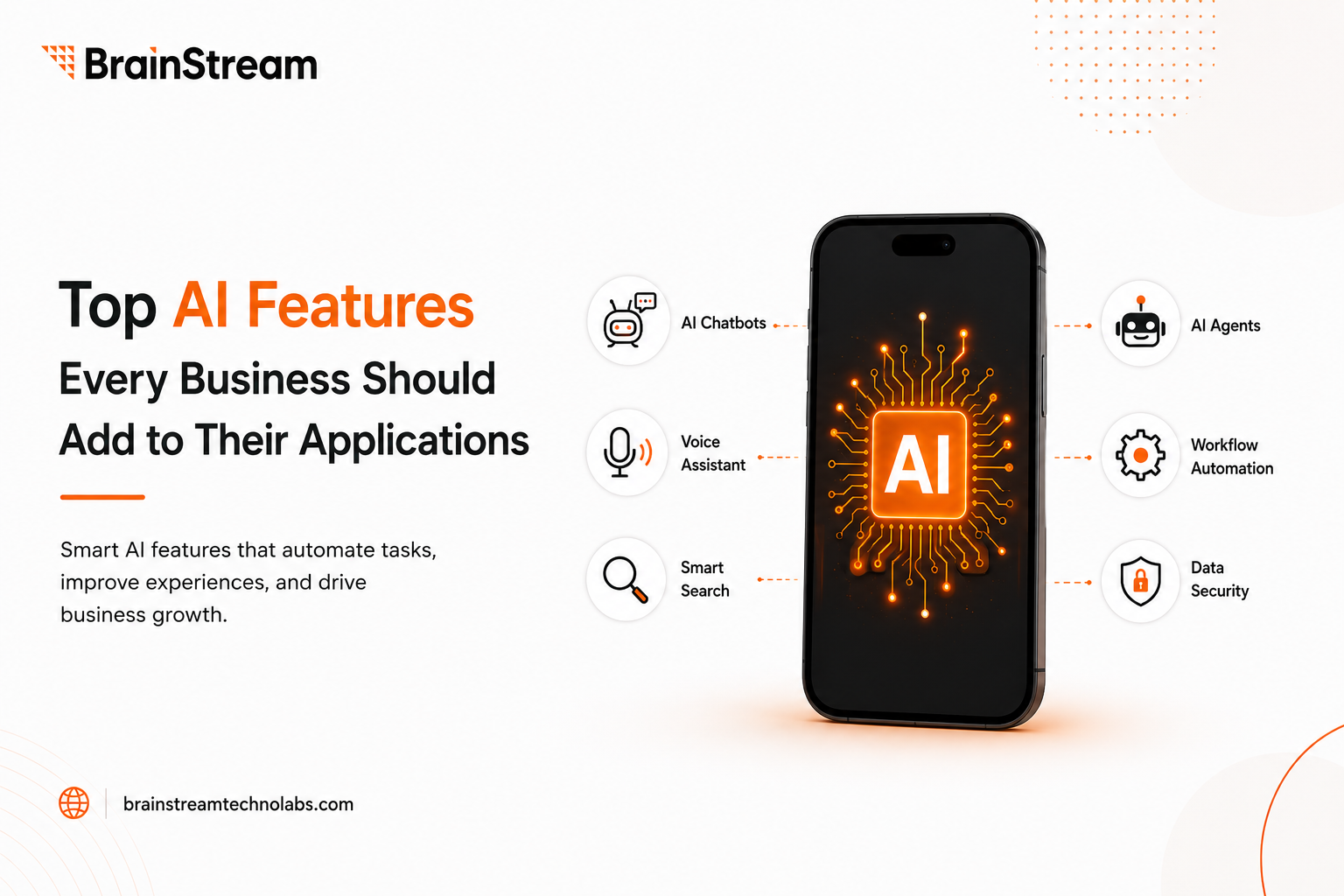
Top AI Features Businesses Should Add to Their Applications
Artificial Intelligence (AI) is changing how businesses build and improve software. Today, users expect applications to be faster, smarter, and more personalized. Businesses that add AI features to their applications can improve customer satisfaction, increase productivity, and gain a competitive edge.
However, adding AI is not about following trends. It’s about solving real business problems and delivering better user experiences.
In this article, we’ll explore the top AI features businesses should consider adding to their applications and how these features create value.
Why AI Features Matter in Modern Applications?
Customers expect quick responses and personalized experiences. At the same time, businesses want to automate repetitive tasks and make better decisions.
AI helps achieve both goals.
With the right AI features, businesses can:
- Improve customer experience
- Increase employee productivity
- Automate routine tasks
- Reduce operational costs
- Make data-driven decisions
- Create personalized user experiences
The key is choosing AI features that align with your business goals.
1. AI Chatbots for Instant Customer Support
AI chatbots have become one of the most popular business features.
Unlike traditional chatbots, modern AI chatbots understand natural language and provide human-like responses.
They can:
- Answer customer questions
- Book appointments
- Track orders
- Recommend products
- Collect customer information
- Provide 24/7 support
As a result, businesses can improve customer satisfaction while reducing support costs.
2. Personalized Recommendations
Customers appreciate personalized experiences.
AI analyzes user behavior, purchase history, and preferences to recommend relevant products or services.
You can use AI recommendations for:
- E-commerce stores
- Streaming platforms
- Learning applications
- Travel websites
- Healthcare portals
Better recommendations often lead to higher engagement and increased sales.
3. Smart Search
Many users leave an application because they cannot find what they need.
AI-powered search understands user intent instead of matching exact keywords.
For example, users can search using natural language such as:
“Show me affordable laptops with good battery life.”
The application delivers more relevant results, improving the overall experience.
4. AI-Powered Content Generation
Content creation takes time.
AI can assist users by generating:
- Product descriptions
- Email drafts
- Reports
- Marketing content
- Meeting summaries
- Social media captions
Instead of replacing employees, AI helps them work faster and more efficiently.
5. Predictive Analytics
Businesses collect large amounts of data every day.
AI transforms that data into useful insights.
Predictive analytics helps businesses:
- Forecast sales
- Predict customer behavior
- Identify business risks
- Improve inventory planning
- Detect future trends
Therefore, decision-makers can plan with greater confidence.
6. Intelligent Document Processing
Many companies still manage invoices, contracts, and forms manually.
AI can automatically:
- Read documents
- Extract important information
- Organize files
- Verify data
- Reduce manual entry
This saves time and minimizes human errors.
7. Voice Assistants
Voice technology continues to grow.
Adding voice commands allows users to interact with applications more naturally.
Voice assistants are especially useful for:
- Healthcare
- Banking
- Smart home applications
- Customer support
- Mobile apps
Additionally, voice features improve accessibility for many users.
8. Image Recognition
AI can analyze images in seconds.
Businesses use image recognition for:
- Product identification
- Quality inspection
- Medical imaging
- Identity verification
- Inventory management
This feature improves accuracy and speeds up business operations.
9. Fraud Detection
Security is a top priority for modern businesses.
AI continuously monitors user activity and detects unusual behavior.
It helps identify:
- Payment fraud
- Fake accounts
- Unauthorized access
- Suspicious transactions
As a result, businesses can reduce financial risks and protect customer data.
10. Workflow Automation
Employees spend valuable time on repetitive tasks.
AI automates processes such as:
- Email responses
- Data entry
- Appointment scheduling
- Report generation
- Approval workflows
Automation allows teams to focus on higher-value work.
How to Choose the Right AI Features?
Not every business needs every AI capability.
Before investing in AI, ask these questions:
- Which business problems need solving?
- Which tasks consume the most time?
- What do customers expect?
- Which processes can be automated?
- What data is available?
Start with one or two high-impact features before expanding.
Benefits of AI Features in Business Applications
Adding AI features provides several advantages.
- Better customer experience
- Faster response times
- Higher productivity
- Improved decision-making
- Increased operational efficiency
- Reduced manual work
- Better data insights
- Higher customer retention
Small AI improvements can create significant business value over time.
Common Mistakes to Avoid
Many businesses rush into AI implementation.
Avoid these common mistakes:
- Adding AI without clear goals
- Ignoring user experience
- Using poor-quality data
- Trying to automate everything
- Forgetting data privacy
- Skipping employee training
A strategic approach delivers better long-term results.
Conclusion
AI is no longer a future technology. It has become an essential part of modern business applications. Features like AI chatbots, predictive analytics, smart search, and workflow automation help businesses improve efficiency and deliver better customer experiences.
The best approach is to start with features that solve real business problems. As your business grows, you can gradually expand your AI capabilities and continue creating value for your customers.
Investing in the right AI features today will help your application stay competitive, scalable, and future-ready.
FAQs
What are the most useful AI features for business applications?
AI chatbots, personalized recommendations, predictive analytics, workflow automation, smart search, and fraud detection are among the most valuable features for businesses.
Can small businesses benefit from AI?
Yes. Small businesses can use AI to automate routine tasks, improve customer service, and increase efficiency without hiring large teams.
Is AI expensive to implement?
The cost depends on the project’s complexity. Many businesses start with one AI feature and expand as they see positive results.
How do I decide which AI feature to add first?
Focus on your biggest business challenge. If customer support takes too much time, start with an AI chatbot. If data analysis is difficult, consider predictive analytics.
Can AI replace human employees?
AI is designed to assist people, not replace them. It automates repetitive work so employees can focus on creative, strategic, and customer-focused tasks.

Manish Khilwani
Author
Co-Founder at BrainStream Technolabs, he focuses on building people-first, scalable eCommerce and digital products that help brands grow with clarity and innovation.
Table of contents
BLOGS
Learn & Grow with Us
Get the latest updates on trends and strategies that shape the business world. Our insights are here to keep you informed and inspired.
How Much Does AI Integration into a Symfony Application Cost in 2026?
Adding artificial intelligence to your Symfony application can improve customer…
Modernizing Legacy Symfony Applications with AI: Where to Start
Your Symfony application still runs your business. However, adding features…
Agentic Commerce in 2026: How AI Agents Are Changing Online Shopping
Online shopping is entering a new phase. For years, shoppers…
Top 7 Must-Have Bagisto Extensions to Improve Your eCommerce Store in 2026
Running an online store takes more than adding products and…