













Summary:
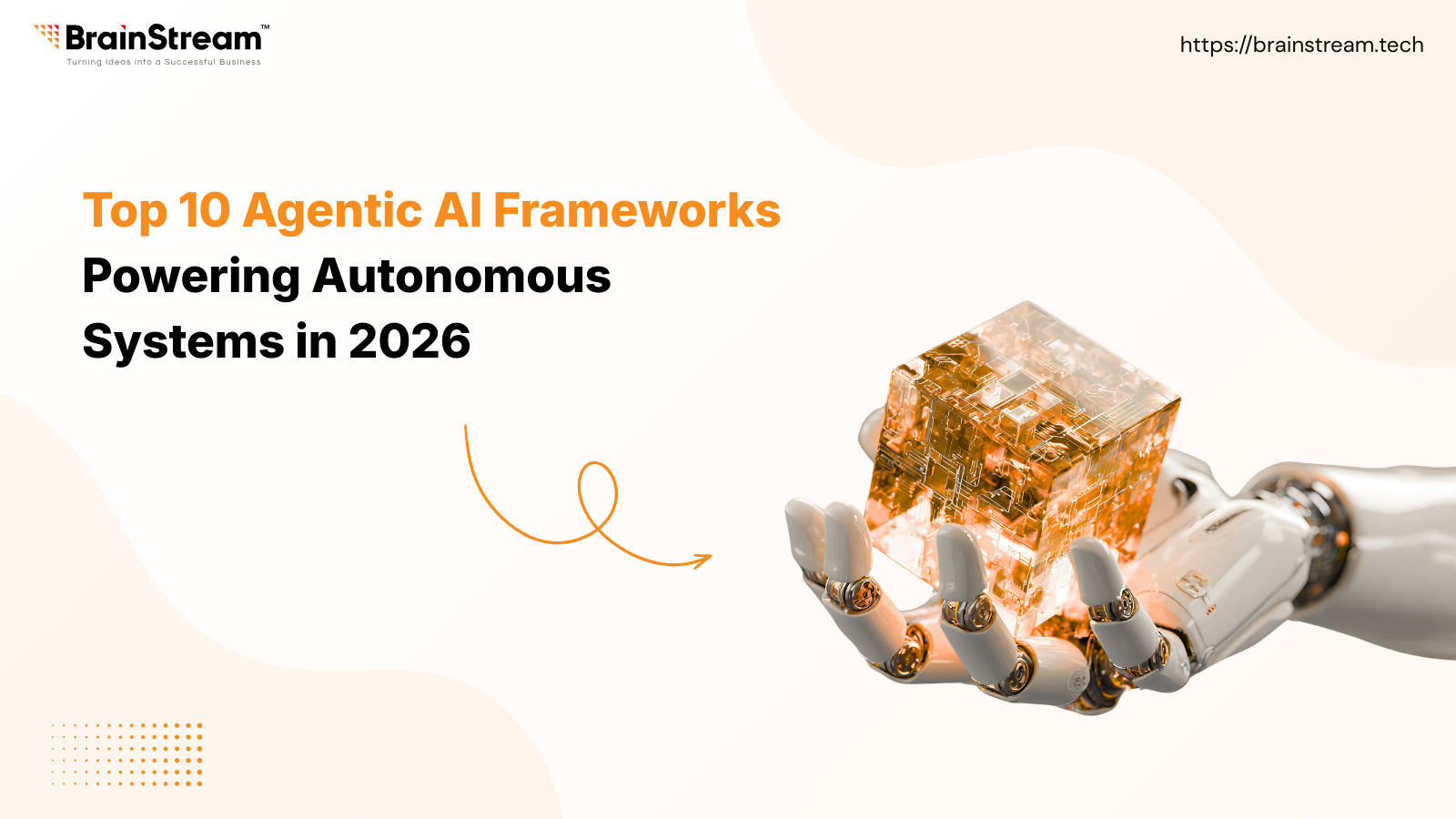
Agentic AI frameworks are transforming traditional AI into autonomous systems that can plan, reason, and execute complex tasks independently. In 2026, businesses are adopting these frameworks to build multi-agent workflows, AI copilots, and intelligent automation systems. From flexible open-source tools to enterprise-ready orchestration platforms, each framework serves different scalability and integration needs. Choosing the right one depends on your use case, infrastructure, and long-term AI strategy.
February 27, 2026
Artificial Intelligence has evolved rapidly over the past few years. We moved from predictive models to generative AI, and now we are entering the era of Agentic AI systems capable of planning, reasoning, acting, and continuously adapting to achieve defined goals.
Unlike traditional AI applications that simply respond to prompts, agentic AI frameworks enable the creation of autonomous digital agents. These agents can:
- Break down complex tasks
- Use external tools
- Access memory
- Collaborate with other agents
- Make structured decisions
- Learn from feedback loops
For businesses, this shift is transformational. Instead of building static AI features, companies can now build intelligent autonomous systems that operate workflows, assist teams, and even execute multi-step operations independently.
But here’s the challenge: choosing the right framework.
In this guide, we’ll explore the Top 10 Agentic AI Frameworks in 2026, deeply analyzing their architecture, strengths, limitations, and ideal use cases.
What Makes a Strong Agentic AI Framework?
Before diving into the list, it’s important to understand what differentiates a true agentic framework from a simple LLM wrapper.
A strong agentic AI framework typically provides:
- Planning & Reasoning Engine
The ability to decompose large goals into smaller, actionable steps.
- Memory Architecture
Short-term memory for ongoing tasks and long-term memory for persistent learning.
- Tool Integration
APIs, search engines, databases, code interpreters, and external services.
- Multi-Agent Collaboration
Support for role-based or cooperative AI systems.
- Observability & Governance
Monitoring, debugging, logging, and human-in-the-loop controls.
The frameworks listed below represent leaders across these dimensions.
1. LangChain - The Modular Pioneer
LangChain is often considered the foundational ecosystem of modern agentic AI development.
Architecture & Philosophy
LangChain introduced the concept of “chains”, structured sequences of LLM calls combined with tools and memory. It later evolved into full agent systems capable of autonomous decision-making.
The framework is modular, meaning developers can combine components such as:
- Prompt templates
- Output parsers
- Memory buffers
- Toolkits
- Custom logic
This flexibility makes LangChain extremely powerful for complex workflows.
Where LangChain Excels
- Custom AI copilots
- Research automation systems
- Retrieval-Augmented Generation (RAG)
- Enterprise-grade orchestration
Limitations
- Can become complex at scale
- Requires strong architectural planning
- Debugging large agent flows may require additional tooling
LangChain is ideal for teams that want maximum control and are comfortable managing AI infrastructure.
2. AutoGen - Multi-Agent Collaboration at Scale
AutoGen, developed by Microsoft Research, focuses heavily on multi-agent conversational systems.
Core Concept
Instead of one autonomous agent, AutoGen allows multiple AI agents to interact with each other in structured conversations. Each agent can have:
- A defined role
- Access to specific tools
- Independent reasoning capability
For example, one agent may generate code, another may review it, and a third may test it.
Real-World Applications
- Code generation + automated review systems
- AI-driven research collaborations
- Structured business decision simulations
- Workflow approval automation
Strengths
- Strong conversational design
- Clear role separation
- Human-in-the-loop integration
Limitations
- Requires thoughtful conversation design
- Not ideal for extremely lightweight projects
AutoGen is particularly powerful for enterprises building collaborative AI systems.
3. CrewAI - Structured Agent Teams
CrewAI simplifies the process of creating “teams” of AI agents working together.
Design Philosophy
CrewAI mimics human organisational structures. You define:
- Roles (Manager, Researcher, Analyst, Writer)
- Goals
- Tasks
- Dependencies
The framework handles delegation and coordination.
Ideal Use Cases
- Content production pipelines
- Market research automation
- Startup prototyping
- AI project simulations
Why It’s Growing Fast
Its simplicity makes it accessible for startups and product teams who want structure without heavy configuration.
CrewAI balances power and usability effectively.
4. Semantic Kernel - Enterprise AI Orchestration
Semantic Kernel integrates AI orchestration directly into traditional programming environments.
What Makes It Enterprise-Ready
- Native SDK support (C#, Python, Java)
- Planner modules for goal execution
- Secure memory connectors
- Azure integration
It’s not just about agents, it’s about embedding AI logic into production-grade systems.
Best For
- Enterprises modernising legacy systems
- AI-powered enterprise SaaS
- Internal AI copilots for large teams
Limitation
Less flexible compared to open modular frameworks like LangChain.
Semantic Kernel is ideal when governance, compliance, and structured integration are priorities.
5. Haystack Agents - Retrieval-Driven Intelligence
Haystack built its reputation on document search and retrieval pipelines. Its agent extension builds on that strength.
Core Advantage
Deep integration with:
- Vector databases
- Document stores
- Search pipelines
When to Use It
- Legal tech platforms
- Medical AI assistants
- Enterprise knowledge management
- Technical documentation copilots
If your agent’s primary job is reasoning over large datasets, Haystack offers strong architecture.
6. OpenAI Assistants API - Managed Agent Infrastructure
The Assistants API simplifies agent creation by abstracting away much of the orchestration complexity.
Built-in Features
- Persistent conversation threads
- File uploads
- Code interpreter tools
- Function calling
Why Businesses Like It
- Fast time-to-market
- Managed infrastructure
- Reduced DevOps overhead
Trade-Off
Less architectural control compared to self-hosted frameworks.
Perfect for SaaS companies building AI features quickly.
7. LlamaIndex - Data-Centric Agent Framework
LlamaIndex focuses heavily on connecting LLMs to structured and unstructured enterprise data.
Strength Areas
- Data ingestion pipelines
- Knowledge graph integration
- Advanced indexing strategies
- Multi-step reasoning
Best Use Cases
- Financial data analysis agents
- Internal business intelligence tools
- Customer support AI connected to CRM
It shines when data depth is critical.
LlamaIndex focuses heavily on connecting LLMs to structured and unstructured enterprise data.
Strength Areas
- Data ingestion pipelines
- Knowledge graph integration
- Advanced indexing strategies
- Multi-step reasoning
Best Use Cases
- Financial data analysis agents
- Internal business intelligence tools
- Customer support AI connected to CRM
It shines when data depth is critical.
8. SuperAGI - Observability-First Agent Systems
SuperAGI emphasises visibility and monitoring of autonomous agents.
Why Observability Matters
As agents gain autonomy, understanding their decision patterns becomes crucial. SuperAGI offers:
- Monitoring dashboards
- Task logs
- Tool usage tracking
- Agent lifecycle management
Ideal For
- Production-grade AI deployments
- Experiment-heavy teams
- Continuous optimisation workflows
SuperAGI reduces the “black box” problem of autonomous AI.
9. AgentOps - Governance & Reliability Layer
AgentOps acts as a performance monitoring and evaluation system for AI agents.
Capabilities
- Failure detection
- Experiment tracking
- Performance benchmarking
- Debugging support
As AI moves into mission-critical operations, reliability becomes non-negotiable.
AgentOps provides the safety layer enterprises increasingly require.
10. MetaGPT - Simulated AI Organizations
MetaGPT takes a unique approach by simulating entire AI software teams.
How It Works
Agents are assigned structured roles such as:
- Product Manager
- Architect
- Developer
- QA Engineer
Each follows predefined Standard Operating Procedures (SOPs).
Applications
- Rapid product ideation
- MVP planning
- Automated documentation
- Software design proposals
MetaGPT demonstrates the potential of fully structured AI organisations.
How to Choose the Right Agentic AI Framework
Choosing a framework depends on strategic goals.
For Startups:
CrewAI or OpenAI Assistants API
For Enterprise Integration:
Semantic Kernel or LangChain
For Multi-Agent Systems:
AutoGen or MetaGPT
For Data-Heavy Use Cases:
LlamaIndex or Haystack
For Observability & Governance:
SuperAGI + AgentOps combination
The right framework depends on long-term architecture planning, not just short-term experimentation.
The Future of Agentic AI
We are moving toward a future where:
- AI agents autonomously manage workflows
- Companies deploy AI departments
- Software development becomes AI-assisted end-to-end
- Business decisions are AI-simulated before execution
By 2027 and beyond, agentic AI frameworks will likely become as fundamental as cloud platforms are today.
Organisations investing early will build operational leverage and competitive advantage.
Final Thoughts
Agentic AI represents a structural shift from reactive AI systems to proactive, goal-driven intelligence.
The frameworks listed above are not just tools; they are foundational building blocks for the next generation of intelligent systems.
The real opportunity lies not in replacing humans but in building hybrid systems in which AI agents extend human capabilities.
If your organisation is exploring AI-driven automation, autonomous systems, or intelligent copilots, now is the time to experiment, prototype, and scale strategically.

FAQs
Q1. What is an Agentic AI framework?
An Agentic AI framework is a software system that enables developers to build autonomous AI agents capable of reasoning, planning, using tools, and executing multi-step tasks independently.
Q2. How is Agentic AI different from traditional AI?
Traditional AI responds to prompts, while Agentic AI can plan, take actions, collaborate with tools, and pursue defined goals with minimal human intervention.
Q3. Which is the best Agentic AI framework in 2026?
The best framework depends on your use case. LangChain is ideal for flexibility, AutoGen for multi-agent collaboration, and OpenAI Assistants API for rapid deployment.
Q4. Are Agentic AI frameworks open source?
Many frameworks, such as LangChain, CrewAI, and LlamaIndex, are open source, while some managed solutions offer enterprise-grade hosted environments.
Q5. What industries benefit from Agentic AI?
Industries like SaaS, fintech, healthcare, legal tech, eCommerce, and enterprise IT benefit significantly from agent-driven automation and intelligent workflows.
Q6. Can Agentic AI replace human teams?
Agentic AI is designed to augment human teams, not replace them. It automates repetitive tasks and supports complex decision-making.
Q7. What is a multi-agent system?
A multi-agent system consists of multiple AI agents working together, each with defined roles and responsibilities to achieve a shared objective.
Q8. Is Agentic AI suitable for startups?
Yes. Lightweight frameworks like CrewAI and OpenAI Assistants API make it easier for startups to experiment with autonomous AI systems.
Q9. What is the biggest challenge in Agentic AI?
The biggest challenges include governance, observability, error handling, and ensuring reliable decision-making in autonomous environments.
Q10. How do I choose the right Agentic AI framework?
Evaluate based on scalability, data integration needs, governance requirements, multi-agent support, and infrastructure readiness.

Manish Khilwani 

Co-Founder at BrainStream Technolabs, he focuses on building people-first, scalable eCommerce and digital products that help brands grow with clarity and innovation.
Share :


Related Blog
AI Development
The AI Renaissance of 2026: From Generative Tools to Autonomous Intelligence
The year 2026 marks a pivotal chapter in human history. We have officially moved past the "AI Hype" phase of 2023-2024 and entered the era of Functional Integration. If 2025 was about experimenting with Large Language Models (LLMs), 2026 is...
AI Development
ChatGPT OS: How OpenAI’s Intelligence Layer Is Reshaping Business Software in 2026
In 2026, the way businesses build and use software is undergoing a structural transformation. We are moving from interface-driven applications to intent-driven systems. At the centre of this shift is ChatGPT OS, an intelligence layer that is beginning to function...
AI Development
2026 Generative AI Playbook: A Strategic Guide for Business Leaders
The digital landscape has officially crossed a Rubicon. If 2023 was the year of "Aha!" moments with ChatGPT and 2024–2025 were years of frantic experimentation, 2026 is the year of the AI-Native Enterprise. For business leaders, the conversation has shifted....


Keep up-to-date with our newsletter.
Sign up for our newsletter to receive weekly updates and news directly to your inbox.