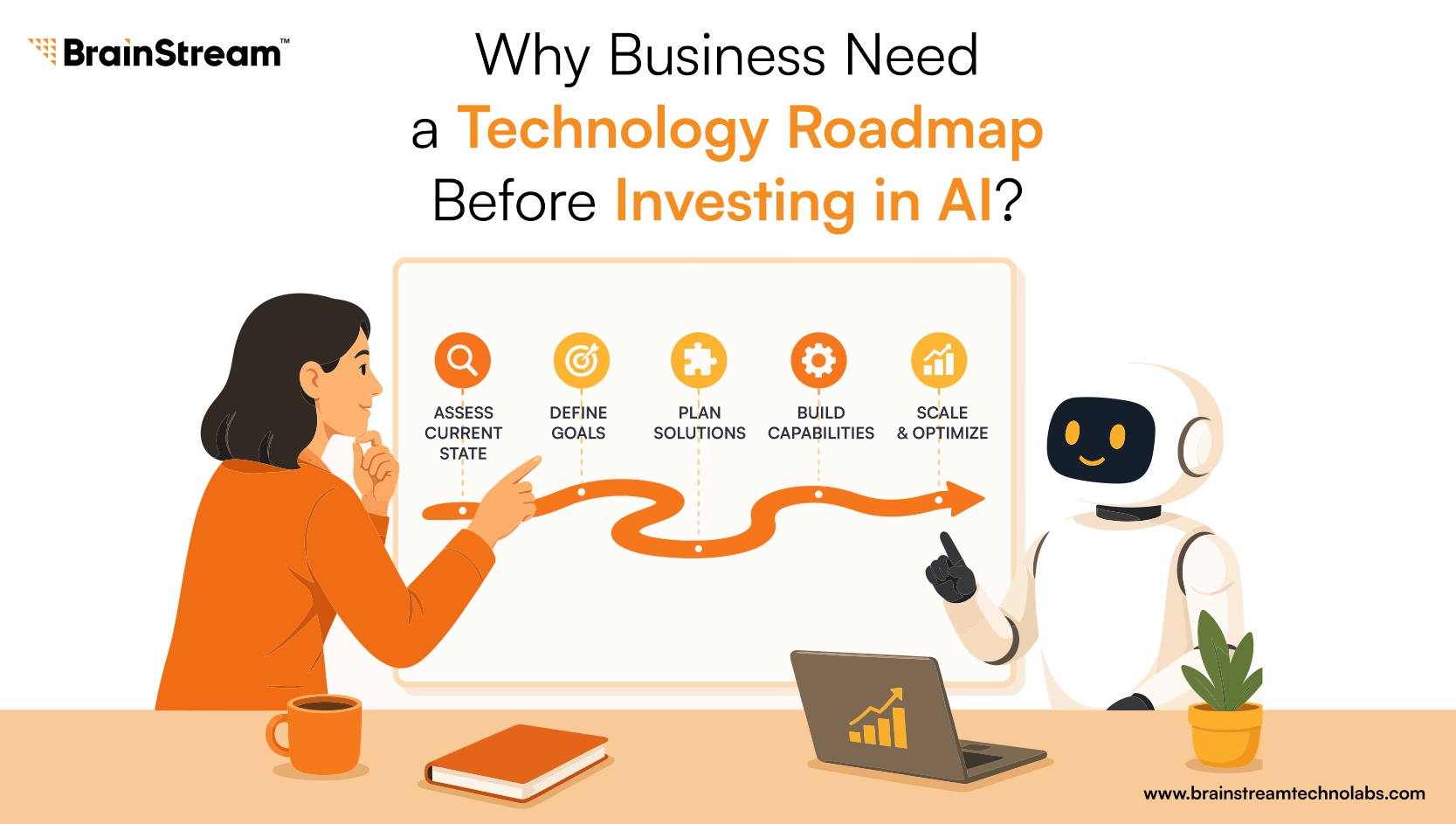
Why Business Need a Technology Roadmap Before Investing in AI?
Artificial Intelligence (AI) is transforming the way businesses operate. From automating repetitive tasks to improving customer experiences, AI offers countless opportunities for growth and innovation.
As a result, many organizations are eager to invest in AI solutions.
However, there is one common mistake businesses often make. They invest in AI before evaluating whether their technology infrastructure, processes, and data are ready to support it.
This approach can lead to wasted budgets, failed projects, and disappointing results.
Before investing in AI, businesses need a clear technology roadmap.
A technology roadmap helps organizations align AI initiatives with business goals, assess readiness, prioritize investments, and create a realistic implementation plan.
In this article, we will explore why a technology roadmap is essential before adopting AI and how it helps businesses achieve better outcomes.
What Is a Technology Roadmap?
A technology roadmap is a strategic plan that outlines how technology will support business objectives over time.
It helps organizations understand:
- Current technology capabilities
- Future technology requirements
- Investment priorities
- Implementation timelines
- Business growth goals
Rather than making technology decisions based on trends, businesses use a roadmap to make informed and strategic investments.
Therefore, every technology initiative contributes to long-term success.
Why Businesses Are Rushing Into AI?
AI has become one of the most talked-about technologies in recent years.
Companies hear success stories about:
- AI-powered automation
- Predictive analytics
- AI chatbots
- Machine learning
- Generative AI
Consequently, many businesses feel pressure to adopt AI quickly.
However, successful AI adoption requires more than purchasing software or implementing new tools.
Without proper planning, AI projects often struggle because the underlying technology foundation is not ready.
AI has become one of the most talked-about technologies in recent years.
Companies hear success stories about:
- AI-powered automation
- Predictive analytics
- AI chatbots
- Machine learning
- Generative AI
Consequently, many businesses feel pressure to adopt AI quickly.
However, successful AI adoption requires more than purchasing software or implementing new tools.
Without proper planning, AI projects often struggle because the underlying technology foundation is not ready.
The Risks of Investing in AI Without a Technology Roadmap
Organizations that skip strategic planning often face avoidable challenges.
Unclear Business Objectives
Many businesses implement AI simply because competitors are doing it.
Unfortunately, this approach rarely delivers meaningful results.
AI projects should solve specific business problems.
For example:
- Improving customer support
- Reducing operational costs
- Enhancing decision-making
- Increasing productivity
Without defined objectives, AI initiatives often lose direction.
Poor Data Readiness
AI systems depend on data.
If data is incomplete, outdated, or inconsistent, AI performance suffers.
Many businesses discover data quality issues only after implementation begins.
A technology roadmap identifies these challenges early.
As a result, organizations can prepare their data before investing in AI solutions.
Technology Integration Challenges
Most businesses already use multiple systems.
These may include:
- CRM platforms
- ERP software
- Marketing tools
- E-commerce systems
- Customer support platforms
AI solutions must integrate with these technologies.
Without proper planning, integration becomes complex and expensive.
Unexpected Costs
AI projects often require investments in:
- Infrastructure
- Data management
- Cloud services
- Security enhancements
- Employee training
Without a roadmap, businesses may underestimate costs.
Consequently, projects exceed budgets and timelines.
How a Technology Roadmap Supports Successful AI Adoption?
A technology roadmap provides structure and clarity throughout the AI journey.
Aligning AI With Business Goals
Technology should always support business objectives.
A roadmap helps organizations identify where AI can create the most value.
For example:
| Business Goal | Potential AI Solution |
|---|---|
| Improve Customer Service | AI Chatbots |
| Increase Sales Forecast Accuracy | Predictive Analytics |
| Automate Repetitive Tasks | Intelligent Automation |
| Enhance Personalization | Recommendation Engines |
| Improve Decision-Making | AI-Powered Insights |
This alignment improves ROI and project success rates.
Assessing Technology Readiness
Before adopting AI, businesses should evaluate their existing technology environment.
A roadmap assesses:
- Infrastructure capabilities
- Application architecture
- Data management systems
- Security frameworks
- Integration readiness
Therefore, organizations can address weaknesses before implementation begins.
Prioritizing AI Investments
Not every AI project should start immediately.
A roadmap helps businesses identify high-impact opportunities first.
This phased approach reduces risk and improves resource allocation.
As a result, organizations achieve measurable results faster.
Supporting Long-Term Scalability
AI initiatives often expand over time.
A small automation project today may evolve into a company-wide transformation tomorrow.
A roadmap ensures infrastructure and systems can scale as AI adoption grows.
This prevents future bottlenecks and costly redesigns.
Key Components of an AI-Focused Technology Roadmap
A strong roadmap includes several essential elements.
Business Strategy Alignment
Every technology initiative should support a specific business objective.
This ensures investments generate measurable value.
Technology Assessment
Organizations should evaluate:
- Existing applications
- Infrastructure
- Cloud environments
- Development processes
This assessment identifies strengths and improvement opportunities.
Data Readiness Evaluation
Data is the foundation of AI.
Businesses should review:
- Data quality
- Data accessibility
- Governance policies
- Compliance requirements
Strong data practices improve AI performance.
Implementation Timeline
A roadmap defines realistic timelines for:
- Preparation
- Pilot projects
- Full deployment
- Optimization
This creates clear expectations across teams.
Common Mistakes Businesses Make When Planning AI Initiatives
Starting With Technology Instead of Business Problems
Many organizations purchase AI tools before identifying business challenges.
Successful companies take the opposite approach.
They start with business goals and then select the appropriate technology.
Ignoring Employee Adoption
Technology alone does not guarantee success.
Employees must understand how to use AI effectively.
Training and change management should be part of every roadmap.
Underestimating Infrastructure Requirements
AI workloads often require scalable cloud infrastructure and strong data management capabilities.
Failing to prepare infrastructure can limit project success.
Focusing Only on Short-Term Results
AI should support long-term growth.
A roadmap balances quick wins with future opportunities.
The Role of Technology Leadership in AI Planning
Technology leadership plays a critical role in AI adoption.
Experienced leaders help businesses:
- Assess readiness
- Define priorities
- Build technology roadmaps
- Manage risks
- Align AI with business strategy
This is why many organizations work with technology advisors or Fractional CTOs during their AI planning process.
Strategic leadership helps businesses avoid costly mistakes and accelerate results.
Benefits of Creating a Technology Roadmap Before AI Investment
Businesses that develop a roadmap first often experience:
Better ROI
Investments focus on initiatives that create measurable business value.
Lower Risk
Potential challenges are identified before implementation begins.
Faster Implementation
Teams work with clear priorities and defined objectives.
Improved Scalability
Technology infrastructure supports future growth.
Stronger Competitive Advantage
Organizations adopt AI strategically rather than reactively.
How to Build a Technology Roadmap for AI Success?
Step 1: Define Business Goals
Identify the outcomes you want AI to support.
Step 2: Evaluate Current Technology
Assess infrastructure, applications, and integrations.
Step 3: Analyze Data Readiness
Review data quality, accessibility, and governance.
Step 4: Identify High-Value AI Use Cases
Prioritize opportunities with measurable impact.
Step 5: Create an Implementation Plan
Develop timelines, budgets, and success metrics.
Step 6: Monitor and Optimize
Track performance and refine the roadmap as business needs evolve.
Conclusion
AI has the potential to transform businesses across every industry.
However, successful AI adoption requires more than enthusiasm and new technology.
Organizations need a clear technology roadmap before investing in AI solutions.
A roadmap aligns technology with business goals, improves readiness, reduces risks, and creates a structured path toward successful implementation.
Businesses that plan strategically are far more likely to achieve meaningful results from their AI investments.
Before asking which AI tool to implement, companies should first ask whether they have the right roadmap to support long-term success.
FAQs
What is a technology roadmap?
A technology roadmap is a strategic plan that outlines how technology investments support business goals over time.
Why is a technology roadmap important before AI adoption?
It helps businesses assess readiness, prioritize investments, reduce risks, and align AI initiatives with business objectives.
Can small businesses benefit from a technology roadmap?
Yes. Businesses of all sizes benefit from structured planning before investing in AI.
Who should create a technology roadmap?
Technology leaders, consultants, and Fractional CTOs often help organizations develop roadmaps.
What are the biggest risks of adopting AI without a roadmap?
Common risks include poor ROI, integration challenges, unexpected costs, and failed projects.

Manish Khilwani
Author
Co-Founder at BrainStream Technolabs, he focuses on building people-first, scalable eCommerce and digital products that help brands grow with clarity and innovation.
Table of contents
BLOGS
Learn & Grow with Us
Get the latest updates on trends and strategies that shape the business world. Our insights are here to keep you informed and inspired.
How Much Does AI Integration into a Symfony Application Cost in 2026?
Adding artificial intelligence to your Symfony application can improve customer…
Modernizing Legacy Symfony Applications with AI: Where to Start
Your Symfony application still runs your business. However, adding features…

Agentic Commerce in 2026: How AI Agents Are Changing Online Shopping
Online shopping is entering a new phase. For years, shoppers…

Top 7 Must-Have Bagisto Extensions to Improve Your eCommerce Store in 2026
Running an online store takes more than adding products and…