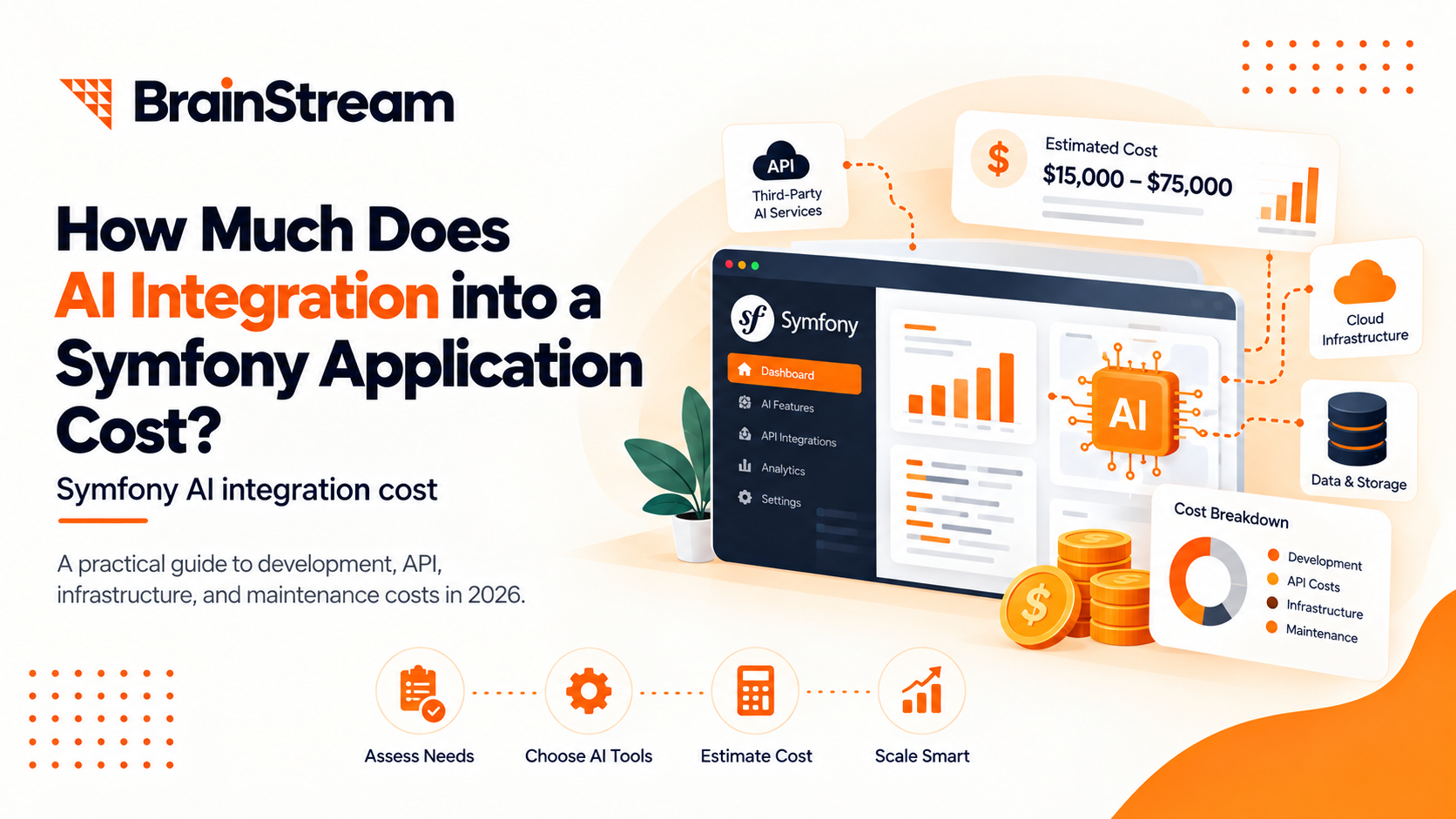
How Much Does AI Integration into a Symfony Application Cost in 2026?
Adding artificial intelligence to your Symfony application can improve customer service, automate tasks, and save valuable time. However, businesses often have one important question: How much will AI integration cost?
The answer depends on your application’s features, existing code, and AI requirements.
In 2026, Symfony AI integration can cost around $1,500 to $50,000 or more. A simple chatbot usually costs less than a complete AI-powered business platform.
You do not need to rebuild your application to get started. In many cases, developers can add AI features to your existing Symfony system.
This guide explains Symfony AI integration costs, pricing factors, popular features, and ways to reduce your budget.
What Is AI Integration in a Symfony Application?
AI integration means adding artificial intelligence features to an existing Symfony application.
Symfony is a PHP framework that developers use to build web applications, business platforms, and custom software.
By connecting AI models with Symfony, businesses can introduce smarter features without replacing their entire systems.
For example, you can add:
- AI chatbots for customer support
- Smart product recommendations
- Automated document processing
- AI-powered search functionality
- Customer behavior analysis
- Content generation tools
- Business workflow automation
These features can reduce manual work and help teams complete tasks faster.
Additionally, Symfony offers flexible ways to connect with AI services through APIs and dedicated components.
The Symfony AI ecosystem also provides tools for working with multiple AI providers, agents, and data storage.
How Much Does Symfony AI Integration Cost in 2026?
The cost depends on how complex your AI features are.
Some businesses need a basic chatbot. Others need advanced automation that connects with several business systems.
Here is a practical cost breakdown.
| AI Integration Type | Estimated Cost (USD) | Estimated Timeline |
|---|---|---|
| Basic AI chatbot | $1,500–$4,000 | 1–3 weeks |
| AI content generation | $2,000–$5,000 | 2–4 weeks |
| AI-powered search | $3,000–$8,000 | 3–6 weeks |
| AI product recommendations | $4,000–$10,000 | 4–8 weeks |
| AI document processing | $5,000–$12,000 | 4–8 weeks |
| Custom AI workflow automation | $8,000–$20,000 | 6–12 weeks |
| Advanced AI business integration | $20,000–$50,000+ | 3–6+ months |
Note: These are illustrative project planning estimates, not fixed market rates or supplier quotations. Actual costs vary by project scope, developer rates, data quality, security needs, and testing. Timelines also depend on team size and project requirements.
Basic AI Integration: $1,500–$5,000
Basic integration works well for businesses that want to introduce AI without making major changes.
For example, an online store might add a chatbot to answer common customer questions.
Common features include:
- Simple AI chatbot integration
- AI-generated product descriptions
- Basic text summarization
- Automated email responses
These projects often use an existing AI API, which reduces development work.
Mid-Level AI Integration: $5,000–$15,000
Mid-level projects require more custom development and business logic.
For example, a company might connect AI with its CRM to summarize customer conversations.
Features may include:
- AI-powered business search
- Customer support automation
- Document analysis
- CRM integration
- Personalized recommendations
These projects usually need database connections, additional testing, and custom workflows.
Advanced AI Integration: $15,000–$50,000+
Advanced AI integration supports businesses with complex processes.
For example, a large eCommerce platform might use AI for product discovery, customer support, and order management.
Such projects may involve:
- AI agents connected to multiple systems
- Advanced workflow automation
- Secure access to private business data
- Multiple AI models
- Custom reporting and monitoring
The total budget can increase when the system needs enterprise security or large-scale processing.
What Factors Affect Symfony AI Integration Cost?
Not every Symfony application needs the same amount of development work.
Several factors directly influence your final project budget.
1. Complexity of AI Features
A chatbot that answers simple questions is easier to build than an AI assistant that manages business workflows.
As features become more complex, developers need additional time for testing and integration.
Therefore, start with the features that provide the most business value.
2. Existing Symfony Application Structure
Your application’s condition can also affect the budget.
A well-maintained Symfony project often makes integration easier.
However, older applications may need code updates, security improvements, or API changes.
Developers should review the existing system before preparing an estimate.
3. AI Model and API Selection
You can connect Symfony applications with AI services such as OpenAI, Google Gemini, or Anthropic Claude.
Each provider has different models, features, and pricing.
Some models work well for simple text tasks. Others handle complex reasoning, images, or business documents.
Choosing the right model helps control ongoing expenses.
4. Data Preparation and Integration
AI tools often need access to your application data.
For example, a support chatbot may need product information, FAQs, or customer service documents.
Developers must prepare this data and connect it securely.
Poorly organized data can increase development time.
5. Security and Data Privacy
Security is important when AI handles customer or business information.
Your application may need:
- User permission controls
- Secure API connections
- Sensitive data protection
- Activity monitoring
- Data storage policies
These features can increase initial costs. However, they also help reduce business risks.
6. Development Team Experience
Developer experience influences project cost and quality.
An experienced Symfony development team can help choose suitable tools and avoid unnecessary features.
This may reduce future maintenance problems.
How Much Do AI APIs Cost for Symfony Applications?
Development is only one part of the overall AI integration budget.
Most businesses must also consider ongoing API usage costs.
Many AI providers charge based on tokens. Tokens are small pieces of text that AI models process.
Longer conversations and larger documents generally use more tokens.
For example, a simple chatbot may use fewer resources than a tool that analyzes lengthy business reports.
Example: Monthly AI API Cost
Suppose your Symfony chatbot handles 10,000 customer requests every month.
Each request uses approximately:
- 1,000 input tokens
- 500 output tokens
That equals 10 million input tokens and 5 million output tokens monthly.
Using an example model rate of $0.25 per million input tokens and $2 per million output tokens:
- Input cost: $2.50
- Output cost: $10.00
- Total model cost: $12.50 per month
This example only covers model token usage. It excludes hosting, storage, extra API tools, and development expenses.
Actual pricing depends on your selected model and provider. Check the latest provider rates before preparing a budget.
What Are the Hidden Costs of Symfony AI Integration?
Some costs may not appear in the first project estimate.
Understanding them early helps prevent unexpected spending.
Hosting and Infrastructure
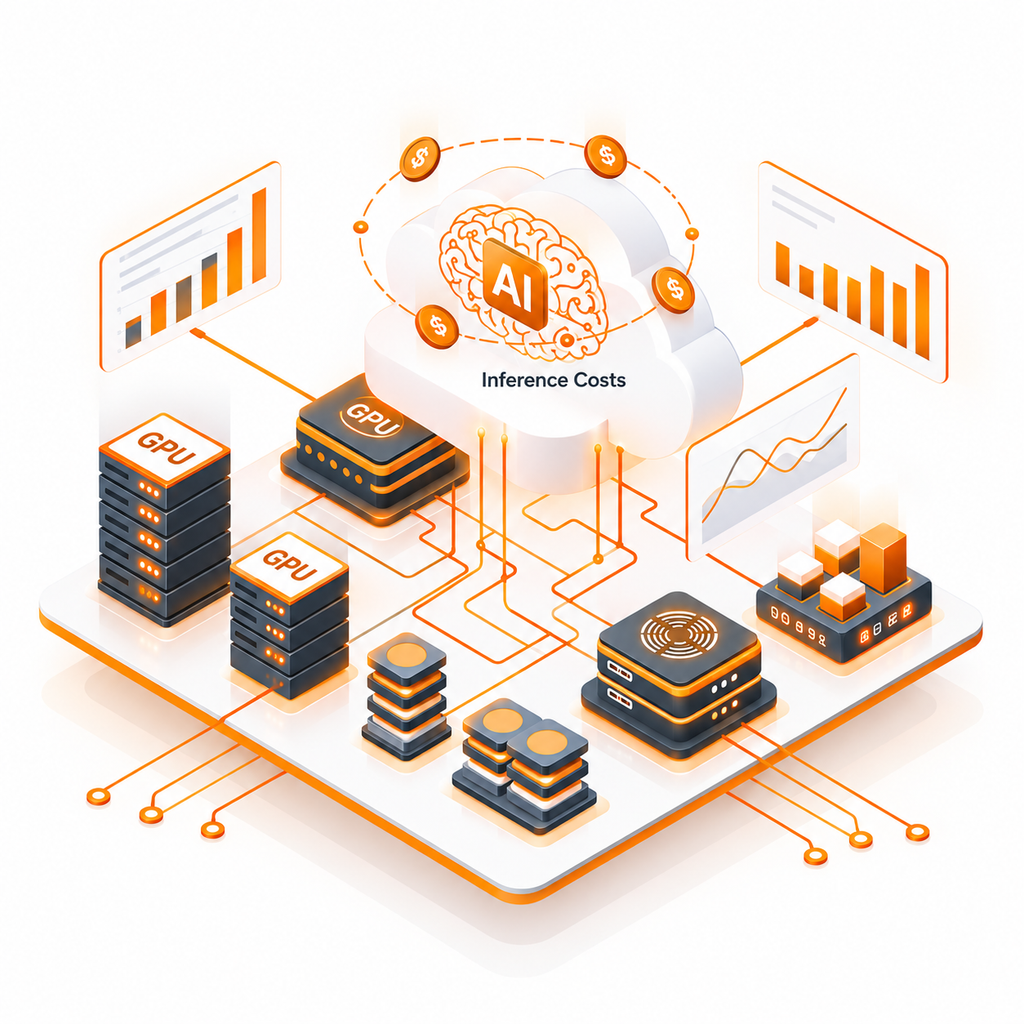
AI-powered features may increase server traffic or require additional services.
For example, document search may need a separate database for storing searchable information.
Maintenance and Updates
AI services and application requirements can change.
Your development team may need to update integrations, test new models, or improve existing features.
Testing and Quality Checks
AI responses are not always correct.
Therefore, developers should test accuracy, response time, and unusual user requests.
Some workflows may also need human approval before taking important actions.
Data Storage
Applications that store conversations, documents, or search records may face additional storage costs.
These expenses often grow with usage.
Security Monitoring
Businesses should review AI activity, API usage, and access permissions regularly.
This helps identify unusual activity and protect sensitive information.

How Can You Reduce Symfony AI Integration Costs?
AI integration does not always require a large investment.
With the right plan, businesses can control spending while building useful features.
Start with One AI Feature
Avoid introducing several AI features at once.
For example, begin with a customer support chatbot. Measure its performance before adding recommendations or automation.
This approach reduces unnecessary development expenses.
Use Existing AI APIs
Building your own AI model from scratch can require significant resources.
Instead, connect your Symfony application with an existing AI provider.
This often reduces development time and infrastructure requirements.
Select a Cost-Effective AI Model
Not every task needs the most advanced AI model.
Simple tasks, such as text classification or basic summaries, may work with smaller models.
Choose models based on accuracy, speed, and cost.
Improve API Usage
You can reduce unnecessary API calls through caching and better request handling.
For example, frequently requested information may not need a new AI response every time.
Shorter prompts and controlled response lengths can also help.
Build AI Features in Phases
Divide your project into smaller development stages.
First, launch the most useful feature. Next, review user feedback and business results.
Then invest in additional functionality when needed.
Real-World Example: AI Integration for a Symfony eCommerce Application
Imagine an eCommerce business running its website on Symfony.
The company receives hundreds of customer questions about products, orders, and delivery.
Its support team spends considerable time answering similar questions.
To improve efficiency, the business plans to introduce three AI features.
| Feature | Illustrative Budget |
|---|---|
| AI customer support chatbot | $2,500 |
| Smart product search | $4,000 |
| AI-powered product descriptions | $2,000 |
| Total estimated development cost | $8,500 |
These figures illustrate a possible project budget. They do not represent a standard package or guaranteed quotation.
The company could start with the chatbot and introduce other features later.
This approach allows the team to measure results before increasing investment.
As a result, the business may reduce repetitive support tasks and improve the shopping experience.
However, actual savings depend on AI accuracy, customer adoption, and support volume.
Is AI Integration Worth the Investment for Symfony Applications?
AI integration can deliver value when it solves a clear business problem.
For example, a company might spend several hours each week handling repetitive customer requests.
An AI chatbot could answer common questions and pass complex issues to a support agent.
This may free up employees for more valuable work.
Other possible benefits include:
- Faster customer responses
- Reduced repetitive tasks
- Better product discovery
- Improved employee productivity
- More personalized customer experiences
- Easier access to business information
However, AI does not guarantee immediate returns.
Businesses should measure results using relevant metrics, such as time saved, support resolution rates, and customer satisfaction.
A small, successful AI feature can sometimes provide more value than an expensive system with unnecessary functions.
How to Choose the Right Symfony AI Integration Partner
Choosing the right development partner can make a major difference.
Look for a team that understands Symfony development, API integrations, and practical AI use cases.
Before starting, discuss these questions:
- Have you worked with existing Symfony applications?
- Which AI providers would suit our business?
- Can you explain development and API costs separately?
- How will you protect customer information?
- What testing will you perform before launch?
- What maintenance support will we need?
- Can we introduce features in stages?
A good development partner should explain technical choices in simple terms.
They should also recommend features based on your business goals rather than adding AI everywhere.
Why Choose Brainstream Technolabs for Symfony AI Integration?
If you want to add AI to your Symfony application, working with an experienced development team can simplify the process.
At Brainstream Technolabs, our Symfony development services can help businesses plan and implement application improvements.
Depending on your project requirements, the integration scope may include:
- AI chatbot integration
- AI API connections
- AI-powered search features
- Custom workflow automation
- Symfony application modernization
- Performance and security improvements
Every application has different requirements. Therefore, the first step is to review your existing system and business goals.
Planning AI integration for your Symfony application?
Explore our Symfony Development Services or contact Brainstream Technolabs to discuss your project.

Frequently Asked Questions
1. How much does Symfony AI integration cost?
Symfony AI integration may cost $1,500 to $50,000 or more. Simple chatbot projects usually cost less. Advanced AI automation requires a larger budget. Actual pricing depends on features and project complexity.
2. Can I add AI to my existing Symfony application?
Yes. Developers can integrate AI into many existing Symfony applications using APIs and compatible components. However, older applications may require updates before integration.
3. How long does AI integration take in Symfony?
A simple integration may take one to three weeks. More complex projects can take several months. The timeline depends on features, existing code, and testing requirements.
4. Is Symfony suitable for AI-powered web applications?
Yes. Symfony supports API integrations, business logic, and custom services. Its AI ecosystem also offers components for connecting AI models, agents, and data storage systems.
5. Do I need to build a custom AI model?
No. Most businesses can begin with existing AI services. Custom model development is usually unnecessary for common chatbot, search, and automation features.
6. What is the monthly maintenance cost of Symfony AI integration?
Monthly costs depend on API usage, hosting, monitoring, and support requirements. A small application may have modest running expenses. Larger systems with complex workflows can cost much more.
7. Which AI provider is best for Symfony applications?
The best provider depends on your specific requirements. OpenAI, Google Gemini, and Anthropic offer different models and capabilities. Compare their pricing, performance, and data policies before choosing.
8. Can AI integration improve an older Symfony application?
Yes. AI can introduce useful features into older applications. However, developers should first check compatibility, security, and code quality.
Conclusion
The Symfony AI integration cost depends on your business goals, application structure, and selected AI features.
A basic integration may cost a few thousand dollars. Meanwhile, advanced automation can require a much larger investment.
The best approach is to start small, choose suitable AI tools, and expand based on measurable results.
You do not need to transform your entire application immediately. Even one useful AI feature can improve daily operations.
If you are planning to integrate AI into your existing Symfony platform, Brainstream Technolabs can help you explore suitable development options.
Start with a clear plan, understand your costs, and build AI features that support your business goals.

Manish Khilwani
Author
Co-Founder at BrainStream Technolabs, he focuses on building people-first, scalable eCommerce and digital products that help brands grow with clarity and innovation.
Table of contents
BLOGS
Learn & Grow with Us
Get the latest updates on trends and strategies that shape the business world. Our insights are here to keep you informed and inspired.
How Much Does AI Integration into a Symfony Application Cost in 2026?
Adding artificial intelligence to your Symfony application can improve customer…
Modernizing Legacy Symfony Applications with AI: Where to Start
Your Symfony application still runs your business. However, adding features…
Agentic Commerce in 2026: How AI Agents Are Changing Online Shopping
Online shopping is entering a new phase. For years, shoppers…
Top 7 Must-Have Bagisto Extensions to Improve Your eCommerce Store in 2026
Running an online store takes more than adding products and…