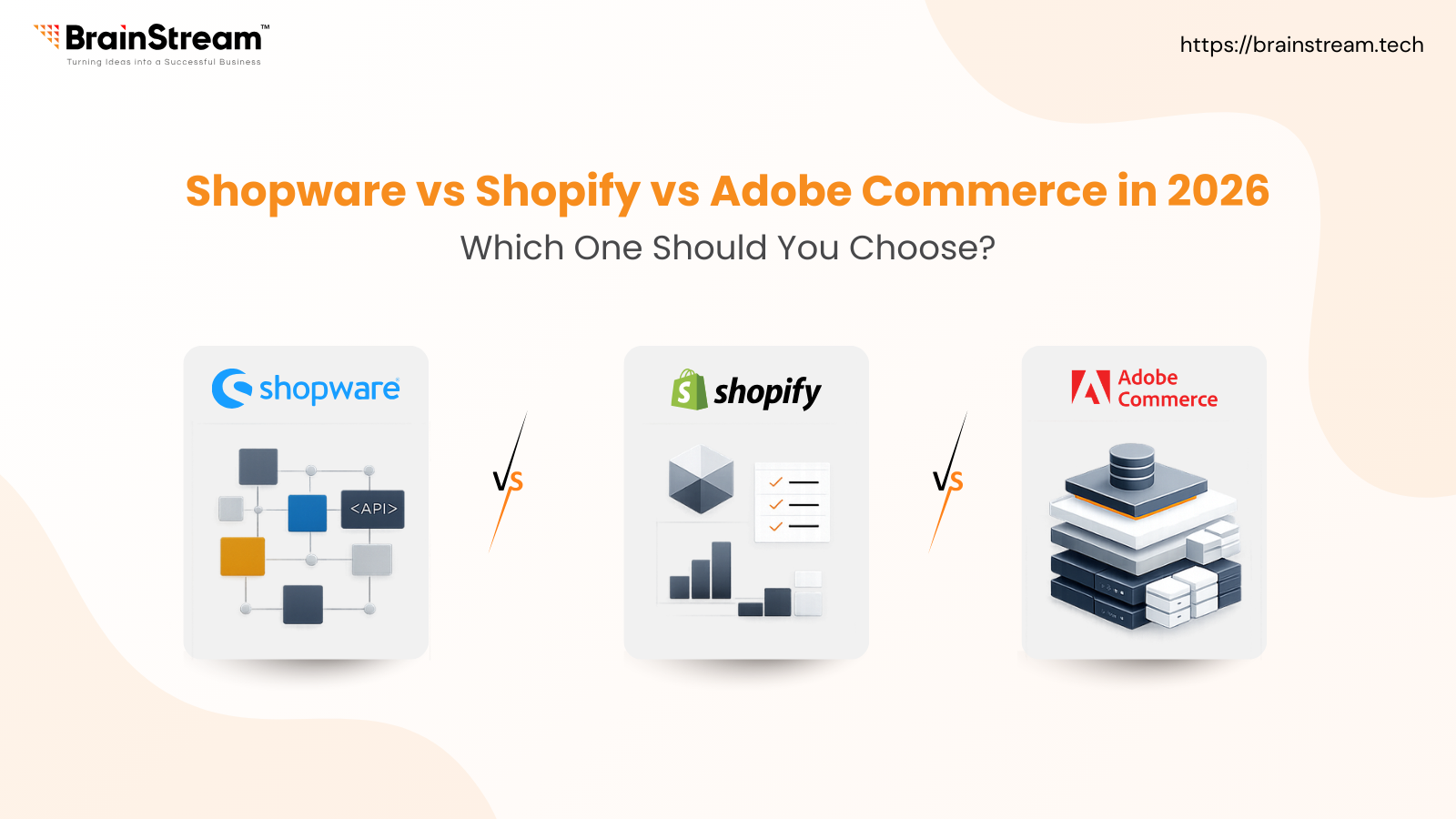
Shopware vs Shopify vs Adobe Commerce in 2026: Which One Should You Choose?
Shopware vs Shopify vs Adobe Commerce – Choosing the right eCommerce platform in 2026 is no longer just a technical decision; it’s a strategic growth decision.
Whether you’re a founder scaling a D2C brand, a CTO planning international expansion, or a marketing team focused on performance, your platform will define how fast you innovate, how efficiently you operate, and how well you compete.
In this guide, we compare: Shopware vs Shopify vs Adobe Commerce. We’ll evaluate them based on: Scalability, Cost, Flexibility & B2B capabilities.
Let’s break it down.
1. Scalability: Can It Grow With Your Ambition?
Shopware – Composable & API-First Scalability
Shopware in 2026 is well-positioned for composable commerce.
It offers:
- API-first architecture
- Headless capabilities
- Modular extensions
- Flexible hosting options
You can scale:
- From mid-market to enterprise
- From B2C to hybrid B2B
- Across multiple regions
Best for: Ambitious brands that want long-term flexibility without enterprise bloat.
Shopify – Scalable, But Within a Box
Shopify is incredibly stable and easy to scale for small to mid-sized brands. With Shopify Plus, high-traffic stores can manage significant volume.
However:
- Infrastructure is controlled by Shopify.
- Custom logic beyond Shopify’s ecosystem can be limiting.
- Enterprise-level custom workflows may require workarounds.
Best for: Fast-growing D2C brands that want simplicity over architectural freedom.
Adobe Commerce – Enterprise-Grade, Heavyweight Scaling
Adobe Commerce is built for enterprise complexity.
It handles:
- Massive catalogs
- Multi-store architecture
- Advanced integrations
- Global operations
But scalability comes with:
- High infrastructure requirements
- Complex DevOps
- Long development cycles
Best for: Large enterprises with in-house technical teams.
2. Cost: What Are You Really Paying?
Shopware
- Open-source edition available
- Paid enterprise editions for advanced needs
- Flexible hosting options
- Lower plugin dependency compared to Shopify
Strategically, Shopware offers strong value when you want customization without enterprise-level license pressure.
Shopify
- Monthly subscription model
- App ecosystem costs add up
- Transaction fees (unless using Shopify Payments)
- Limited control over infrastructure
While upfront costs are predictable, scaling often increases dependency on paid apps.
Adobe Commerce
- High license fees
- Hosting and infrastructure costs
- A dedicated development team is required
- Maintenance-heavy
Total cost of ownership (TCO) is typically the highest among the three.
3. Flexibility: How Much Control Do You Really Have?
Shopware – Balanced Flexibility
- Modern PHP & Symfony-based architecture
- API-first approach
- Plugin and event-driven system
- Clean separation of backend and frontend
Shopware hits the sweet spot between:
- Control
- Maintainability
- Speed of development
Shopify – Controlled Flexibility
- App-based ecosystem
- Limited backend customization
- Customization often requires Shopify Plus
Great for speed. Not ideal for deep system-level customization.
Adobe Commerce – Maximum Flexibility (With Complexity)
- Full code-level control
- Highly customizable
- Complex upgrade paths
- Heavy developer reliance
It’s powerful, but you need strong governance.
4. B2B Capabilities: The Real Differentiator in 2026
B2B commerce is growing faster than B2C in many industries. Platform choice matters here.
Shopware (Modern B2B Flexibility)
Shopware offers:
- Role-based access
- Custom pricing structures
- Quote workflows
- Sales agent functionality
- API-driven ERP integrations
It’s particularly strong for European B2B brands and hybrid B2B/B2C models.
Shopify (B2B)
Shopify Plus offers:
- Company profiles
- Custom pricing
- Net payment terms
But advanced B2B workflows often need custom Shopify apps or integrations.
Adobe Commerce (Strong Enterprise B2B)
Adobe Commerce includes:
- Custom catalogs
- Negotiated pricing
- Quote management
- Company accounts
- Advanced permissions
It’s robust but expensive and complex to implement.
Technical Comparison
| Feature | Shopware | Shopify | Adobe Commerce |
| Hosting | Flexible (Cloud/Self) | SaaS | Cloud/Self |
| Architecture | API-first | Monolithic SaaS | Traditional monolith |
| Customization | High | Limited | Very High |
| TCO | Medium | Medium | High |
| B2B Strength | Strong | Moderate | Very Strong |
| Dev Complexity | Medium | Low | High |
So… Which One Should You Choose?7. Governance, Ethics, and the New AI Workforce
Choose Shopware if:
- You want composable commerce
- You plan to scale across regions
- You operate B2B or hybrid
- You want flexibility without enterprise overhead
Choose Shopify if:
- You want a fast time-to-market
- You prefer simplicity over flexibility
- You’re primarily D2C
Choose Adobe Commerce if:
- You’re an enterprise
- You have internal development teams
- You need extreme customization
- Budget is not your primary concern
Our Perspective
At Brainstream, we don’t believe in “best platform.”
We believe in:
- Best architecture for your business model
- Best scalability for your ambition
- Best long-term ROI
In 2026, we’re seeing a clear shift:
- Founders want control without complexity.
- Marketing teams want agility.
- Technical teams want clean architecture.
That’s where Shopware is becoming increasingly compelling.
But the real question isn’t:
“Which platform is best?”
It’s:
Which platform aligns with your 3–5 year growth vision?
If you’re evaluating platforms and want a strategic consultation instead of a sales pitch, Brainstream is happy to help you design the right commerce architecture.
Because platform decisions shouldn’t just support your business.
They should accelerate it.

Smit Bhavsar
Author
Smit Bhavsar is a Shopware expert providing end-to-end eCommerce solutions, including Shopware development, customization, and performance optimization.
Table of contents
BLOGS
Learn & Grow with Us
Get the latest updates on trends and strategies that shape the business world. Our insights are here to keep you informed and inspired.
How Much Does AI Integration into a Symfony Application Cost in 2026?
Adding artificial intelligence to your Symfony application can improve customer…
Modernizing Legacy Symfony Applications with AI: Where to Start
Your Symfony application still runs your business. However, adding features…
Agentic Commerce in 2026: How AI Agents Are Changing Online Shopping
Online shopping is entering a new phase. For years, shoppers…
Top 7 Must-Have Bagisto Extensions to Improve Your eCommerce Store in 2026
Running an online store takes more than adding products and…