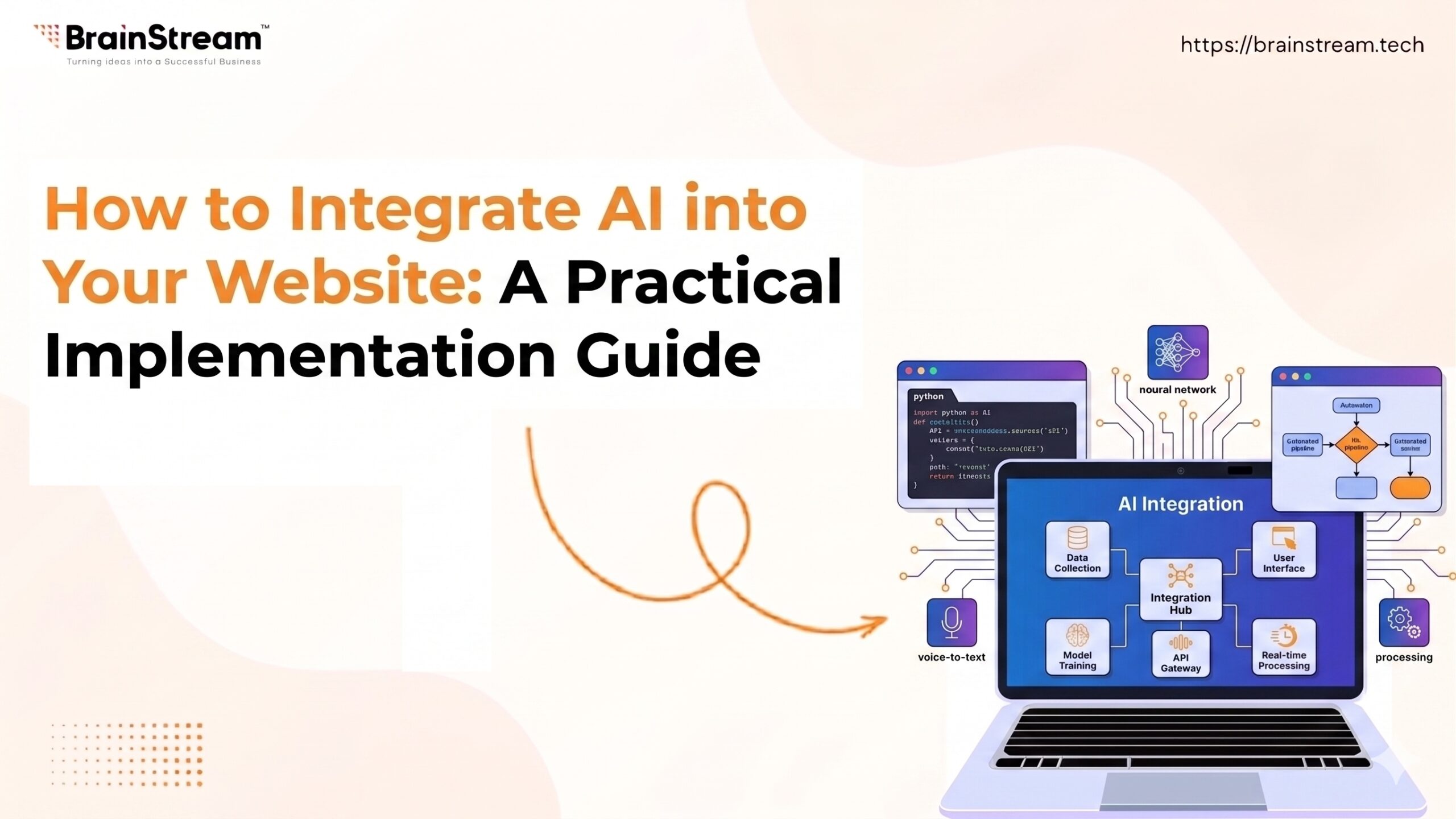
How to Integrate AI into Your Website: A Practical Implementation Guide
Artificial intelligence is no longer an experimental addition to websites; it has become a practical layer that enhances how websites interact, respond, and evolve.
Incorporating AI into a website requires clear objectives, structured data, system integration, and continuous improvement. It is not as simple as embedding a tool or connecting an API.
With a focus on both technical structure and business outcomes, this guide illustrates how AI can realistically be implemented in a website environment.
How AI fits into a website ecosystem
To understand integration, you must first understand how AI works on a website.
AI does not replace your website; it is enhanced in certain areas.
AI’s role in the following areas:
Layer 1: User Interaction
Users can directly experience AI here:
- Using chatbots
- Smart forms
- Personalized recommendations
Layer 2: Process
Decisions are made here.
- Prediction models
- Recommendation logic
- Search engine intelligence
Layer 3: Data
The backbone of the system.
- User behavior data
- An overview of historical activity
- Content and product data
Data flows continuously, and decision-making is improved when AI is integrated across all three layers.
Identification of High-Impact Use Cases
AI is not necessary for every feature; it should be used to enhance those functionalities that can truly benefit from it.
High-impact use cases include:
Automated customer support
The use of AI-powered chatbots reduces response time and streamlines repetitive tasks.
Personalized content delivery
Content is tailored based on user behavior, increasing engagement.
Product or content recommendations
Users are shown relevant suggestions based on their activity.
Intelligent search
Search results improve by understanding user intent rather than relying only on exact keywords.
Behavior analysis
AI analyzes patterns and optimizes user journeys.
The key is to select a use case that aligns with a real business challenge.
Choosing the Right Integration Approach
Depending on the complexity and scale of your project, AI can be integrated in a variety of ways.
1. Pre-Built AI Tools
- Quick to implement
- Suitable for basic use cases
- Limited customization
2. API-Based Integration
- Connect external AI services
- Flexible and scalable
- Requires backend development
3. Custom AI Systems
- Built specifically for your business
- High control and scalability
- Requires more resources
Most businesses begin with API-based solutions and evolve toward custom implementations as their needs grow.
- Faster content production
- Better SEO performance
- Data-driven decisions
Building a data foundation
AI systems depend heavily on data quality.
Without reliable data, AI outputs become inaccurate or irrelevant.
Types of data required:
- Behavioural data (clicks, navigation paths)
- Transactional data (purchases, sign-ups)
- Interaction data (search queries, chat inputs).
Data preparation steps:
- Clean and remove inconsistencies
- Normalize the formats
- Organize into structured datasets
- Ensure compliance with all privacy standards
Strong data foundations directly impact AI models’ effectiveness.
Designing the integration workflow
AI should be part of your website’s workflow, not an isolated feature.
Example workflow:
- User visits the website
- User acts (search, click, query).
- Data is sent to the backend
- Backend communicates with the AI service
- AI processes and returns output
- The website displays the result
This flow ensures AI responses:
- Context-aware
- Real-time
- Integrated into the user experience
Implementing AI features
Once the foundation is ready, AI features can be implemented based on your selected use case.
Chatbot Integration
- Connect chatbot API
- Training on FAQs and business data
- Embed into website interface
Recommendation Engine
- Analyze user behavior
- Apply recommendation logic
- Display dynamic suggestions
Smart Search
- Replace keyword-based search
- Use AI models to understand intent
Automation of Systems
- Automate repetitive workflows
- Integrates with CRM or backend systems
Each feature should be tested individually before combining them.
Performance considerations.
AI integration can impact website performance if not handled correctly.
Common issues:
- Increased load time
- API delays
- Heavy data processing
Optimization strategies:
- Use asynchronous API calls
- Cache frequently used data
- Limit unnecessary AI requests
- Optimize the backend processing
Maintaining performance is critical to ensuring a smooth user experience.
Testing and validation
Before deployment, testing ensures AI features work correctly.
Key testing areas:
- Accuracy of responses
- Speed of execution
- Compatibility across devices
- User interaction flow
Testing should simulate real user scenarios to identify potential issues.
Monitoring and Continuous Improvement
AI systems can improve over time, but only with proper monitoring.
Metrics to track:
- Engagement rate
- Conversion rate
- Bounce rate
- Accuracy of AI outputs
Optimization actions:
- Update training data
- Adjust the algorithms
- Improve logic based on feedback
AI is not a one-time setup. It requires continuous refinement.
Security and Privacy
Since AI relies on user data, security becomes critical.
Key considerations:
- Secure API communication
- Data encryption
- Compliance with regulations
- User consent and transparency
Ignoring security can lead to technical and legal issues.
Challenges in AI integration
Despite its benefits, AI integration comes with challenges.
- Data consistency
- Integration complexity
- Resource requirements
- Need technical expertise
These challenges can be managed with proper planning and a phased implementation.
Best Practices for Implementation
To ensure a successful integration:
- Start with a clear use case
- Focus on high-impact areas
- Build a strong data foundation
- Integrated AI into workflow
- Monitor and optimize continuously
A structured approach reduces risk and improves results.
Conclusion
Integrating AI into a website involves more than just adding features. It requires aligning business goals, data, technology, and user experience into a cohesive system.
When implemented correctly, AI enables websites to:
- Deliver personalized experiences
- Automate complex processes
- Improve decision-making
- Enhance overall performance
As websites continue to evolve, AI will play an increasingly significant role in shaping how users interact with digital platforms.

Manish Khilwani
Author
Co-Founder at BrainStream Technolabs, he focuses on building people-first, scalable eCommerce and digital products that help brands grow with clarity and innovation.
Table of contents
BLOGS
Learn & Grow with Us
Get the latest updates on trends and strategies that shape the business world. Our insights are here to keep you informed and inspired.
How Much Does AI Integration into a Symfony Application Cost in 2026?
Adding artificial intelligence to your Symfony application can improve customer…
Modernizing Legacy Symfony Applications with AI: Where to Start
Your Symfony application still runs your business. However, adding features…
Agentic Commerce in 2026: How AI Agents Are Changing Online Shopping
Online shopping is entering a new phase. For years, shoppers…

Top 7 Must-Have Bagisto Extensions to Improve Your eCommerce Store in 2026
Running an online store takes more than adding products and…