How AI Improves User Experience in SaaS Applications?
User experience has become one of the biggest success factors for modern SaaS applications.
Today, users expect software platforms to be fast, personalized, intelligent, and easy to use. If an application feels slow or confusing, users quickly move to competitors. Because of this, SaaS companies constantly look for ways to improve customer experience and increase user retention.
That is where artificial intelligence is making a major impact.
AI is transforming how SaaS applications interact with users. Instead of offering the same experience to everyone, modern SaaS platforms now deliver personalized recommendations, intelligent automation, predictive insights, and real-time support.
As a result, businesses improve engagement, customer satisfaction, and long-term retention.
In fact, many successful SaaS companies already use AI-powered features to create smarter and more user-friendly platforms.
In this guide, you will learn:
- How AI improves user experience in SaaS applications
- Real-world examples of AI in SaaS
- Key benefits of AI-powered UX
- Common implementation challenges
- Best practices for AI integration
Let’s begin.
Why User Experience Matters in SaaS Applications
The SaaS industry has become extremely competitive.
Most software platforms now offer similar core features. Therefore, user experience often becomes the biggest differentiator.
A good user experience helps businesses:
- Increase user engagement
- Improve customer retention
- Reduce churn rates
- Boost conversions
- Increase customer satisfaction
Meanwhile, poor user experience creates frustration and decreases product adoption.
Users expect:
- Faster workflows
- Personalized experiences
- Smart recommendations
- Easy onboarding
- Instant support
AI helps SaaS companies deliver these experiences more effectively.
How AI Improves User Experience in SaaS Applications
Artificial intelligence improves SaaS user experience in several powerful ways.
Let’s explore the most important ones.
Personalized User Experiences
Personalization is one of the biggest advantages of AI-powered SaaS applications.
Traditional software platforms often provide the same interface and recommendations to every user. However, AI can analyze user behavior and customize the experience dynamically.
For example, AI can track:
- User activity
- Feature usage
- Search behavior
- Purchase history
- Navigation patterns
Based on this information, SaaS platforms can:
- Recommend relevant features
- Personalize dashboards
- Suggest workflows
- Deliver custom notifications
As a result, users feel more connected to the platform and complete tasks more efficiently.
Companies building scalable SaaS platforms often integrate intelligent personalization systems with modern cloud infrastructure strategies from BrainStream Technolabs.
AI-Powered Chatbots and Virtual Assistants
Customer support is another area where AI significantly improves the user experience.
Users want quick answers and instant support. Waiting hours for responses creates frustration and lowers satisfaction.
AI-powered chatbots help solve this problem.
Modern AI assistants can:
- Answer common questions
- Guide users through workflows
- Troubleshoot issues
- Provide onboarding assistance
- Route support tickets automatically
Unlike traditional chatbots, AI-driven assistants can understand context and respond more naturally.
As a result, users receive faster, more accurate support experiences.
Smarter Search Functionality
Search functionality plays a major role in SaaS usability.
Traditional search systems often fail because they rely only on exact keywords. Meanwhile, AI-powered search systems understand user intent and context.
For example, AI search engines can:
- Predict user queries
- Understand natural language
- Recommend relevant results
- Improve search accuracy
As a result, users find information much faster.
This improves productivity and overall user satisfaction.
Predictive Analytics and Smart Recommendations
AI helps SaaS applications predict user needs before users even ask.
This creates a smoother and more intelligent experience.
For example, AI can:
- Recommend next actions
- Predict customer behavior
- Identify workflow bottlenecks
- Suggest automation opportunities
Streaming platforms like Netflix and ecommerce platforms like Amazon already use predictive AI extensively.
Similarly, SaaS businesses now use AI-driven recommendations to improve engagement and reduce user effort.
Intelligent Workflow Automation
Many SaaS users spend time handling repetitive tasks.
AI helps automate these workflows intelligently.
For example, AI can:
- Generate reports automatically
- Organize data
- Prioritize tasks
- Schedule actions
- Trigger notifications
As a result, users save time and improve productivity.
Meanwhile, businesses increase software value and customer retention.
Improved User Onboarding
User onboarding often determines whether customers continue using a SaaS platform.
Complex onboarding processes increase churn rates significantly.
AI improves onboarding by:
- Guiding users step by step
- Personalizing tutorials
- Recommending relevant features
- Detecting user confusion
Because of this, users learn platforms faster and adopt features more effectively.
AI-Driven Data Insights
Modern SaaS platforms generate large amounts of data.
However, raw data alone is not useful for most users.
AI helps transform complex information into actionable insights.
For example, AI can:
- Identify trends
- Generate summaries
- Highlight anomalies
- Recommend decisions
This helps users make faster and smarter business decisions.
Real-World Examples of AI in SaaS Applications
Many successful SaaS platforms already use AI extensively.
For example:
- CRM platforms use AI for lead scoring
- Marketing platforms use AI for automation
- HR software uses AI for candidate screening
- Finance platforms use AI for predictive analytics
- Project management tools use AI for workflow optimization
Because of this, AI-powered SaaS applications continue growing rapidly across industries.
Benefits of AI in SaaS Applications
Businesses invest in AI because the benefits are substantial.
Better Customer Engagement
AI-powered personalization keeps users engaged longer.
Therefore, businesses improve retention rates.
Higher Productivity
Workflow automation reduces manual work.
As a result, users complete tasks faster.
Reduced Churn Rates
Better user experiences improve customer satisfaction.
Meanwhile, satisfied customers are more likely to stay long term.
Faster Support Experiences
AI-powered chatbots provide instant assistance.
Therefore, users solve problems more quickly.
Improved Scalability
AI helps SaaS platforms handle growing user demands efficiently.
Businesses can scale without dramatically increasing support teams.
Challenges of AI Integration in SaaS Applications
Although AI offers many advantages, businesses still face implementation challenges.
Data Privacy and Security
AI systems often process sensitive customer data.
Therefore, SaaS companies must focus heavily on:
- Data protection
- Compliance
- Access control
- Security monitoring
Integration Complexity
Integrating AI into existing SaaS platforms can become technically challenging.
Many businesses struggle with:
- Legacy systems
- API limitations
- Infrastructure scalability
AI Accuracy Issues
AI systems are not always perfect.
Poor-quality training data can reduce recommendation accuracy and user trust.
Because of this, continuous optimization is extremely important.
Benefits of AI in SaaS Applications
Businesses invest in AI because the benefits are substantial.
Better Customer Engagement
AI-powered personalization keeps users engaged longer.
Therefore, businesses improve retention rates.
Higher Productivity
Workflow automation reduces manual work.
As a result, users complete tasks faster.
Reduced Churn Rates
Better user experiences improve customer satisfaction.
Meanwhile, satisfied customers are more likely to stay long term.
Faster Support Experiences
AI-powered chatbots provide instant assistance.
Therefore, users solve problems more quickly.
Improved Scalability
AI helps SaaS platforms handle growing user demands efficiently.
Businesses can scale without dramatically increasing support teams.
Best Practices for AI-Powered SaaS Development
Businesses should follow a strategic approach when implementing AI features.
Focus on User Problems First
Do not add AI only because it is trending.
Instead, solve real customer pain points.
Start With Small AI Features
Many successful SaaS platforms begin with:
- Smart recommendations
- AI chatbots
- Predictive search
- Workflow automation
After testing performance, they expand gradually.
Use Scalable Infrastructure
AI-powered SaaS applications require scalable cloud environments.
Cloud-native architecture improves:
- Performance
- Reliability
- Scalability
Continuously Improve AI Models
AI systems require regular optimization.
Businesses should monitor:
- User feedback
- Recommendation accuracy
- Engagement metrics
- Workflow efficiency
The Future of AI in SaaS Applications
AI will continue transforming SaaS applications rapidly.
In the coming years, SaaS platforms will likely become:
- More autonomous
- More predictive
- More personalized
- More conversational
Meanwhile, generative AI and AI agents are evolving quickly.
Because of this, SaaS companies that invest in AI today will likely gain strong competitive advantages in the future.
Industries expected to adopt AI-powered SaaS heavily include:
- Ecommerce
- Healthcare
- Finance
- Marketing
- HR technology
- Enterprise software
Conclusion
AI is transforming the user experience in modern SaaS applications.
From personalization and predictive analytics to workflow automation and intelligent support, AI helps businesses create smarter and more engaging platforms.
As a result, SaaS companies improve customer satisfaction, reduce churn, and increase long-term growth.
However, successful AI integration requires proper infrastructure, strategic planning, and continuous optimization.
Businesses that adopt AI-powered SaaS experiences early will likely lead the next generation of software innovation.
FAQs
How does AI improve SaaS user experience?
AI improves personalization, automation, customer support, search functionality, and predictive recommendations.
Why do SaaS companies use AI?
SaaS companies use AI to improve engagement, reduce churn, automate workflows, and deliver better customer experiences.
Can AI improve SaaS customer retention?
Yes. Personalized experiences and intelligent automation improve user satisfaction and increase retention rates.
Is AI important for modern SaaS applications?
Absolutely. AI is becoming a major competitive advantage for SaaS businesses across industries.

Manish Khilwani
Author
Co-Founder at BrainStream Technolabs, he focuses on building people-first, scalable eCommerce and digital products that help brands grow with clarity and innovation.
Table of contents
BLOGS
Learn & Grow with Us
Get the latest updates on trends and strategies that shape the business world. Our insights are here to keep you informed and inspired.
How Much Does AI Integration into a Symfony Application Cost in 2026?
Adding artificial intelligence to your Symfony application can improve customer…
Modernizing Legacy Symfony Applications with AI: Where to Start
Your Symfony application still runs your business. However, adding features…
Agentic Commerce in 2026: How AI Agents Are Changing Online Shopping
Online shopping is entering a new phase. For years, shoppers…
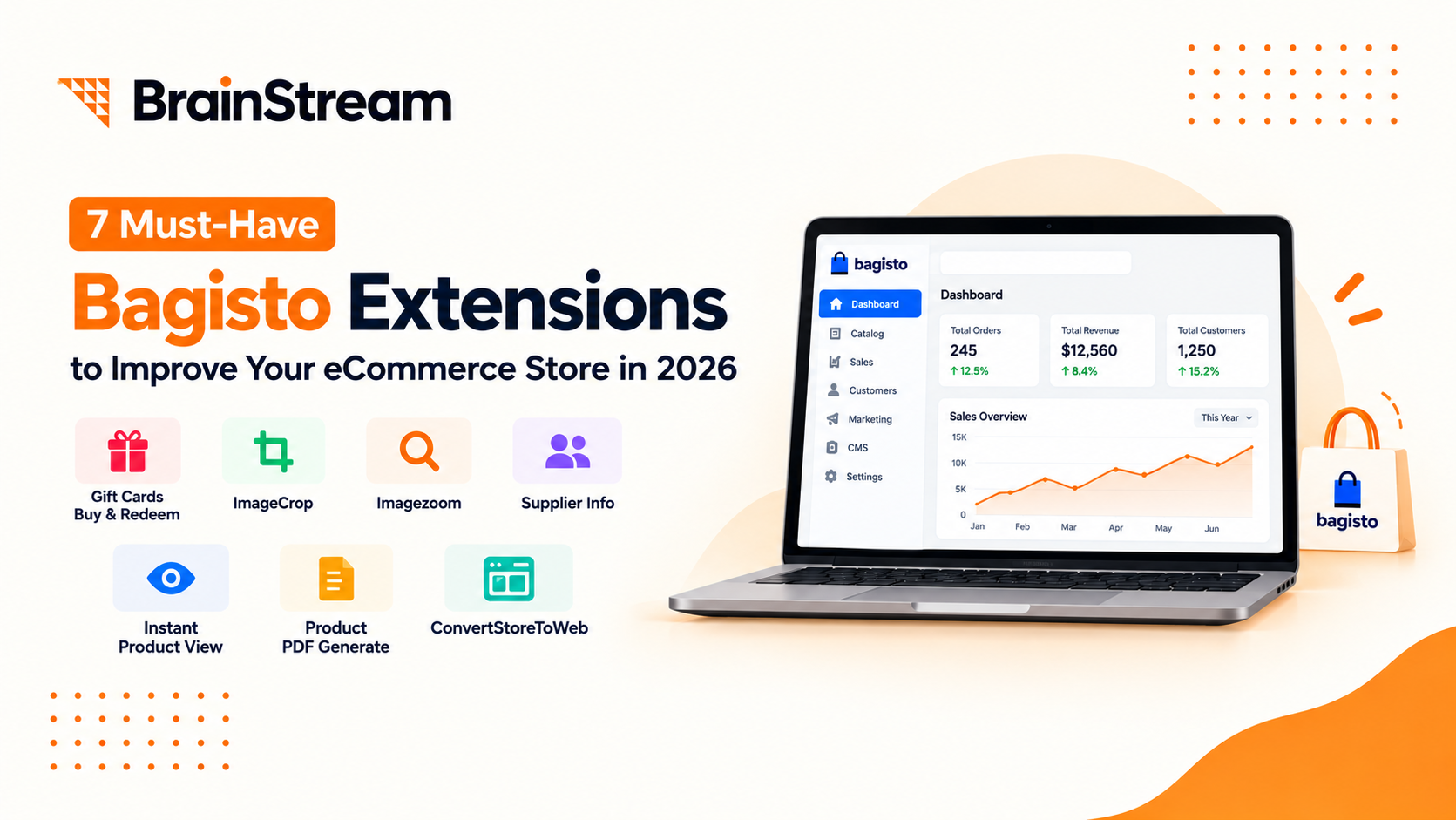
Top 7 Must-Have Bagisto Extensions to Improve Your eCommerce Store in 2026
Running an online store takes more than adding products and…