













Summary:
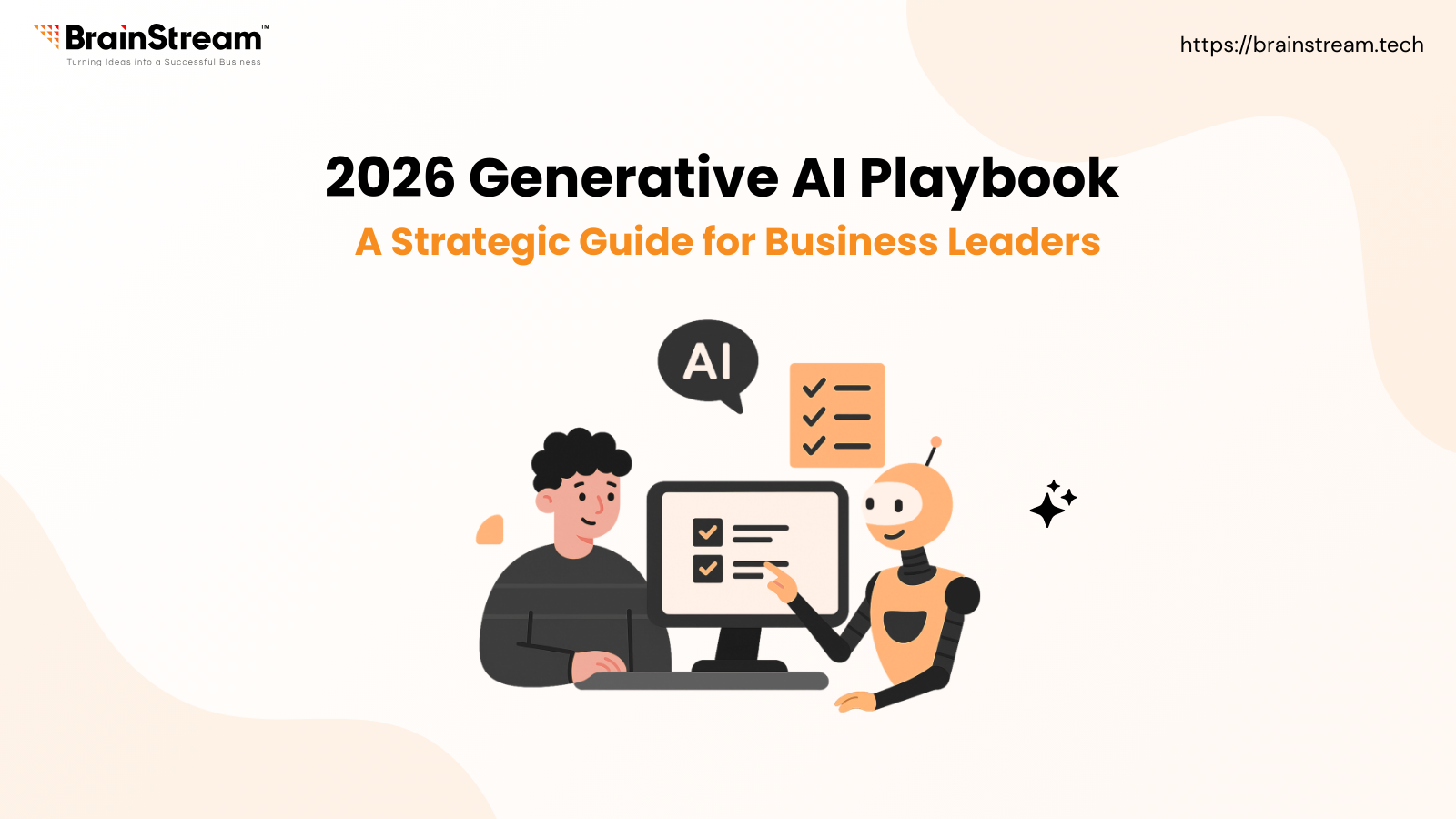
By 2026, Generative AI has evolved from a creative tool into Autonomous “Agentic” AI systems that don’t just suggest ideas but execute entire business workflows. This guide explores the “AI-Native Enterprise,” where Retrieval-Augmented Generation (RAG) ensures data accuracy, Multi-modal models allow AI to see and hear, and Generative Engine Optimisation (GEO) replaces traditional SEO. For leaders, the focus has shifted from experimenting with chatbots to managing a digital workforce and ensuring ethical AI governance.
February 24, 2026
The digital landscape has officially crossed a Rubicon. If 2023 was the year of “Aha!” moments with ChatGPT and 2024–2025 were years of frantic experimentation, 2026 is the year of the AI-Native Enterprise.
For business leaders, the conversation has shifted. We are no longer asking, “What can Generative AI do?” Instead, the mission-critical question is: “How fast can AI run our core operations autonomously?” This guide breaks down the definitive trends of 2026 and provides a roadmap for navigating this profound shift from AI assistants to autonomous digital workers.
1. The Great Pivot: From Generative AI to Agentic AI
In 2026, the most significant trend is the rise of Agentic AI. Traditionally, Generative AI was reactive; it waited for a human prompt to write an email or generate an image.
Agentic AI, however, is proactive. These are “Digital Workers” designed to understand high-level goals and break them down into actionable tasks without constant human intervention.
Imagine telling an AI agent, “We need to launch our SaaS product in the Japanese market by Q3.”
Instead of just giving you a plan, the Agentic AI:
- Analyses local market regulations and competitor pricing.
- Draft localised product descriptions.
- Coordinates with your CRM to identify potential leads.
- Schedules the first round of outreach meetings.
Strategic Impact: Business leaders must rethink workforce structures. The value of a human employee in 2026 is moving from “doing the task” to “orchestrating the agents.”
2. Multi-Modal Intelligence: Beyond the Text Box
For years, AI models were siloed. You had one model for text, another for images, and another for audio. In 2026, Unified Multi-Modal Models have become the standard. These systems perceive the world much like humans do, simultaneously processing sight, sound, and language.
This convergence enables a new class of workflows:
- Interactive Business Intelligence: Instead of reading a static report, you can show a video of a warehouse operation to an AI, and it can instantly spot bottlenecks or safety violations while explaining them to you in real-time.
- Seamless Content Ecosystems: Marketing teams can now generate an entire campaign of social media posts, high-fidelity video ads, and personalised audio scripts from a single brand guidelines document.
The barrier between “thinking” and “creating” has effectively vanished.
3. RAG: Solving the Trust and Accuracy Crisis
One of the biggest hurdles to AI adoption was “hallucination”, the tendency for models to confidently state falsehoods. In 2026, Retrieval-Augmented Generation (RAG) has become the “Enterprise Default.”
RAG acts as an anchor, grounding the AI’s creative power in a company’s own trusted, real-time data. Rather than relying on what the model learned during its initial training, RAG allows the AI to:
- Pull from the latest compliance documents.
- Reference real-time inventory and pricing sheets.
- Consult sensitive internal project histories.
Why it matters: In 2026, data readiness is the new oil. Companies that have organised their internal knowledge bases are winning because their AI is accurate, while disorganised companies are left with “hallucinating” bots.
4. Hyper-Personalisation: The End of "One-Size-Fits-All"
Customer experience in 2026 is no longer about “segments” or “personas.” It is about the individual. Generative AI allows for Hyper-Personalisation at Scale, where every touchpoint is unique.
- Dynamic Web Interfaces: A website in 2026 will literally rewrite its copy, change its layout, and highlight products in real-time based on the specific user’s browsing history and current intent.
- Context-Aware Marketing: Email campaigns are no longer templated. Every sentence is uniquely generated for the recipient, referencing past interactions and predicting future needs.
This shift moves the needle from engagement to anticipation. Businesses are no longer reacting to customer needs; they are predicting them before customers even click.
5. The Content Revolution: AI-Generated Video and Media
We have entered the era of the “AI-Native Production Studio.” AI-generated video has moved from grainy, experimental clips to high-fidelity, big-budget production tools. Major streaming platforms and marketing agencies are now weaving AI directly into their pipelines to reduce costs and time-to-market.
For mid-sized businesses, this is a massive equaliser. A small marketing team can now produce cinematic-quality commercials that previously required a six-figure budget and a month of post-production.
6. GEO: The Successor to SEO
Search Engine Optimisation (SEO) as we knew it is dying. In 2026, users don’t just scroll through links; they ask AI for answers. This has birthed Generative Engine Optimisation (GEO).
Businesses are now optimising their content to be “read” and “cited” by AI models. If an AI agent is recommending a software solution to a CEO, you want your brand to be the one it reasons its way toward. This requires a shift from keyword-stuffing to providing high-value, structured data that AI models can easily digest and trust.
7. Governance, Ethics, and the New AI Workforce
As AI takes on more responsibility, the risk landscape changes. 2026 sees the formalisation of AI Governance. With the EU AI Act and similar global regulations in full swing, businesses must ensure their models are:
- Explainable: Can you prove why the AI made a certain decision?
- Unbiased: Is the AI treating all customer segments fairly?
- Secure: Is the AI protecting sensitive intellectual property?
This has led to the rise of new roles within the C-suite. We are seeing Chief AI Officers (CAIOs), AI Ethicists, and Model Auditors becoming as common as HR or Legal departments.
Conclusion: Moving from Experimentation to Integration
The message for 2026 is clear: AI is no longer a tool you “use”; it is a teammate you “manage.” The companies that will dominate the late 2020s are those that stop viewing AI as a “plugin” and start viewing it as the foundational layer of their organisation. To lead in this environment, you must focus on three pillars:
- Data Hygiene: Ensure your internal data is “AI-ready” for RAG implementations.
- Process Redesign: Don’t just automate old tasks; design new workflows that assume AI is doing the heavy lifting.
- Trust as a Brand: In a world of synthetic media, human-verified trust will be your most valuable currency.
The future of business is intelligent, autonomous, and moving faster than ever. The inflexion point is here. Are you ready to lead an AI-native enterprise?

Manish Khilwani 

Co-Founder at BrainStream Technolabs, he focuses on building people-first, scalable eCommerce and digital products that help brands grow with clarity and innovation.
Share :


Related Blog
AI Development
Top 10 Agentic AI Frameworks Powering Autonomous Systems in 2026
Artificial Intelligence has evolved rapidly over the past few years. We moved from predictive models to generative AI, and now we are entering the era of Agentic AI systems capable of planning, reasoning, acting, and continuously adapting to achieve defined...
AI Development
The AI Renaissance of 2026: From Generative Tools to Autonomous Intelligence
The year 2026 marks a pivotal chapter in human history. We have officially moved past the "AI Hype" phase of 2023-2024 and entered the era of Functional Integration. If 2025 was about experimenting with Large Language Models (LLMs), 2026 is...
AI Development
ChatGPT OS: How OpenAI’s Intelligence Layer Is Reshaping Business Software in 2026
In 2026, the way businesses build and use software is undergoing a structural transformation. We are moving from interface-driven applications to intent-driven systems. At the centre of this shift is ChatGPT OS, an intelligence layer that is beginning to function...


Keep up-to-date with our newsletter.
Sign up for our newsletter to receive weekly updates and news directly to your inbox.