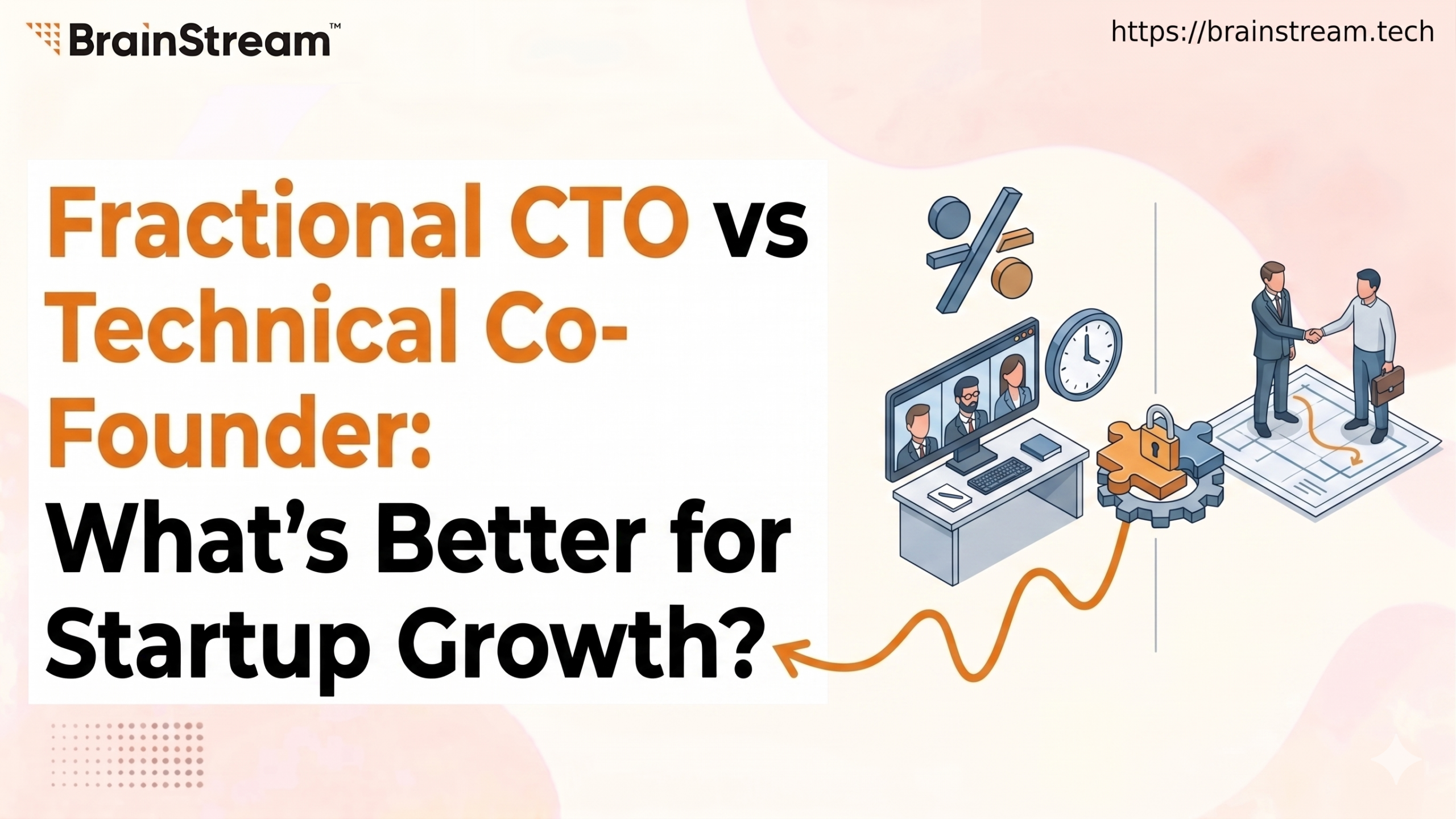
Fractional CTO vs Technical Co-Founder: What’s Better for Startup Growth?
Launching a startup today is easier than ever. Scaling one successfully is where the real challenge begins.
Most startups eventually reach a stage where technology becomes more than just product development. Decisions around infrastructure, scalability, engineering processes, AI integration, security, hiring, and product architecture start directly impacting business growth.
At this point, founders often face a critical question:
Should you hire a Fractional CTO or bring in a Technical Co-Founder?
While both roles provide technical leadership, they solve very different business problems. Choosing the wrong approach can slow down execution, increase operational costs, create technical debt, and even impact investor confidence.
Choosing the right one, however, can accelerate product growth, improve scalability, and help startups build a stronger technology foundation.
In this blog, we’ll break down the key differences between a Fractional CTO and a Technical Co-Founder, when each option makes sense, and which model is better suited for modern startup growth.
Why This Decision Matters More in 2026?
The startup ecosystem has evolved significantly over the last few years.
Today’s startups are expected to:
- Launch products faster
- Operate lean teams
- Integrate AI capabilities
- Scale globally early
- Optimize operational costs
Unlike traditional startup models, businesses no longer need massive engineering teams from day one.
With advancements in:
- Cloud-native infrastructure
- AI-assisted development
- Low-code and no-code platforms
- Remote engineering teams
- Agile development frameworks
…startups can validate ideas much faster than before.
Because of this shift, many founders are rethinking how they approach technical leadership.
Instead of immediately searching for a full-time technical co-founder, many startups are now leveraging Fractional CTO services to gain strategic technology expertise without giving away significant equity early.
What Is a Technical Co-Founder?
A Technical Co-Founder is a founding partner who shares ownership, long-term vision, and operational responsibility within the company.
Unlike a consultant or advisor, they are deeply involved in building the startup from the ground up.
A Technical Co-Founder typically:
- Owns the technology vision
- Leads engineering strategy
- Builds product architecture
- Hires and manages developers
- Oversees scalability planning
- Participates in fundraising discussions
- Shapes the engineering culture
- Shares startup equity and decision-making
In most startups, technical co-founders work full-time and take significant risks early in exchange for long-term ownership and future company growth.
When Does a Technical Co-Founder Make Sense?
A Technical Co-Founder is usually the right fit when technology itself is the startup’s core competitive advantage.
This is common in:
- AI startups
- SaaS platforms
- Fintech products
- Health-tech solutions
- Deep-tech companies
- Businesses with proprietary technology
- Products requiring ongoing R&D
For example, if your startup is building a proprietary AI engine or a highly scalable platform infrastructure, long-term internal engineering leadership becomes critical.
In such cases, a Technical Co-Founder often becomes a strategic necessity rather than an optional role.
Advantages of Having a Technical Co-Founder
1. Long-Term Product Ownership
Technical co-founders focus on building sustainable systems for long-term growth.
They think beyond short-term deadlines and prioritize:
- Scalable architecture
- Product stability
- Engineering culture
- Technical innovation
This often creates stronger product continuity as the company scales.
2. Stronger Investor Confidence
Investors often prefer startups with technical expertise inside the founding team.
A startup without internal technical leadership may raise concerns such as:
- Who owns technical direction?
- How scalable is the product?
- Who manages engineering decisions internally?
A strong Technical Co-Founder helps reduce these concerns during fundraising discussions.
3. Faster Product Decision-Making
Since technical co-founders are deeply integrated into the business, product and engineering decisions happen faster.
There is a minimal communication gap between business strategy and technical execution.
4. Deep Product Commitment
Technical co-founders usually develop a strong sense of ownership of the product and company vision.
This often improves:
- Product quality
- Innovation speed
- Engineering accountability
- Long-term execution consistency
Challenges of Hiring a Technical Co-Founder
While the role offers major advantages, it also comes with significant challenges.
1. Founder Equity Is Expensive
One of the biggest long-term costs is equity dilution.
Technical co-founders may receive:
- 20% to 50% ownership
- Strategic influence
- Board-level involvement
- Long-term control over technology decisions
Many founders underestimate the future value of early-stage equity.
2. Finding the Right Person Is Extremely Difficult
A skilled engineer is hard.
Finding someone who:
- Understands business strategy
- Shares your long-term vision
- Handles startup pressure
- Thinks strategically
- Communicates effectively
- Accepts founder-level risk
…is significantly harder.
Many startups fail because of co-founder conflicts rather than product failures.
3. Misaligned Vision Can Slow Growth
A co-founder relationship is a long-term partnership.
If priorities shift later, conflicts may arise around:
- Product roadmap decisions
- Hiring strategy
- Fundraising
- Company culture
- Technology direction
Resolving founder conflicts can become extremely difficult as the company grows.
What Is a Fractional CTO?
A Fractional CTO is an experienced technology leader who works with startups on a part-time, strategic, or contract basis.
Instead of hiring a full-time executive, startups gain access to senior technical leadership only when needed.
A Fractional CTO typically helps with:
- Technology strategy
- Product architecture
- Engineering team management
- Technical hiring
- Infrastructure planning
- AI adoption strategy
- Security and compliance
- Development workflow optimization
- Product scalability planning
Unlike a Technical Co-Founder, a Fractional CTO usually works without major equity ownership.
Why Fractional CTO Services Are Growing Rapidly
Modern startups are increasingly prioritizing:
- Faster execution
- Lean operations
- Flexible leadership
- Reduced hiring risk
- Access to specialized expertise
A Fractional CTO helps businesses achieve all of these goals without long-term executive commitments.
This model is especially valuable for:
- Non-technical founders
- Early-stage startups
- MVP-stage businesses
- Bootstrapped startups
- Scaling SaaS companies
- Startups preparing for fundraising
Instead of spending months searching for the “perfect” technical co-founder, startups can immediately access senior technology expertise and begin building faster.
Benefits of Hiring a Fractional CTO
1. Lower Financial Risk
Hiring a full-time CTO can be expensive.
Giving away founder equity can become even more expensive later.
A Fractional CTO allows startups to access senior leadership without:
- Large executive salaries
- Long-term commitments
- Significant equity dilution
This helps founders retain more ownership.
2. Faster Access to Experience
Many Fractional CTOs have already:
- Built scalable SaaS platforms
- Managed engineering teams
- Solved infrastructure challenges
- Led product scaling initiatives
- Worked with startup growth stages
This experience helps startups avoid costly technical mistakes early.
3. Faster Time-to-Market
Fractional CTOs often focus heavily on lean execution.
Instead of overengineering products, they prioritize:
- MVP launch speed
- Product validation
- Agile development
- Scalable foundations
This helps startups move faster without compromising future scalability.
4. Flexible Engagement Model
One of the biggest advantages of a Fractional CTO is flexibility.
Startups may need:
- Strategic guidance during MVP development
- Hiring support while scaling teams
- Technical leadership during fundraising
- Infrastructure planning during growth
Fractional engagement models allow businesses to scale leadership support based on actual business needs.
Limitations of a Fractional CTO
1. Limited Ownership
Even highly experienced Fractional CTOs may not have the same emotional investment as a founder.
Their role is strategic rather than ownership-driven.
2. Less Day-to-Day Involvement
Most Fractional CTOs work part-time.
This means they may not always be involved in daily engineering discussions or operational decisions.
3. Not Ideal for Deep-Tech Innovation
If the startup’s core advantage depends entirely on proprietary technology or ongoing R&D, part-time leadership may not be sufficient.
In such cases, a dedicated Technical Co-Founder is often the better long-term choice.
Fractional CTO vs Technical Co-Founder: Key Differences
| Factor | Fractional CTO | Technical Co-Founder |
| Commitment Level | Part-time / Strategic | Full-time Founder |
| Equity Requirement | Low or None | High Equity Ownership |
| Financial Risk | Lower | Higher Long-Term Cost |
| Speed to Start | Immediate | Slower Hiring Process |
| Product Ownership | Advisory Leadership | Deep Founder Ownership |
| Best for MVPs | Excellent | Good |
| Best for Deep-Tech Startups | Limited | Excellent |
| Flexibility | High | Low |
| Investor Confidence | Strong if Experienced | Very Strong |
| Long-Term Technical Vision | Moderate | Strong |
Which Option Is Better for Startup Growth?
The answer depends entirely on your startup’s:
- Growth stage
- Product complexity
- Funding situation
- Technical requirements
- Long-term business goals
A Fractional CTO Is Better When:
A Fractional CTO is often the better choice if:
- Validating an MVP
- Seeking faster execution
- The budget is limited
- A desire to avoid early equity
- Your product is not deeply technical yet
- You already have developers, but lack technical leadership
- You need strategic guidance quickly
A Technical Co-Founder Is Better When:
A Technical Co-Founder is often the right fit if:
- Technology is your core competitive advantage
- Your product requires continuous innovation
- Long-term R&D is critical
- Investors expect internal technical ownership
- You need full-time engineering leadership
- Your startup depends heavily on proprietary systems
Why Many Startups Are Choosing a Hybrid Approach
Interestingly, many startups today begin with a Fractional CTO before hiring a full-time CTO or Technical Co-Founder later.
This approach allows founders to:
- Launch MVPs faster
- Validate product-market fit
- Build early traction
- Understand technical requirements better
- Avoid rushed co-founder decisions
As the company grows, startups can later:
- Hire a full-time CTO
- Expand internal engineering teams
- Bring in long-term technical leadership
This hybrid model significantly reduces early-stage risk while maintaining scalability.
Final Thoughts
There is no universal answer to whether a Fractional CTO or Technical Co-Founder is better.
The right decision depends on your startup’s:
- Business maturity
- Product complexity
- Technical dependencies
- Funding stage
- Long-term vision
A Technical Co-Founder can become a transformational growth partner when technology is deeply embedded into the company’s competitive advantage.
A Fractional CTO, on the other hand, offers a faster, leaner, and lower-risk way to access experienced technical leadership without sacrificing major ownership early.
For many modern startups, especially during the MVP and scaling stages, Fractional CTO services provide the ideal balance between execution speed, strategic guidance, and operational flexibility.
The smartest founders today are no longer asking:
“Which role sounds better?”
They are asking:
“Which leadership model fits our current stage of growth?”

Manish Khilwani
Author
Co-Founder at BrainStream Technolabs, he focuses on building people-first, scalable eCommerce and digital products that help brands grow with clarity and innovation.
Table of contents
BLOGS
Learn & Grow with Us
Get the latest updates on trends and strategies that shape the business world. Our insights are here to keep you informed and inspired.
Agentic Commerce in 2026: How AI Agents Are Changing Online Shopping
Online shopping is entering a new phase. For years, shoppers…
Top 7 Must-Have Bagisto Extensions to Improve Your eCommerce Store in 2026
Running an online store takes more than adding products and…
8 Best Ecommerce Platforms for Your Online Store in 2026
Choosing the best e-commerce platform is one of the biggest…
Top 10 Shopware Development Companies in India 2026
Looking for a Shopware development company in India? Choosing a…