











Summary:
Choosing between Custom AI Development and Off-the-Shelf AI Solutions depends on your business goals, scalability needs, and long-term strategy. Off-the-shelf AI tools offer quick deployment and lower upfront costs, making them ideal for standard use cases and early-stage experimentation. In contrast, custom AI development provides tailored solutions built around your unique workflows, data, and competitive objectives, delivering stronger differentiation, better scalability, and higher long-term ROI.
February 16, 2026
Artificial Intelligence is no longer a future investment. It is a present-day competitive weapon.
Businesses are using AI to predict customer behaviour, automate operations, reduce manual work, personalise user experiences, and improve decision-making. But once you decide to adopt AI, a more complex question appears:
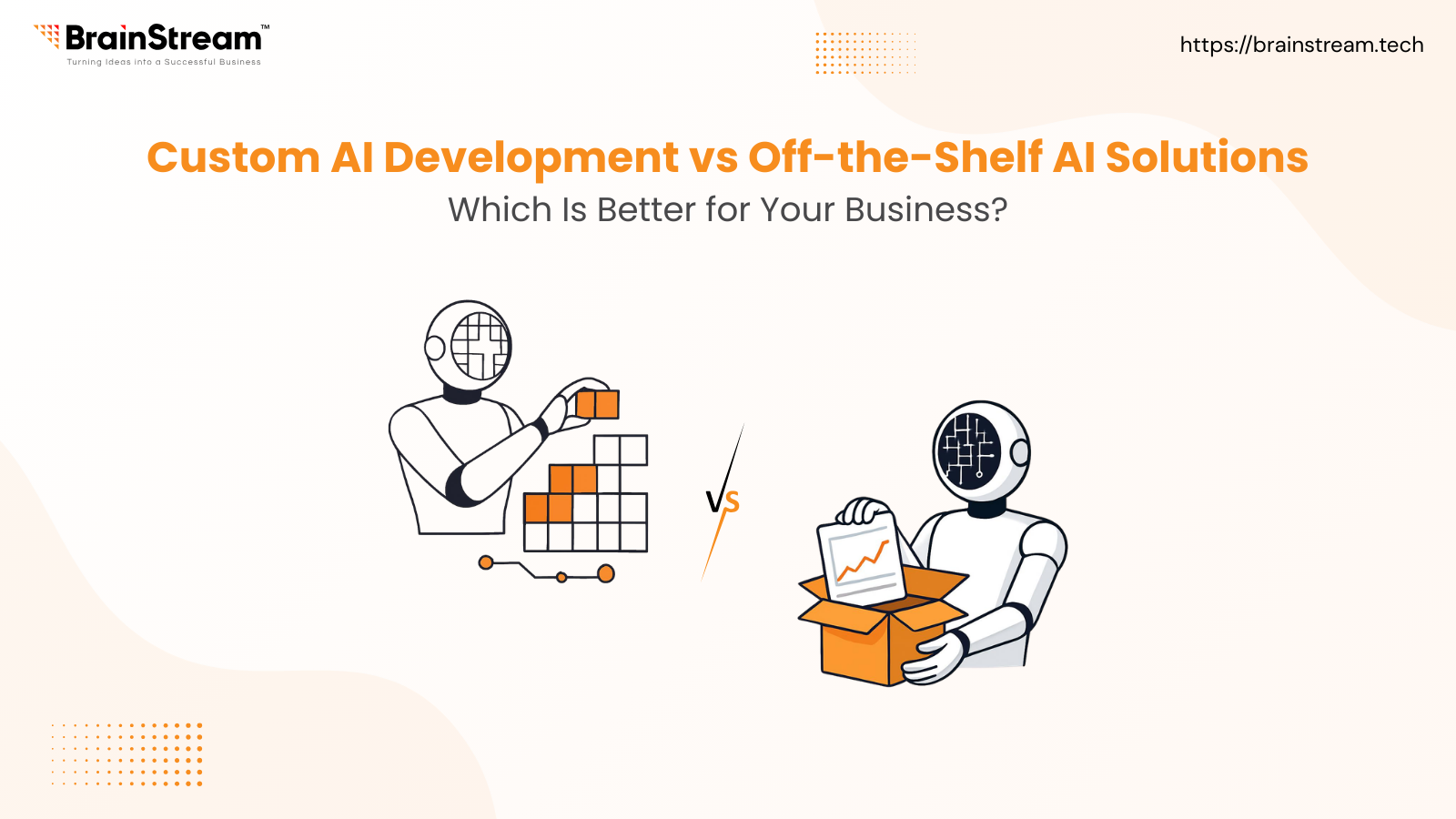
Should you build a custom AI solution tailored specifically to your organisation, or should you adopt an off-the-shelf AI product that is ready to deploy?
At first glance, the answer seems simple. One is faster and cheaper. The other is powerful and flexible. But the real decision goes much deeper than cost and convenience. It affects your scalability, your operational efficiency, your data ownership, and ultimately, your competitive positioning in the market.
Let’s break this down strategically.
The Strategic Difference Most Businesses Overlook
Many companies assume AI is just another software purchase. It isn’t.
AI becomes embedded in your workflows. It influences how decisions are made. It processes sensitive business data. It evolves with your growth. That’s why choosing between custom AI development and off-the-shelf AI solutions is not just a technical decision; it’s a strategic one.
If AI is going to drive revenue, reduce operational costs, or define customer experience, your approach must align with your long-term vision.
And that’s where the two paths diverge.
What Custom AI Development Really Means
Custom AI development is the process of building artificial intelligence systems specifically for your business model, data structure, internal processes, and future goals.
It does not force your organisation to adapt to software limitations. Instead, the system is engineered around your operations.
Imagine a logistics company with complex route optimisation challenges. A generic AI tool might offer basic forecasting. But a custom AI solution can analyse historical delivery data, traffic patterns, weather conditions, fuel costs, and warehouse coordination, all integrated into one intelligent system tailored to that company’s workflow.
The result isn’t just automation. It’s optimisation.
Custom AI becomes part of your company’s intellectual property. It evolves with your data. It improves over time. And most importantly, it gives you something your competitors don’t have.
That uniqueness is where long-term value lives.
Why Custom AI Development Creates Competitive Advantage
Here’s a truth many executives realise too late: when everyone uses the same tools, no one has an advantage.
Off-the-shelf AI products are available to anyone willing to pay a subscription fee. That means your competitors can deploy the same algorithms, dashboards, and automation features.
Custom AI development changes that equation.
When your models are trained on your proprietary data and built around your specific operational challenges, you create a defensible system. It becomes difficult for competitors to replicate your performance because they don’t have your data or architecture.
Over time, this gap widens.
The AI learns from your customers. It adapts to your market. It becomes smarter within your ecosystem. That’s when AI transforms from a tool into a strategic asset.
The Reality of Off-the-Shelf AI Solutions
Off-the-shelf AI solutions, on the other hand, are pre-built software platforms designed to serve broad market needs. They are practical, accessible, and often powerful, but they are generalised.
They work exceptionally well when your requirements are standard.
For example, if you need a chatbot to answer common customer questions, a ready-made AI chatbot platform may solve your problem quickly. If you need AI-powered email marketing automation, many SaaS tools can deliver results within days.
These solutions offer speed. They offer simplicity. And for many startups or growing businesses, they offer a low-risk entry into AI adoption.
But here’s the limitation.
Because these tools are built for the masses, they cannot deeply adapt to your unique business logic. You operate within their boundaries. Your customisation is limited to configuration options.
At scale, those boundaries start to matter.
Cost: The Most Misunderstood Factor
Many decision-makers focus only on upfront costs.
Custom AI development requires a higher initial investment. It involves planning, data preparation, model training, testing, integration, and ongoing optimisation.
Off-the-shelf AI appears cheaper because it typically operates on a subscription model.
But long-term cost tells a different story.
Over three to five years, subscription fees accumulate. Add-on features increase expenses. Integration adjustments require additional spending. Vendor pricing changes impact your budgeting. And switching platforms later can be costly and disruptive.
Meanwhile, custom AI becomes an owned asset. While it requires maintenance, you are not locked into recurring licensing structures that escalate with growth.
The real question isn’t “Which is cheaper today?”
It’s “Which delivers better total ROI over time?”
Scalability and Long-Term Vision
Scalability is where the difference becomes more visible.
Off-the-shelf AI works well when your processes remain within common use cases. But as your business expands, entering new markets, handling larger datasets, and introducing new products, you may encounter structural limitations.
Custom AI systems, by contrast, are designed with your roadmap in mind. They can be architected to handle data growth, integrate with evolving systems, and incorporate advanced analytics as your needs mature.
If your company plans aggressive growth or digital transformation, scalability should weigh heavily in your decision.
Data Ownership and Security Considerations
Data is one of your most valuable assets.
With off-the-shelf AI tools, your data is often processed and stored on vendor-managed infrastructure. While reputable providers maintain high security standards, you remain dependent on third-party compliance frameworks and policies.
For industries such as healthcare, fintech, logistics, and enterprise SaaS, this dependency can introduce regulatory and operational risks.
Custom AI development provides stronger control over data governance. You decide where the data lives, how it’s encrypted, how it’s accessed, and how it complies with regional regulations.
For organisations operating under strict compliance requirements, this control is not optional; it is critical.
When Off-the-Shelf AI Makes Strategic Sense
Despite its limitations, off-the-shelf AI should not be underestimated.
It is ideal when:
- AI supports operations but is not central to revenue generation
- Budget constraints require controlled experimentation
- You need rapid implementation
- Your use case is standard and widely supported
For early-stage companies or businesses testing AI viability, this approach reduces risk and accelerates adoption.
Sometimes speed matters more than perfection.
When Custom AI Development Becomes the Better Investment
Custom AI development becomes strategically powerful when:
- AI directly impacts revenue
- Your workflows are complex
- You rely on proprietary data
- Competitive differentiation is critical
- Long-term scalability is a priority
If AI is going to define how your company competes in the market, customisation is often the smarter long-term decision.
The Hybrid Strategy: A Practical Path Forward
Interestingly, many mature organisations adopt a hybrid strategy.
They begin with off-the-shelf AI tools to validate use cases and measure early ROI. Once they confirm value and identify limitations, they transition toward custom AI development for deeper integration and scalability.
This phased approach balances speed with strategic growth.
It allows businesses to learn before investing heavily and build confidently.
So, Which Is Better for Your Business?
There is no universal winner.
If you prioritise speed, simplicity, and lower upfront investment, off-the-shelf AI solutions provide immediate value.
If you prioritise scalability, differentiation, data ownership, and long-term ROI, custom AI development delivers a stronger strategic advantage.
The better choice depends on your growth stage, operational complexity, competitive landscape, and long-term ambition.
AI is not just software.
It’s infrastructure for your future.
Choose accordingly.

Manish Khilwani 

Co-Founder at BrainStream Technolabs, he focuses on building people-first, scalable eCommerce and digital products that help brands grow with clarity and innovation.
Share :


Related Blog
AI Development
Top 10 Agentic AI Frameworks Powering Autonomous Systems in 2026
Artificial Intelligence has evolved rapidly over the past few years. We moved from predictive models to generative AI, and now we are entering the era of Agentic AI systems capable of planning, reasoning, acting, and continuously adapting to achieve defined...
AI Development
The AI Renaissance of 2026: From Generative Tools to Autonomous Intelligence
The year 2026 marks a pivotal chapter in human history. We have officially moved past the "AI Hype" phase of 2023-2024 and entered the era of Functional Integration. If 2025 was about experimenting with Large Language Models (LLMs), 2026 is...
AI Development
ChatGPT OS: How OpenAI’s Intelligence Layer Is Reshaping Business Software in 2026
In 2026, the way businesses build and use software is undergoing a structural transformation. We are moving from interface-driven applications to intent-driven systems. At the centre of this shift is ChatGPT OS, an intelligence layer that is beginning to function...


Keep up-to-date with our newsletter.
Sign up for our newsletter to receive weekly updates and news directly to your inbox.