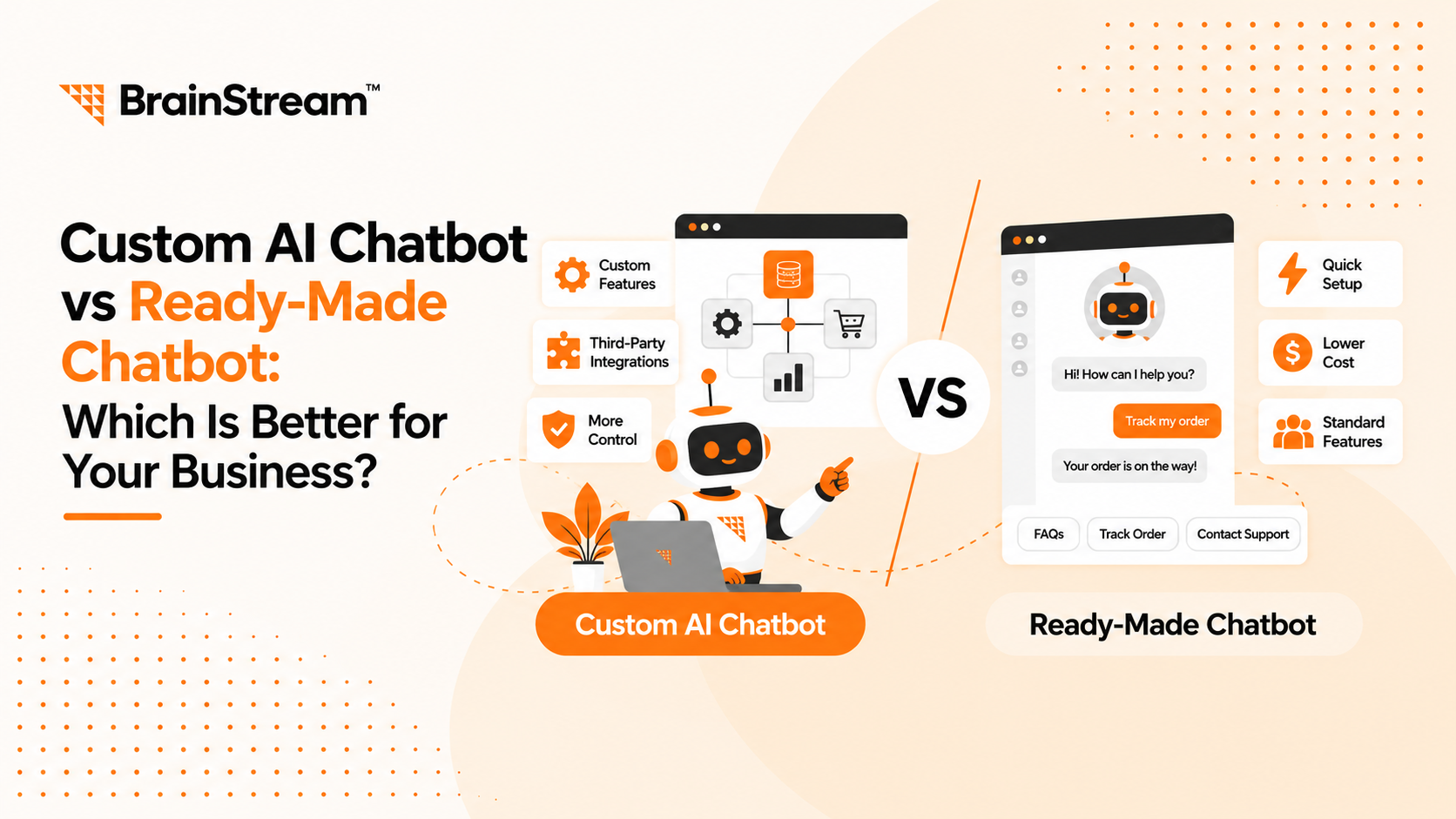
Custom AI Chatbot vs Ready-Made Chatbot: Which Is Better for Your Business?
AI chatbots are changing how businesses communicate with customers, manage inquiries, and handle everyday tasks. From answering simple questions to supporting sales teams, chatbots now play an important role in business operations.
However, choosing the right chatbot is not always easy.
Should you use a ready-made AI chatbot that works with minimal setup? Or should you invest in a custom AI chatbot built around your business needs?
Both options have benefits. However, their costs, features, flexibility, and long-term value can be very different.
A ready-made chatbot is usually better for businesses that need a quick, affordable solution for common tasks. A custom AI chatbot is often more suitable for companies that need advanced integrations, unique workflows, greater control, or industry-specific features.
In this guide, we compare custom AI chatbots and ready-made chatbots to help you make an informed decision in 2026.
What Is a Custom AI Chatbot?
A custom AI chatbot is a conversational application designed around a company’s specific requirements.
Unlike a standard chatbot platform, a custom solution can connect with existing software and support unique business processes.
For example, an online store might need a chatbot that checks live inventory, tracks orders, and recommends products.
A manufacturing company may need a chatbot that answers technical product questions and sends qualified inquiries to its sales team.
Developers can build these features using large language models (LLMs), APIs, databases, and business applications.
Key Features of Custom AI Chatbots
- Custom workflows: Automate tasks that follow your business processes.
- CRM integration: Connect conversations with customer records and sales pipelines.
- Business data access: Retrieve relevant information from approved company sources.
- Personalized conversations: Use customer context when appropriate and permitted.
- Multilingual support: Assist customers in different languages.
- Advanced automation: Handle tasks such as booking requests, lead qualification, and order updates.
- Custom reporting: Track chatbot performance using metrics relevant to your business.
A custom chatbot does not always require training an AI model from scratch. Developers can use existing AI models and create the application, integrations, and controls around them.
What Is a Ready-Made AI Chatbot?
A ready-made AI chatbot is a chatbot solution provided through an existing software platform.
Businesses can usually configure these chatbots without developing an application from the beginning.
Many platforms provide conversation templates, website widgets, knowledge-base connections, and integrations with popular business tools.
Examples include Intercom Fin, Tidio Lyro, Zendesk AI, and HubSpot’s AI-powered customer support tools.
Features and pricing vary by platform and subscription plan.
Key Features of Ready-Made AI Chatbots
- Faster setup and deployment
- Prebuilt website chat widgets
- Common customer support workflows
- Standard reporting dashboards
- Knowledge-base integrations
- Vendor-managed software updates
- Subscription-based pricing
- Basic or advanced customization, depending on the platform
Ready-made solutions can be a good starting point for companies that want to introduce AI-powered support without building their own system.
However, some businesses may face limitations when they need unusual integrations or complex workflows.
Custom AI Chatbot vs Ready-Made Chatbot: Key Differences
Before choosing a chatbot, compare the main differences.
| Feature | Custom AI Chatbot | Ready-Made AI Chatbot |
|---|---|---|
| Development | Built for specific business needs | Uses an existing platform |
| Setup time | Usually longer | Usually faster |
| Initial investment | Generally higher | Often lower |
| Customization | Highly flexible | Depends on platform capabilities |
| CRM integration | Can support custom integrations | Often provides prebuilt connectors |
| Business workflows | Designed around specific processes | Limited to available configuration and APIs |
| Data control | Depends on architecture and hosting | Depends on vendor policies and settings |
| AI model selection | May support different models | Often controlled by the provider |
| Maintenance | Managed by the business or development partner | Core platform managed by the vendor |
| Scalability | Depends on solution architecture | Depends on subscription limits and platform |
| Long-term cost | Hosting, APIs, support, and development | Subscription, usage, and add-on charges |
| Best suited for | Complex or specialized requirements | Common and standardized use cases |
Quick answer: Choose a ready-made chatbot for speed and simplicity. Choose a custom AI chatbot when business-specific workflows, integrations, or technical control justify the additional investment.
7 Important Factors to Consider Before Choosing an AI Chatbot
1. Business Requirements
Start by identifying what you want the chatbot to achieve.
Do you need a chatbot to answer frequently asked questions? Or should it perform tasks inside your business applications?
A ready-made chatbot may be enough for standard customer support.
However, complex business processes often need additional customization.
For example, a logistics company may want a chatbot that checks shipment information across several systems.
A custom solution may be more suitable if existing platforms cannot support that process.
2. Development and Setup Time
Ready-made chatbots generally take less time to implement.
Some platforms allow businesses to create basic chatbot experiences using existing documentation and configuration tools.
However, setup time increases when complex integrations, security reviews, and content preparation are required.
Custom chatbot development usually involves several stages:
- Understanding business requirements
- Selecting suitable AI technology
- Designing conversation workflows
- Building integrations
- Preparing business knowledge sources
- Testing responses and security
- Deploying and monitoring the chatbot
The timeline depends on the number of features and the complexity of existing systems.
3. Customization and Flexibility
Customization is one of the biggest differences between the two options.
Ready-made platforms offer configuration settings and predefined features. Some also support custom APIs, actions, and integrations.
However, businesses must work within the platform’s supported capabilities.
Custom AI chatbots offer more flexibility in application design.
For example, developers can create a chatbot that:
- Checks available inventory before recommending products.
- Generates quotations using approved pricing rules.
- Collects customer requirements.
- Creates support tickets in an internal system.
- Connects with ERP and CRM software.
- Escalates complex questions to employees.
These features require suitable integrations, permissions, and testing.
4. AI Chatbot Integration with Existing Systems
A chatbot becomes more useful when it can access the right business information.
Many companies already use CRM, ERP, eCommerce, and customer support platforms.
Common integrations include:
- Salesforce
- HubSpot
- Shopify
- Shopware
- Odoo
- Microsoft Dynamics 365
- Internal databases
- Custom business applications
Ready-made platforms may already support some of these systems.
However, a custom chatbot can be built for specialized APIs or internal applications.
Before choosing a solution, confirm that the required integrations are technically possible and secure.
5. Data Security and Privacy
Security should be a priority for every AI chatbot project.
Chatbots may process personal information, customer messages, or internal company data.
Therefore, businesses should evaluate:
- Data storage and retention
- Access permissions
- Encryption
- Vendor data-processing agreements
- Hosting requirements
- Audit logs
- Compliance obligations
- Protection against unauthorized data access
A custom chatbot can provide additional architectural control, but this does not automatically make it more secure.
Similarly, ready-made platforms may provide mature security features.
The right choice depends on your requirements and the controls offered by each solution.
6. AI Chatbot Development and Maintenance Cost
Ready-made chatbots usually involve recurring subscription or usage charges.
Some platforms charge based on features, users, conversations, or AI resolutions.
Custom AI chatbots typically require a larger initial development investment.
Ongoing expenses may include:
- AI model API usage
- Hosting and infrastructure
- Database and storage
- Security updates
- Monitoring and testing
- Software maintenance
- New feature development
However, a custom chatbot may provide better long-term value when it replaces expensive manual processes or supports important business workflows.
The best comparison is the total cost of ownership, not only the setup price.
7. Long-Term Scalability
Your chatbot requirements may change as your business grows.
A simple support chatbot may later need order processing, customer verification, or integration with internal systems.
Some ready-made platforms support these additions through advanced plans or integrations.
However, businesses with highly specialized requirements may eventually reach platform limitations.
A well-designed custom chatbot can offer more control over future development.
Still, scaling a custom application requires reliable infrastructure, monitoring, and maintenance.
How Much Does a Custom AI Chatbot Cost Compared to a Ready-Made Chatbot?
The cost of an AI chatbot depends on its features, usage, integrations, security requirements, and support needs.
There is no single price that applies to every project.
Ready-Made AI Chatbot Costs
Ready-made solutions commonly use subscription or usage-based pricing.
Businesses may need to pay for:
- Monthly or annual subscriptions
- Additional users or support seats
- AI conversations or resolutions
- Premium integrations
- Advanced automation
- Extra reporting features
A platform that appears inexpensive at first may become more costly as usage increases.
Custom AI Chatbot Development Costs
Custom chatbot pricing depends on development work and ongoing operational expenses.
A basic AI assistant that answers questions from company documents may require less development than an enterprise chatbot.
For example, a chatbot connected to a CRM, ERP, and order management system may need additional integration and security work.
| Cost Component | Ready-Made Chatbot | Custom AI Chatbot |
|---|---|---|
| Setup | Usually low to moderate | Depends on development scope |
| Subscription | Common | Not always required |
| AI API usage | Often included or usage-based | Usually usage-based |
| Integrations | Included, add-on, or custom | Built into project scope |
| Maintenance | Vendor manages core platform | Requires defined support ownership |
| Additional features | Plan upgrades or custom development | Additional development |
| Hosting | Usually vendor-managed | Cloud, managed service, or private infrastructure |
Which is more cost-effective?
A ready-made chatbot may be more economical for simple and predictable requirements.
A custom chatbot may become more valuable when automation saves significant staff time or supports unique business processes.
However, businesses should estimate development, maintenance, and usage costs before making a decision.
When Should You Choose a Ready-Made AI Chatbot?
A ready-made chatbot may be the right choice if your business:
- Needs a chatbot quickly.
- Has a limited initial budget.
- Wants to answer common customer questions.
- Uses standard software integrations.
- Does not have a technical development team.
- Prefers vendor-managed infrastructure.
- Has relatively simple automation requirements.
Example: Small Online Store
Imagine a small online store receiving questions about shipping, returns, and product availability.
A ready-made chatbot connected to its help center may answer many of these questions.
The store can introduce AI support without building a complex application.
As the business grows, it can review whether additional customization is necessary.
When Should You Invest in a Custom AI Chatbot?
A custom AI chatbot may be a better option when your business needs more advanced features.
Consider custom development if you:
- Need integrations with internal business applications.
- Have complex sales or support workflows.
- Require specialized industry knowledge.
- Want control over the chatbot interface and architecture.
- Need custom access permissions and approval processes.
- Want to automate tasks across several systems.
- Have requirements that existing platforms cannot support.
Example: Manufacturing Company
A manufacturing company receives inquiries about technical specifications, quotations, and product availability.
A basic chatbot can answer common questions.
However, the company may need a more advanced system that can:
- Understand customer product requirements.
- Search approved technical documentation.
- Retrieve current product information.
- Send inquiries to the right sales department.
- Create lead records in the CRM.
- Request employee approval before sharing quotations.
A custom AI chatbot can connect these processes when appropriate integrations are available.
This may reduce repetitive work and help sales teams respond more efficiently.
AI Chatbot Use Cases Across Different Industries
The right chatbot solution also depends on your industry.
| Industry | Common Chatbot Use Cases | Suitable Approach |
|---|---|---|
| eCommerce | FAQs, order tracking, product guidance | Ready-made or custom |
| Healthcare | Appointment scheduling, general information | Depends on privacy and integration needs |
| Manufacturing | Product inquiries, technical support, lead qualification | Often custom for complex requirements |
| Real Estate | Property inquiries, lead collection, viewing requests | Ready-made or custom |
| Banking and Finance | Account assistance, support, secure workflows | Often specialized and tightly controlled |
| Education | Admissions inquiries, course information | Ready-made or custom |
| SaaS | Onboarding, product support, account workflows | Depends on product complexity |
| Logistics | Shipment tracking, order updates, customer support | Often custom for internal integrations |
For sensitive or regulated industries, security and compliance requirements should guide the decision.
Can a Ready-Made Chatbot Be Customized Later?
Yes. Many ready-made chatbot platforms provide configuration options and API integrations.
Businesses may be able to add:
- Custom conversation flows
- CRM connections
- Knowledge-base content
- External API actions
- Human support handoffs
- Brand-specific interfaces
However, customization depends on the selected platform.
Before subscribing, ask whether the vendor supports your current requirements and planned future features.
Also confirm data export options, integration limits, and cancellation conditions.
These details can help avoid difficult platform migrations later.
What Is the Role of RAG in Custom AI Chatbot Development?
Retrieval-Augmented Generation, or RAG, allows an AI chatbot to retrieve information from selected sources before generating a response.
For example, a company can connect a chatbot to its product documentation, support guides, and approved internal resources.
When a customer asks a question, the system can retrieve relevant content and use it to prepare an answer.
Benefits of RAG Chatbots
- Access to relevant company knowledge
- Easier knowledge updates
- More context-aware answers
- Potentially fewer unsupported responses
- Support for technical documentation
- Possible source references in chatbot replies
However, RAG does not guarantee accurate answers.
Businesses still need content quality checks, access controls, testing, and response monitoring.
Both custom and ready-made chatbot platforms may support RAG-based features.
How to Calculate AI Chatbot ROI
Return on investment (ROI) helps businesses understand whether a chatbot provides financial value.
Start by identifying the tasks the chatbot can handle.
Then estimate the time and costs involved.
Example ROI Calculation
Suppose a company receives 2,000 customer inquiries every month.
Each inquiry currently requires five minutes of employee time.
If a chatbot successfully handles 40% of inquiries without human assistance, the business could save approximately 67 staff hours per month.
However, the financial benefit depends on actual staff costs, chatbot expenses, and whether the saved time can be used productively.
A simplified calculation is:
ROI (%) = [(Financial Benefits − Total Chatbot Costs) ÷ Total Chatbot Costs] × 100
Include development, subscription, API, hosting, support, and maintenance costs.
Also track customer satisfaction, response quality, and successful task completion.
Do not rely only on the number of chatbot conversations.
How BrainStream Technolabs Can Help with Custom AI Chatbot Development
Every business has different customer requirements and internal processes.
A standard chatbot may be enough for simple support tasks. However, specialized workflows often need a more flexible solution.
BrainStream Technolabs provides software development and integration services that can support custom AI chatbot projects.
Depending on your requirements, a custom solution may include:
- AI chatbot development for websites and applications
- LLM and API integrations
- CRM and ERP connectivity
- Company knowledge-base integration
- RAG-based chatbot functionality
- eCommerce chatbot development
- Automated lead qualification
- Custom chatbot dashboards
- Monitoring and ongoing support
Our team can help assess the technical requirements and determine which development approach fits your business.
Looking for a Custom AI Chatbot for Your Business?
Do you need more than a basic chatbot?
Whether you want to automate customer support, connect an AI assistant with your CRM, or build a knowledge-based chatbot, the first step is understanding your requirements.
Discuss your AI chatbot project with BrainStream Technolabs.
Frequently Asked Questions
1. What is the main difference between a custom AI chatbot and a ready-made chatbot?
A custom AI chatbot is developed around specific business requirements. A ready-made chatbot uses an existing software platform with predefined features and configuration options. The main differences involve flexibility, development time, integrations, maintenance, and cost.
2. Is a custom AI chatbot better than a ready-made chatbot?
Not always. A custom chatbot is often better for complex workflows and specialized integrations. A ready-made chatbot can be more practical for simple customer support, faster deployment, and lower initial investment.
3. How much does custom AI chatbot development cost?
Costs depend on the chatbot’s features, integrations, AI models, security requirements, and maintenance needs. Businesses should request a project-specific estimate rather than rely on a fixed price.
4. Can an AI chatbot integrate with CRM software?
Yes. AI chatbots can connect with CRM platforms such as Salesforce and HubSpot using supported integrations or custom APIs. Available features depend on the CRM, chatbot platform, and access permissions.
5. Are custom AI chatbots secure?
Custom chatbots can be designed with encryption, access controls, monitoring, and other security measures. However, security depends on implementation, infrastructure, maintenance, and how data is handled.
6. Can I build an AI chatbot using ChatGPT or OpenAI models?
Yes. Developers can build custom chatbot applications using OpenAI APIs and compatible AI models. The application can include business-specific interfaces, knowledge sources, integrations, and workflow controls.
7. Can AI chatbots replace human customer support teams?
AI chatbots can automate repetitive questions and selected support tasks. However, human employees remain important for complex issues, sensitive requests, and situations requiring judgment or escalation.
8. What is the best AI chatbot for an eCommerce business?
The best solution depends on the store’s requirements. A ready-made chatbot may work well for FAQs and basic support. A custom chatbot may be better when the store needs advanced product recommendations, order integrations, or specialized workflows.
9. How long does it take to develop a custom AI chatbot?
Development time varies with project complexity. A simple proof of concept may take a few weeks, while a production chatbot with multiple integrations, security controls, and testing can take longer.
10. Can a business start with a ready-made chatbot and move to a custom solution later?
Yes. Many businesses can begin with a ready-made platform and evaluate custom development as requirements grow. However, migration effort depends on the original platform’s data export, integration, and portability options.
Conclusion: Custom AI Chatbot or Ready-Made Chatbot?
Both custom and ready-made AI chatbots can help businesses improve customer communication and automate repetitive work.
A ready-made chatbot is often a practical option for businesses that need a quick solution with common features and manageable setup costs.
A custom AI chatbot is worth considering when your business requires specialized workflows, internal integrations, or greater technical flexibility.
The right choice depends on your goals, budget, existing software, and future plans.
Before investing, identify your most important chatbot use cases and compare the total cost of each option.
Need help planning a custom AI chatbot?
Connect with BrainStream Technolabs to discuss your application requirements and explore a suitable development approach.

Manish Khilwani
Author
Co-Founder at BrainStream Technolabs, he focuses on building people-first, scalable eCommerce and digital products that help brands grow with clarity and innovation.
Table of contents
BLOGS
Learn & Grow with Us
Get the latest updates on trends and strategies that shape the business world. Our insights are here to keep you informed and inspired.
Custom AI Chatbot vs Ready-Made Chatbot: Which Is Better for Your Business?
AI chatbots are changing how businesses communicate with customers, manage…
Top 5 Symfony Development Companies in India 2026
Choosing the right development company can make a big difference…
How Much Does AI Integration into a Symfony Application Cost in 2026?
Adding artificial intelligence to your Symfony application can improve customer…
Modernizing Legacy Symfony Applications with AI: Where to Start
Your Symfony application still runs your business. However, adding features…