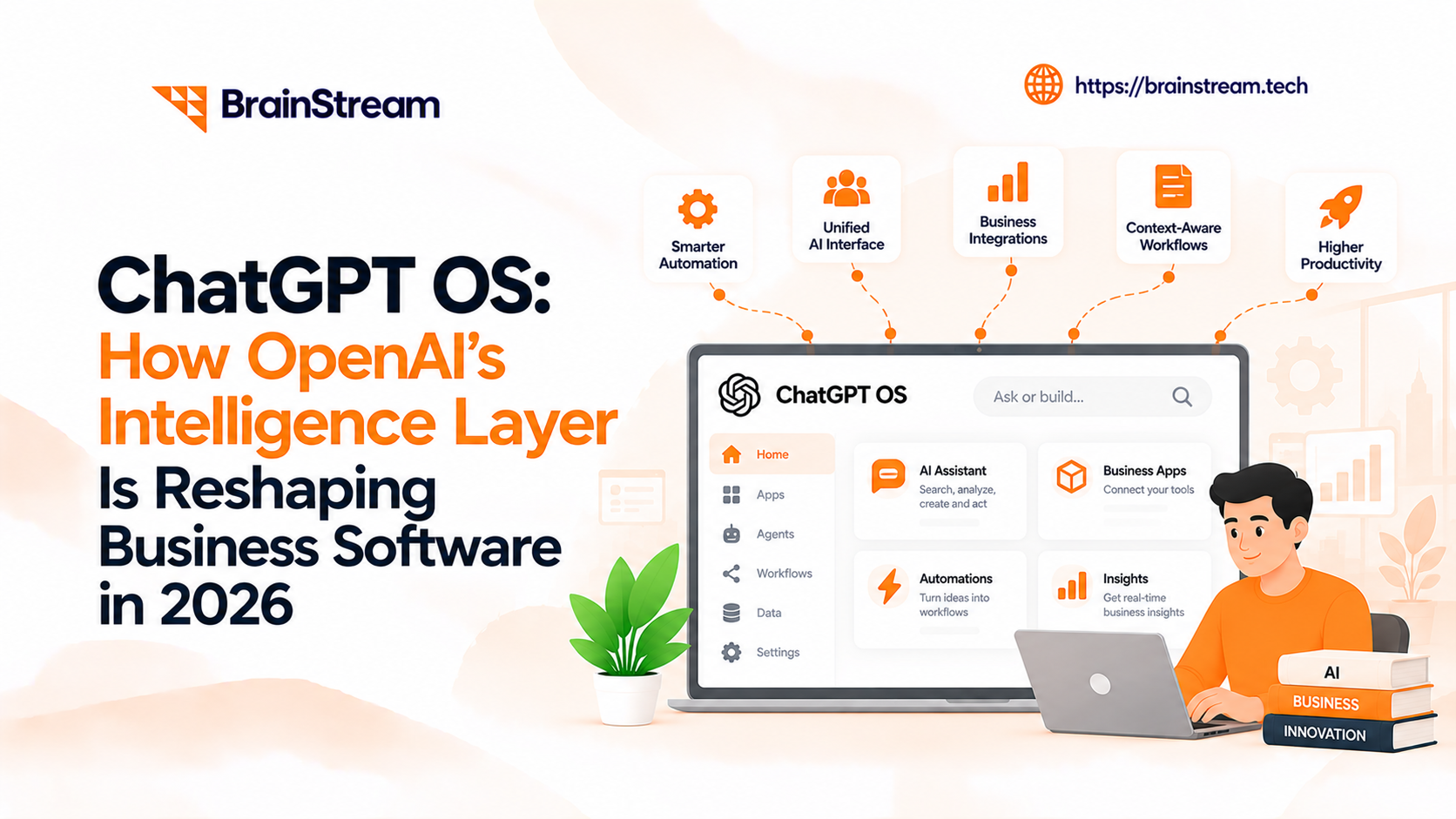
ChatGPT OS: What It Means for Business Software in 2026
ChatGPT OS is an informal term for the idea of ChatGPT acting as an operating layer for business software. Instead of navigating multiple dashboards, users describe their goals in natural language, while connected AI tools help retrieve information, coordinate workflows, and perform permitted actions.
For businesses, this points toward a future where CRM, ERP, analytics, and internal applications become easier to access through conversation.
For example, a sales manager could ask an AI assistant to summarize open opportunities from an authorized CRM integration. A support team might retrieve troubleshooting information from company documentation without switching between multiple applications.
However, these capabilities depend on available integrations, user permissions, security controls, and the specific AI tools deployed. ChatGPT does not automatically have access to every business system.
This article explores what the ChatGPT OS concept means, which capabilities are already available, and how organizations can prepare their software for more connected AI workflows.
Is ChatGPT OS an Official OpenAI Product?
“ChatGPT OS” is a descriptive industry term, not the official name of a standalone operating system announced by OpenAI.
OpenAI provides ChatGPT, connected applications, tools for building integrations, and agentic capabilities that can help users work across supported software systems. These technologies make conversational workflows possible, but they do not replace Windows, macOS, or traditional enterprise software operating systems.
For example, apps in ChatGPT can connect conversational experiences with supported services. Meanwhile, the ChatGPT agent demonstrates how AI can carry out certain multistep workflows using tools.
Together, these developments support the broader idea of AI becoming a conversational interface for business applications. However, the term “ChatGPT OS” should be understood as a concept rather than an official OpenAI product designation.
To understand the broader context behind these developments, read how OpenAI became the face of the AI revolution and how its research and products contributed to wider AI adoption.
From Software Interfaces to Conversational Infrastructure
Traditional enterprise software has always required training. Whether it was a CRM, ERP, or analytics dashboard, businesses invested heavily in onboarding teams to “use the system correctly.” The friction was accepted as unavoidable.
An AI operating layer, as imagined in the ChatGPT OS concept, could reduce this friction by connecting natural-language requests with approved business applications.
For example, a manager could request performance metrics from a connected CRM instead of navigating multiple dashboards. Similarly, an authorized AI agent could prepare parts of a product launch workflow using information from connected systems.
Rather than replacing CRM platforms, finance software, or internal databases, this approach would provide a conversational interface across supported tools. However, available functionality depends on APIs, permissions, integrations, and human approval requirements.
Unlike traditional rule-based automation, some AI agent systems can interpret goals and select actions within defined limits. Even so, complex workflows still require testing, error handling, and appropriate oversight.
This shift is part of wider agentic AI trends in 2026, as organizations explore AI agents, domain-specific models, and more autonomous business workflows.
Healthcare organizations exploring conversational interfaces should first assess their CRM for healthcare industry requirements, particularly patient data security, EHR integration, and approved information access.
How to Prepare Your Business Software for ChatGPT OS
Businesses do not need to replace their existing applications to prepare for AI-powered workflows. Instead, they can improve how their systems expose data, manage permissions, and support secure integrations.
1. Identify Repetitive Business Workflows
Start by listing processes that consume employee time, such as customer follow-ups, report generation, document handling, or order updates.
Example: A sales manager could ask an AI assistant to prepare a summary of open deals from the previous month.
2. Check How Your CRM and ERP Can Connect to ChatGPT
Review whether your existing CRM, ERP, and internal databases provide APIs, supported integrations, and appropriate authentication methods.
For example, a sales manager could use an authorized integration to request a summary of open deals or customer follow-ups from their CRM.
If you are selecting a new platform, choosing a CRM that supports AI integrations can help your business plan for reporting, automation, and future workflow requirements.
3. Define Permissions and Audit Logging
Decide what information AI tools can access, which actions they can perform, and when human approval is required.
Example: An AI assistant may prepare an invoice, but a finance manager must approve it before sending.
4. Start With One AI Agent Pilot
Choose a limited workflow that has measurable business value. Connect the agent only to the systems and data required for that task.
Example: An AI agent could classify support requests and suggest responses for staff review.
5. Measure Business Results
Track time saved, task completion, response accuracy, error rates, and ongoing operational costs.
Example: Compare the average time spent preparing weekly sales reports before and after introducing an AI assistant.
Starting small allows businesses to test the technology, identify risks, and improve the solution before expanding its use.
Why ChatGPT OS Is More Than Just AI Integration
Many businesses believe they are already “AI-enabled” because they use chatbots or analytics tools. However, integrating AI into existing software is very different from building on an AI-native operating layer.
The ChatGPT OS concept suggests a different approach to software design. Rather than relying only on dashboards, menus, and manual navigation, businesses may increasingly offer conversational interfaces for selected workflows.
For example, a traditional chatbot may answer customer questions, while an integrated AI assistant may retrieve approved information or initiate supported actions.
Businesses evaluating these approaches can compare custom vs ready-made AI chatbots to understand the trade-offs between customization, integrations, security, and implementation effort.
In traditional SaaS products, competitive advantage was built through feature expansion, more dashboards, more filters, and more configuration options. Complexity was often equated with capability. But in a ChatGPT OS environment, complexity is abstracted away. The system’s intelligence becomes the feature.
The value no longer lies in how many buttons your platform has. It lies in how deeply it understands user intent and how effectively it executes outcomes.
This forces businesses to rethink product strategy. Instead of asking, “What features should we build next?” companies must ask, “What outcomes should we enable next?”
That shift from features to outcomes is where ChatGPT OS becomes a strategic differentiator.
The Rise of Orchestrated Workflows
A central idea behind ChatGPT OS-style software is workflow orchestration. Businesses often use separate applications for sales, marketing, finance, customer support, and reporting. As a result, employees spend time switching between systems.
With suitable integrations, an AI agent could retrieve authorized information, prepare a revenue forecast, or draft updates for review. However, actions affecting financial records or external communication should follow defined permissions and approval processes.
Organizations exploring these possibilities can compare AI automation companies based on technical expertise, integration capabilities, data security, and ongoing support.
This approach may help reduce repetitive work, but results depend on the quality of integrations and the business processes being automated.
Multimodal Intelligence as the New Standard
Modern AI systems can work with different types of information, including text, images, documents, and audio, depending on the model and product capabilities.
For businesses, multimodal AI may support document analysis, image understanding, customer assistance, and information retrieval. For example, an employee could use a supported AI tool to summarize an uploaded report or examine product information.
OpenAI also offers separate technologies for different use cases, including video generation. However, these features are not all part of a single product called ChatGPT OS.
Businesses should evaluate each capability separately, including its availability, data privacy requirements, accuracy, and integration options.
Accelerating Development in the ChatGPT OS Ecosystem
The impact of ChatGPT OS is not limited to end users. It is also reshaping how software itself is built.
Businesses maintaining older software can also explore how to modernise legacy applications with AI, including AI-assisted code analysis, testing, and modernization planning.
Modern coding models such as GPT-5 Codex allow developers to collaborate with AI during application development. Complex logic can be generated, reviewed, and optimised in conversational form. Legacy systems can be modernised with less manual rewriting. Security standards can be embedded during code generation.
As a result, development timelines shrink significantly. Prototyping becomes conversational. Testing becomes iterative and intelligent. Documentation becomes automatically generated and continuously updated.
For businesses, this reduces time-to-market and increases agility, two factors that are critical in competitive industries.
Monetization Opportunities with AI-Powered Business Software
As ChatGPT OS matures, entirely new revenue models are emerging. Businesses are no longer monetising only software access; they are monetising intelligence.
For example, organisations can deploy AI agents that handle procurement, compliance, onboarding, or customer acquisition as subscription-based services. These agents operate autonomously across systems and deliver measurable outcomes.
eCommerce provides another example. Emerging AI shopping agents may help customers discover products, compare options, and complete supported shopping tasks. Retailers should prepare accurate product data and reliable integrations before adopting these workflows.
Other companies may monetise micro-intelligence charging per generated legal document, per financial analysis, or per AI-driven insight. In performance-based models, GPT-powered agents may even earn commissions for closing sales or optimising supply chains.
AI-powered business software may create new opportunities through workflow automation, personalized customer experiences, and intelligent applications. For example, businesses can offer AI-assisted reporting, document processing, or customer support as part of their existing services. However, the commercial value depends on measurable business outcomes and ongoing operating costs.
In eCommerce, agentic commerce explores how AI agents can help customers discover products, compare options, and complete supported shopping tasks. Businesses preparing for this shift should focus on accurate product data, secure integrations, reliable checkout processes, and transparent customer experiences.
Governance, Trust, and Strategic Responsibility
Despite its promise, building on ChatGPT OS requires strategic discipline.
Before connecting AI systems to sensitive business applications, companies should establish a clear AI strategy covering data access, security, governance, and measurable business outcomes.
When AI systems gain access to sensitive data and operational authority, governance becomes essential. Organizations must define clear permission structures, ensure compliance with industry regulations, and maintain transparent audit trails.
Human oversight remains important, especially in high-stakes environments such as finance, healthcare, or legal operations. While ChatGPT OS enhances reasoning, responsible deployment includes human-in-the-loop validation.
Equally important is brand alignment. AI agents represent your company’s voice. They must reflect your tone, policies, and values consistently across interactions.
Trust will define long-term success in the ChatGPT OS ecosystem.
The Long-Term Outlook: AI-Structured Enterprises
We are at the beginning of a larger transition from AI-assisted businesses to AI-structured enterprises.
In the coming years, ChatGPT OS will not simply support workflows; it will continuously optimise them. Systems will learn from interactions, predict inefficiencies, and automatically recommend structural improvements.
Organisations that embed ChatGPT OS deeply into their digital architecture will operate with greater agility, reduced friction, and enhanced decision intelligence.
Businesses may increasingly use AI systems to connect applications, simplify routine tasks, and help employees make decisions using authorized information.
Over time, more capable AI agents could support workflow monitoring, suggest process improvements, and coordinate selected actions across business tools. However, reliable deployment will depend on data quality, access controls, system integration, and human oversight.
Rather than adopting every emerging AI feature, organizations should identify practical use cases, measure results, and expand successful implementations gradually.
FAQs
1. What is ChatGPT OS?
ChatGPT OS is an informal term describing ChatGPT as a conversational interface for connected business applications. Instead of manually navigating multiple software systems, users can ask AI assistants to retrieve information and perform supported tasks through authorized integrations.
It is not an officially named standalone operating system from OpenAI.
2. Is ChatGPT OS available for businesses today?
There is no standalone OpenAI product officially called ChatGPT OS. However, businesses can use available ChatGPT capabilities, connected applications, and agentic tools to support workflows involving company information and approved software systems.
Availability depends on the product, plan, integrations, and permissions.
3. How can a business connect its software to ChatGPT?
Businesses can use supported connected applications or develop custom integrations using OpenAI’s developer tools and APIs.
For example, a company could connect approved CRM information to an AI assistant for sales reporting. Developers should implement authentication, access controls, testing, and appropriate approval processes before enabling actions.
4. Is it safe to give ChatGPT access to business data?
Business data can be connected to AI tools with appropriate security controls, but safety depends on the integration, permissions, product settings, and data-handling policies.
Organizations should limit access to necessary information, review retention and privacy requirements, and monitor sensitive actions. Human approval may be appropriate for financial, administrative, or other high-impact operations.
How BrainStream Technolabs Helps You Build for ChatGPT OS
As conversational AI becomes more integrated with business software, companies need secure connections between AI tools, business data, and existing applications.
BrainStream Technolabs helps businesses evaluate and implement these opportunities through:
- AI agent development: Build custom AI agents connected to approved CRM, ERP, and internal workflows.
- Custom AI development: Develop AI-powered applications, intelligent assistants, and workflow automation solutions.
- AI readiness and software modernization: Assess existing applications, API availability, security requirements, and an AI implementation roadmap. For older systems, explore software modernization opportunities before introducing AI workflows.
Planning an AI Integration for Your Business?
Whether you want to build your first AI agent or connect existing software with intelligent workflows, our team can help define a practical approach.
Talk to our AI team to discuss your project requirements.
Final Reflection
The ChatGPT OS concept points toward a future in which natural-language interfaces make business software easier to use.
Instead of replacing existing CRM, ERP, and internal applications, connected AI tools may help employees access information and complete selected workflows more efficiently.
For businesses, the opportunity is not simply adding another chatbot. It is designing secure, measurable AI workflows around real operational needs.
Organizations that combine useful integrations, responsible governance, and human expertise will be better prepared to evaluate these emerging capabilities.
Table of contents
BLOGS
Learn & Grow with Us
Get the latest updates on trends and strategies that shape the business world. Our insights are here to keep you informed and inspired.
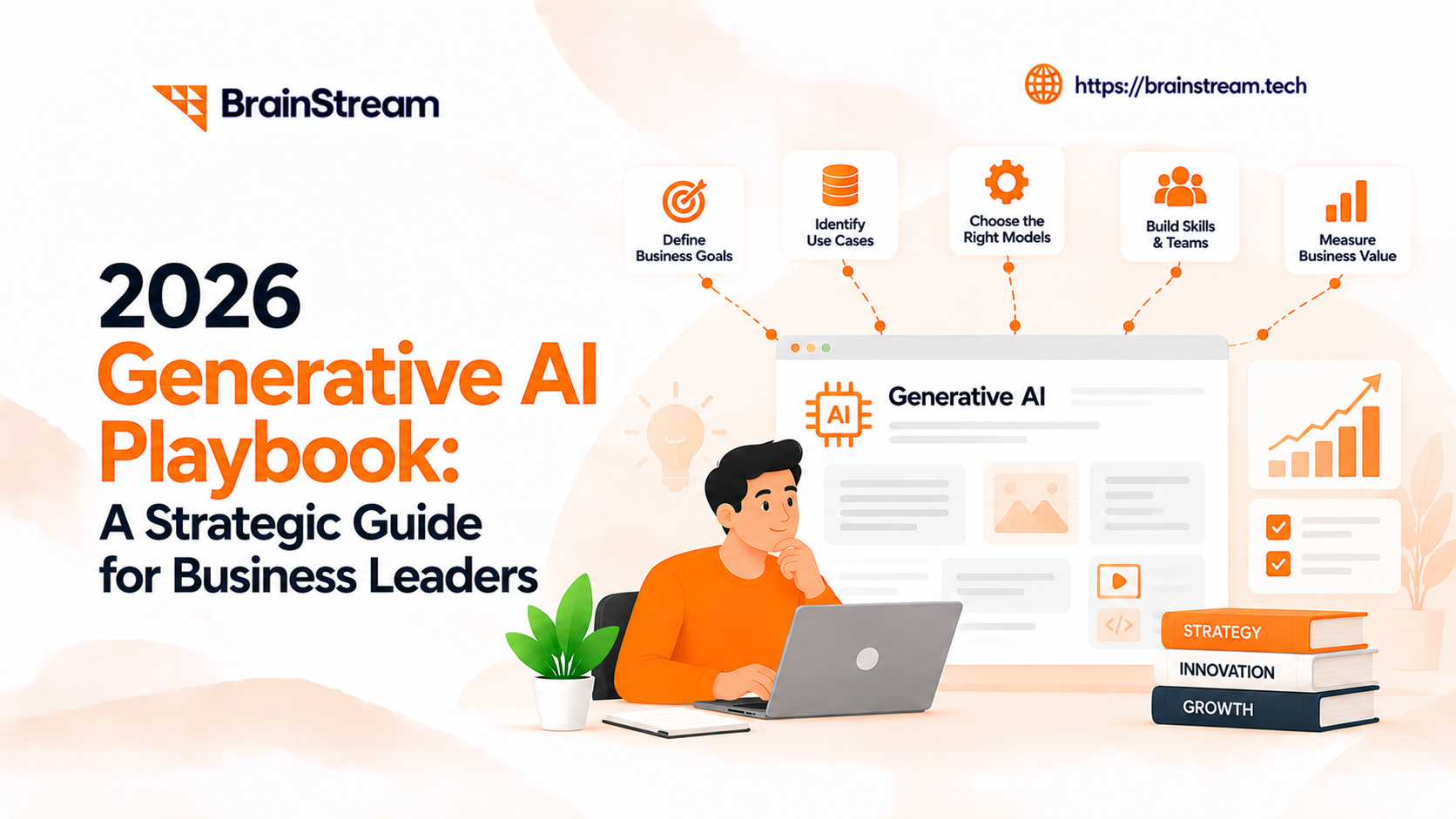
2026 Generative AI Playbook: A Strategic Guide for Business Leaders
The digital landscape has officially crossed a Rubicon. If 2023…
Agentic Commerce in 2026: How AI Agents Are Changing Online Shopping
Agentic commerce is online shopping where AI agents discover, compare,…
AI Advisory & Roadmap Services: How Businesses Build Smarter AI Strategies?
Artificial intelligence is changing how businesses operate. However, many companies…
AI Chatbots in Healthcare: Benefits and Use Cases That Are Transforming Patient Care
AI Chatbots in Healthcare are changing faster than ever. Patients…