Build vs Buy Software: How Enterprises Make the Right Decision?
Every growing business reaches a point where technology becomes a competitive advantage.
At that stage, leaders face an important question:
Should we build custom software or buy an existing solution?
The answer is not always simple.
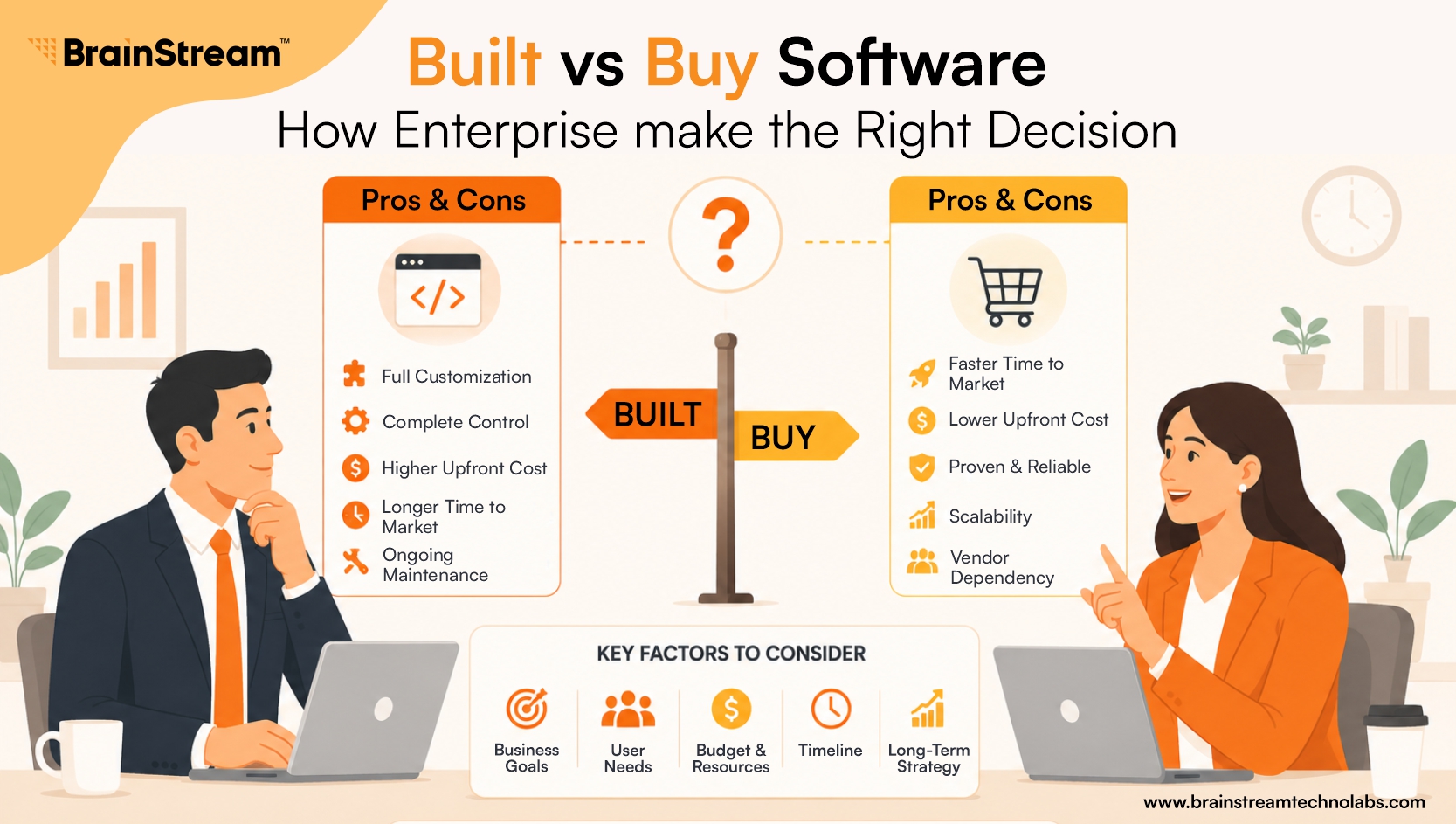
Buying software can save time and reduce upfront costs. However, it may limit flexibility and customization.
Building software gives organizations complete control. Yet it requires more planning, investment, and technical expertise.
Many enterprises struggle with this decision because the wrong choice can lead to wasted resources, operational challenges, and missed growth opportunities.
Therefore, understanding the advantages and disadvantages of both approaches is critical.
In this guide, we’ll explore how enterprises evaluate the build vs buy software decision and identify the factors that matter most.
What Does “Build vs Buy” Mean?
The build vs buy decision refers to whether a business should:
Build Software
Develop a custom solution tailored to specific business requirements.
This may involve:
- Internal development teams
- External software development partners
- Product engineering specialists
Buy Software
Purchase an existing software solution from a vendor.
Examples include:
- CRM platforms
- ERP systems
- Project management tools
- eCommerce platforms
- HR management systems
Both approaches can deliver value. The best choice depends on business goals and operational needs.
Why the Build vs Buy Decision Matters?
Technology investments impact almost every part of a business.
A poor decision can result in:
- Higher costs
- Limited scalability
- Operational inefficiencies
- Integration challenges
- Security concerns
On the other hand, the right decision can improve productivity, customer experience, and long-term growth.
Therefore, enterprises should evaluate software decisions strategically rather than focusing only on short-term costs.
When Buying Software Makes Sense?
Buying software is often the fastest option.
Many businesses choose this approach when their requirements align with existing solutions.
Faster Deployment
Ready-made software can be implemented quickly.
For example, a company may deploy a CRM platform within weeks rather than spending months building one.
Lower Initial Investment
Buying software usually requires less upfront spending.
Subscription-based pricing models make budgeting easier.
Vendor Support
Software vendors provide:
- Updates
- Security patches
- Technical support
- New features
As a result, businesses reduce maintenance responsibilities.
Proven Functionality
Established solutions have already been tested by thousands of users.
This reduces implementation risks.
Common Challenges of Buying Software
Although buying software offers convenience, it also has limitations.
Limited Customization
Most software platforms support common business needs.
However, unique workflows may require workarounds.
Recurring Subscription Costs
Monthly and annual licensing fees can become expensive over time.
Vendor Dependency
Businesses depend on vendors for updates and product direction.
If priorities change, organizations have limited control.
Integration Issues
Some platforms struggle to connect with existing systems.
Consequently, data silos and inefficiencies may appear.
When Building Custom Software Makes Sense?
Custom software is ideal when standard solutions cannot meet business requirements.
Unique Business Processes
Many enterprises operate with specialized workflows.
Custom software supports these processes directly.
Greater Flexibility
Organizations control:
- Features
- User experience
- Integrations
- Development priorities
Therefore, the software evolves with the business.
Competitive Advantage
Custom platforms can create unique customer experiences.
This helps businesses differentiate themselves from competitors.
Better Scalability
Custom solutions can be designed specifically for future growth.
As business requirements change, the platform can adapt accordingly.
Challenges of Building Software
Building software also comes with responsibilities.
Higher Initial Costs
Development requires investment in:
- Design
- Development
- Testing
- Infrastructure
Longer Development Timelines
Custom projects often take several months.
Complex enterprise applications may require even longer.
Ongoing Maintenance
Businesses must continuously:
- Fix bugs
- Improve performance
- Release updates
- Maintain security
Technical Expertise Required
Successful software projects require experienced technical leadership.
Without proper planning, projects can exceed budgets and timelines.
Build vs Buy: Key Decision Factors
Before making a decision, enterprises should evaluate several factors.
Business Requirements
Ask yourself:
- Does existing software meet our needs?
- Are our workflows unique?
The more specialized the requirements, the stronger the case for building.
Total Cost of Ownership
Many organizations focus only on initial costs.
However, long-term expenses matter more.
Consider:
- Licensing fees
- Development costs
- Maintenance
- Infrastructure
- Support
A lower upfront cost does not always mean lower long-term costs.
Time to Market
If speed is critical, buying software often makes sense.
However, if long-term strategic value is more important, custom development may provide better results.
Scalability Requirements
Growing businesses need technology that can scale.
Ask:
- Will the software support future growth?
- Can it handle increasing users and workloads?
Scalability should be part of every technology decision.
Integration Needs
Modern enterprises use multiple systems.
Software should integrate seamlessly with:
- CRM platforms
- ERP systems
- Cloud infrastructure
- Third-party applications
Poor integration can create operational challenges.
Build vs Buy Comparison
| Factor | Build Software | Buy Software |
|---|---|---|
| Initial Cost | Higher | Lower |
| Deployment Speed | Slower | Faster |
| Customization | High | Limited |
| Scalability | Flexible | Depends on Vendor |
| Ownership | Full Control | Vendor Controlled |
| Maintenance | Internal Responsibility | Vendor Responsibility |
| Competitive Advantage | Strong | Moderate |
A Hybrid Approach: The Best of Both Worlds
Many enterprises choose a hybrid strategy.
For example:
- Buy a CRM platform
- Build custom integrations
- Extend functionality through custom development
This approach balances speed, flexibility, and cost.
As a result, organizations can maximize value while minimizing risk.
The Role of Technology Consulting
The build vs buy decision is often more complex than it appears.
Technology consultants and Fractional CTOs help businesses:
- Evaluate requirements
- Analyze costs
- Assess scalability
- Plan software architecture
- Develop technology roadmaps
Expert guidance reduces risk and improves decision-making.
Common Mistakes Enterprises Make
Choosing Based Only on Cost
The cheapest option is not always the best long-term investment.
Ignoring Future Growth
Technology should support future business goals.
Underestimating Integration Requirements
Integration challenges often create unexpected costs.
Lack of Strategic Planning
Software decisions should align with overall business objectives.
Conclusion
There is no universal answer to the build vs buy software debate.
The right choice depends on your business objectives, operational requirements, budget, and growth strategy.
Buying software offers speed and convenience. Meanwhile, custom software provides flexibility, ownership, and competitive differentiation.
Successful enterprises evaluate both options carefully before making a decision.
Most importantly, they focus on long-term business value rather than short-term savings.
When technology decisions align with business goals, organizations create a stronger foundation for future growth.
FAQs
Is custom software always better than buying software?
No. The best option depends on business requirements, budget, scalability needs, and long-term goals.
Why do enterprises build custom software?
Enterprises build software when they need unique functionality, greater flexibility, or a competitive advantage.
Is buying software more affordable?
Buying software often costs less initially. However, long-term licensing fees may exceed custom development costs.
What industries benefit most from custom software?
Healthcare, finance, manufacturing, logistics, SaaS, and eCommerce businesses often benefit from custom solutions.
How can a Fractional CTO help with software decisions?
A Fractional CTO evaluates technical requirements, scalability needs, architecture options, and long-term business goals.

Manish Khilwani
Author
Co-Founder at BrainStream Technolabs, he focuses on building people-first, scalable eCommerce and digital products that help brands grow with clarity and innovation.
Table of contents
BLOGS
Learn & Grow with Us
Get the latest updates on trends and strategies that shape the business world. Our insights are here to keep you informed and inspired.
How Much Does AI Integration into a Symfony Application Cost in 2026?
Adding artificial intelligence to your Symfony application can improve customer…
Modernizing Legacy Symfony Applications with AI: Where to Start
Your Symfony application still runs your business. However, adding features…
Agentic Commerce in 2026: How AI Agents Are Changing Online Shopping
Online shopping is entering a new phase. For years, shoppers…
Top 7 Must-Have Bagisto Extensions to Improve Your eCommerce Store in 2026
Running an online store takes more than adding products and…