













Summary:
Moving beyond simple text generation, 2026 marks the era of Autonomous Intelligence. This blog post explores the critical shift toward Agentic AI, where systems now execute complex workflows independently. We dive into the rise of Edge AI for ultimate privacy, the emergence of Domain-Specific Models for industry precision, and how the global workforce is adapting to a new hybrid reality of human-AI collaboration.
February 26, 2026
The year 2026 marks a pivotal chapter in human history. We have officially moved past the “AI Hype” phase of 2023-2024 and entered the era of Functional Integration. If 2025 was about experimenting with Large Language Models (LLMs), 2026 is the year of Agentic AI systems that don’t just talk but act.
In this deep dive, we explore how Artificial Intelligence is no longer a sidebar in our digital lives but the very fabric of our global economy, scientific research, and daily routines.
In this deep dive, we explore how Artificial Intelligence is no longer a sidebar in our digital lives but the very fabric of our global economy, scientific research, and daily routines.
1. The Rise of Agentic AI: Beyond the Chatbox
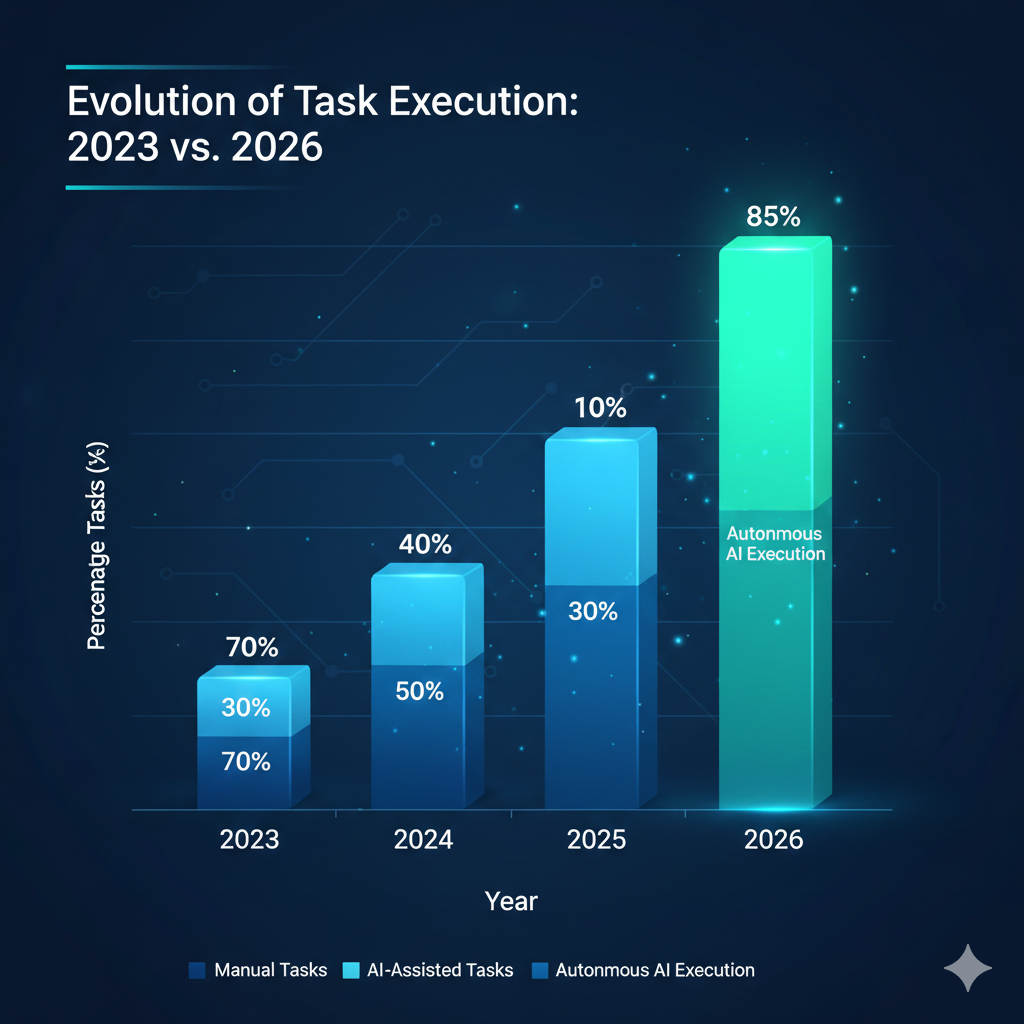
The most significant shift in 2026 is the transition from “Chatbots” to “Intelligent Agents.” Early AI required a human to prompt, verify, and execute. Today, AI agents are autonomous.
An agentic system can now take a high-level goal for example, “Organise a 3-day marketing campaign for our new product launch” and execute it end-to-end. It will book freelancers, generate ad copy, analyse real-time bidding data, and adjust the budget across platforms without constant human intervention.
Key Characteristics of 2026 Agents:
- Multi-step Reasoning: They can break down complex goals into smaller tasks.
- Tool Use: They can use software, browse the live web, and interact with APIs.
- Memory: They remember past interactions to improve future performance.
2. Domain-Specific Models: The Death of "One Size Fits All"
While models like GPT-4 and Gemini laid the groundwork, 2026 is the year of Vertical AI. General-purpose models often hallucinate when faced with highly technical data. To solve this, industries have shifted toward Domain-Specific Language Models (DSLMs).
- Med-AI: Models trained exclusively on peer-reviewed medical journals and clinical trials, assisting doctors with 99.9% diagnostic accuracy.
- Legal-GPT: Systems that can draft airtight contracts and predict litigation outcomes based on decades of case law.
- Code-Native Models: AI that doesn’t just “write” code but understands the entire architecture of legacy systems, making software maintenance nearly effortless.
3. The Edge AI Revolution and Privacy

Privacy concerns in 2024 led to the Edge Computing boom of 2026. Most AI processing no longer occurs in massive, centralised data centres. Instead, high-performance “AI chips” in our smartphones and laptops allow for local processing.
This means your personal data never leaves your device. Your AI assistant knows your schedule, your health metrics, and your private messages, but that data is encrypted and processed locally. This has restored user trust and paved the way for AI in sensitive sectors like government and defence.
4. Synthetic Data: Solving the Data Scarcity Problem
By late 2025, the internet “ran out” of high-quality human-generated text to train models. In 2026, we use Synthetic Data AI-generated data used to train even better AI.
This isn’t just about quantity; it’s about quality. Scientists use AI to simulate millions of chemical reactions or physics experiments. This data is then fed back into the models to create “Scientific AI” that can predict the properties of new materials before they are even created in a lab.
5. The New Workforce: Human-AI Collaboration
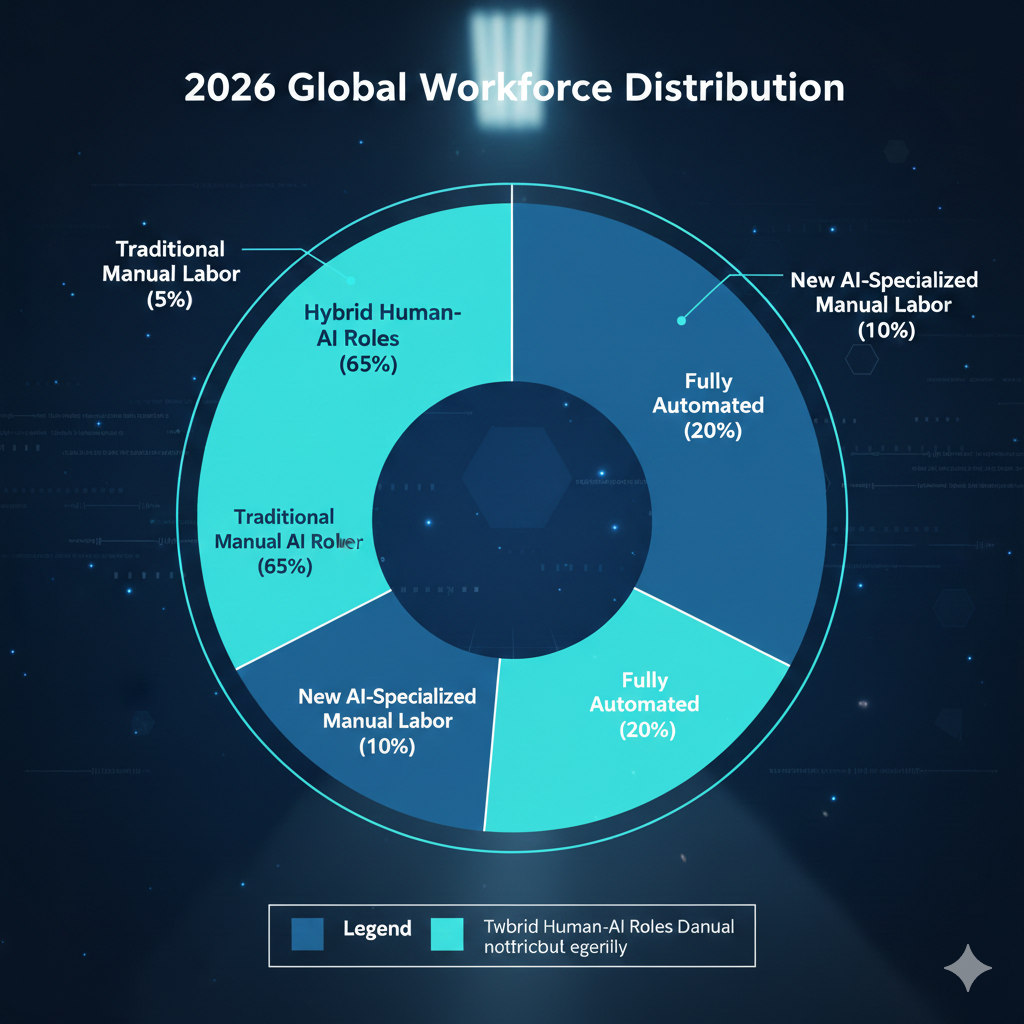
The fear of “AI taking all jobs” has been replaced by the reality of Job Evolution. In 2026, being “AI Literate” is as fundamental as knowing how to use a computer was in the 90s.
New Roles Emerging in 2026:
- AI Ethicists: Ensuring models don’t develop bias or harmful behaviours.
- Workflow Architects: People who design how different AI agents interact with human employees.
- Prompt Engineers (Advanced): Moving beyond simple text to “Context Engineering,” managing the massive data inputs AI needs to function.
6. Generative Media and the "Reality Gap"
We have reached a point where AI-generated video and audio are indistinguishable from reality. This has transformed the entertainment industry. In 2026, “Personalised Cinema” is a thing where you can prompt a streaming service to create a movie starring you in a sci-fi setting, and it renders it in real-time.
However, this has also created the Authenticity Crisis. Digital watermarking (Provenance) is now a legal requirement. Every piece of content carries a “digital birth certificate” that tells the viewer if it was made by a human, an AI, or a mix of both.
7. Sustainable AI: Greening the Machine
In the past, training a large model consumed as much electricity as a small town. By 2026, the industry will have shifted toward Neuromorphic Computing and green data centres powered by fusion and advanced solar. AI is now being used to optimise its own energy consumption, making the technology “Carbon Neutral” for the first time.
Conclusion: The Path Forward
As we move through 2026, the focus has shifted from what AI can do to how we should use it. We are no longer amazed that a machine can write a poem or solve an equation; we are focused on using these capabilities to solve climate change, cure diseases, and expand the horizons of human creativity.
The AI Renaissance is here, and it is not about replacing humans; it is about amplifying our potential.
Frequently Asked Questions (FAQ)
Q1: Is my job safe from AI in 2026?
- A: Most jobs aren’t being replaced, but they are being transformed. The key to job security in 2026 is learning to manage AI agents and focusing on high-level strategy, empathy, and creative problem-solving.
Q2: How do I know if a video I see online is real or AI-generated?
- A: Look for the “Content Credentials” icon. Most browsers and social platforms in 2026 have integrated “Digital Provenance” tools that verify the source of the media.
Q3: Can AI now “think” like a human (AGI)?
- A: While AI in 2026 shows incredible reasoning abilities, it still lacks true consciousness or biological “feeling.” We have reached “Applied Intelligence,” but true Artificial General Intelligence (AGI) is still a subject of debate among scientists.
Q4: Is Edge AI better than Cloud AI?
- A: Edge AI is better for privacy and speed (no latency). However, for massive tasks like global weather forecasting or drug discovery, Cloud AI is still necessary because of the sheer processing power required.
Q5: How can I start using Agentic AI for my business?
- A: Most enterprise software (like ERPs and CRMs) now comes with built-in agentic features. You can start by identifying repetitive workflows and assigning them to specialized AI agents.

Manish Khilwani 

Co-Founder at BrainStream Technolabs, he focuses on building people-first, scalable eCommerce and digital products that help brands grow with clarity and innovation.
Share :


Related Blog
AI Development
Top 10 Agentic AI Frameworks Powering Autonomous Systems in 2026
Artificial Intelligence has evolved rapidly over the past few years. We moved from predictive models to generative AI, and now we are entering the era of Agentic AI systems capable of planning, reasoning, acting, and continuously adapting to achieve defined...
AI Development
ChatGPT OS: How OpenAI’s Intelligence Layer Is Reshaping Business Software in 2026
In 2026, the way businesses build and use software is undergoing a structural transformation. We are moving from interface-driven applications to intent-driven systems. At the centre of this shift is ChatGPT OS, an intelligence layer that is beginning to function...
AI Development
2026 Generative AI Playbook: A Strategic Guide for Business Leaders
The digital landscape has officially crossed a Rubicon. If 2023 was the year of "Aha!" moments with ChatGPT and 2024–2025 were years of frantic experimentation, 2026 is the year of the AI-Native Enterprise. For business leaders, the conversation has shifted....


Keep up-to-date with our newsletter.
Sign up for our newsletter to receive weekly updates and news directly to your inbox.