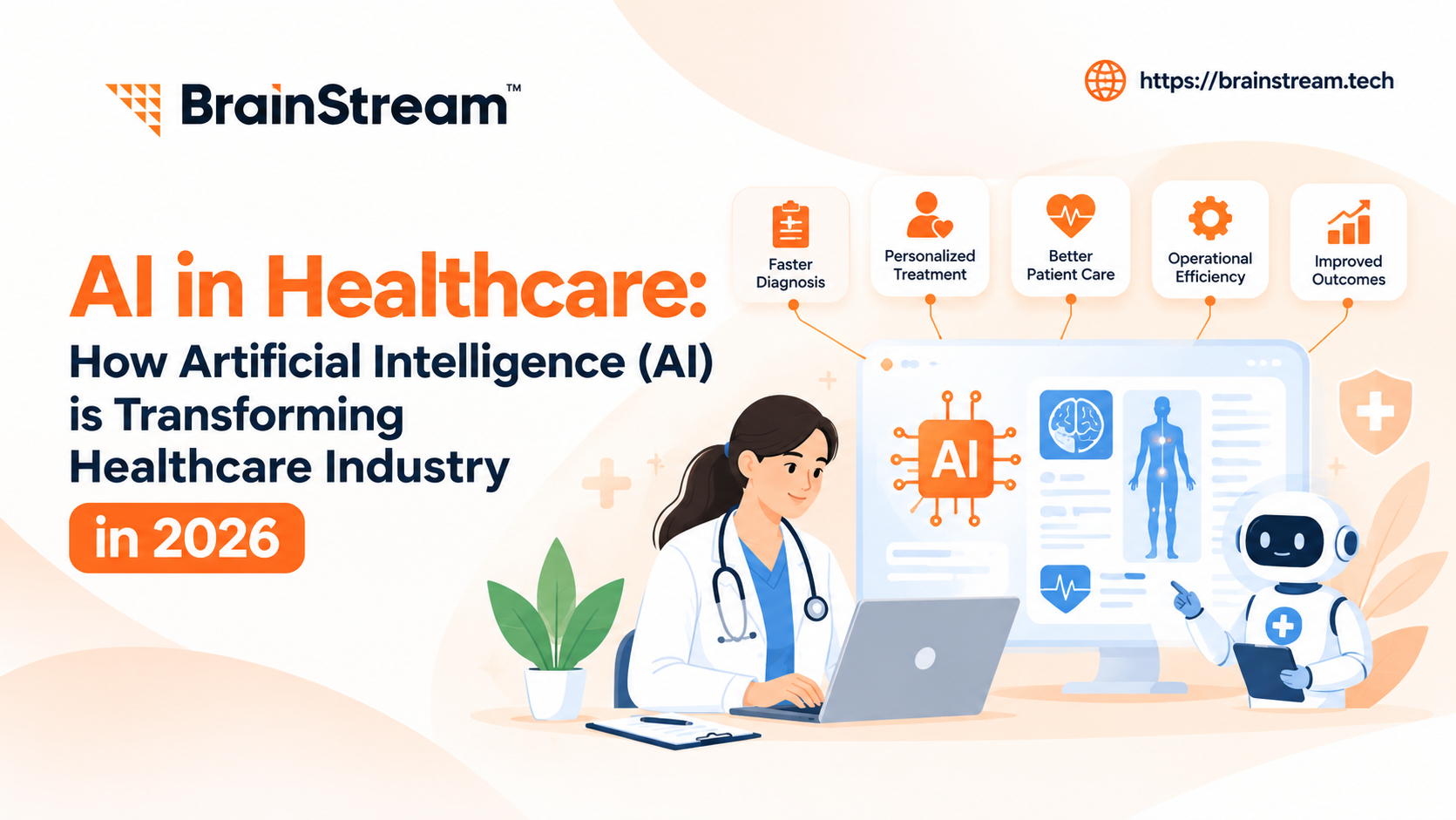
AI in Healthcare: How Artificial Intelligence (AI) is Transforming the Healthcare Industry in 2026
AI in Healthcare is changing the very concepts of healthcare, from identifying illnesses to how patients receive care. The AI in Healthcare sector has long since left the realm of the futuristic, and by 2026. AI will save lives, help cut costs in the healthcare sector, and make it more accessible than ever before.
This blog will discuss the advantages of AI in healthcare, provide real-world examples of its use, examine trends in AI adoption, and answer some of the most frequently asked questions about this disruptive technology.
The concept of Well Health Organic AI in Healthcare highlights how artificial intelligence can support a smarter and more efficient healthcare ecosystem.
By combining AI-powered technologies with a focus on preventive care, personalized health insights, and digital innovation, healthcare providers can improve patient experiences and make medical services more accessible. From early disease detection to intelligent health monitoring, AI is opening new possibilities for modern healthcare.
Why AI in Healthcare Matters in 2026?
The healthcare sector has never been easy: costs are rising, physicians are in short supply, diagnostic errors are common, and patient satisfaction is not always consistent. Artificial Intelligence (AI) is coming in to fix these problems by:
Enhancing the precision of diagnosis.
- Reducing administrative burden for doctors
- Improving care for patients.
- Supporting faster drug discovery
- Enhancing the efficiency and friendliness of healthcare.
As suggested by a recent report, AI in healthcare sector is expected to reach hundreds of billions in market value by the end of this decade. This quick uptake indicates the level of necessity AI has in revamping the current state of healthcare.
Key Benefits of AI in Healthcare
Let’s break down the major benefits of AI in healthcare:
1. Accurate Diagnosis
AI systems can accurately examine X-rays, MRIs, CT scans, and laboratory reports, and may identify problems that humans might miss. Notably, AI algorithms have been shown to detect the early signs of cancer in a shorter timeframe than conventional methods.
2. Personalized Medicine
Through the analysis of patient data, genetics, and medical history, AI is assisting doctors in creating treatment plans that are tailored to each individual. It implies more positive consequences and fewer side effects.
3. Predictive Analytics
The AI can forecast potential health risks using medical records, habits, and lifestyle information. This enables early interventions and proactive care to minimize hospitalizations.
4. Operational Efficiency
In hospitals, AI is used to automate administrative tasks such as scheduling, billing, and record management. This helps reduce paperwork and creates time to attend to more patients.
5. Drug Discovery & Research
Facts that were achieved over the years are now achieved within months. AI models accelerate the discovery of drugs, vaccines, and the development of clinical trials.
Well Health Organic AI in Healthcare: Transforming Modern Healthcare
Well Health Organic AI in Healthcare represents the growing role of artificial intelligence in building a more accessible, personalized, and technology-driven healthcare system. AI-powered solutions are helping healthcare professionals analyze medical information, monitor patient health, and identify potential health risks more efficiently.
Some important ways AI is transforming healthcare include:
- Preventive Healthcare: AI helps identify potential health risks through patient data analysis and predictive insights.
- Personalized Patient Care: AI supports customized healthcare recommendations based on medical history and individual health information.
- Smart Health Monitoring: AI-powered wearable devices help track vital signs and provide useful health insights.
- Accurate Medical Diagnosis: Machine learning tools assist healthcare professionals in analyzing medical images and detecting possible diseases.
- Better Healthcare Management: AI automates routine administrative tasks, allowing medical professionals to focus more on patient care.
By combining healthcare expertise with AI-driven innovation, organizations can create more efficient and patient-focused healthcare experiences.
How is AI Used in the Healthcare Sector Today?
Many people wonder: How is AI used in healthcare in real life? Let’s look at some practical applications.
- Medical Imaging: AI technologies assist radiologists in interpreting scans and detecting tumours, fractures, or infections.
- Virtual Health Assistants: Patients can speak with AI chatbots to book appointments, receive medication reminders, or obtain simple medical guidance.
- Remote Patient Monitoring: Wearables can measure heart rate, oxygen, and blood pressure, and AI will notify users of any anomalies in real time. Healthcare organizations exploring virtual assistants can benefit from choosing a custom AI chatbot when their requirements include secure integrations, specialized workflows, and greater control over patient data.
- Robotic Surgery: AI-driven robots can assist surgeons in performing minimally invasive surgical operations with a high level of precision.
- Generative AI in Healthcare: Generative AI models can generate fake medical data to be used in research and in summarizing patient records, and even assist doctors in writing reports more effectively.
These AI in healthcare examples show how deeply AI has integrated into both hospitals and patients’ homes.
Generative AI in Healthcare: A Game-Changer
Generative AI replacing healthcare is one of the most popular things at the moment. In contrast to traditional AI that merely processes data, a generative one can generate something. The way it is shaking things up is as follows:
- Medical Documentation: Doctors can spend significantly less time typing notes about patients since generative AI can automatically generate a summary of a visit.
- Drug Discovery: The models represent the molecular compositions, allowing researchers to identify potential new medications far more quickly.
- Training & Education: AI combines natural patient cases, providing a better learning experience for medical students.
- Patient Communication: Generative AI enables chatbots to converse with patients in a natural, human-like manner.
By 2026, generative AI will become a reliable co-worker in hospitals, allowing clinicians to spend more time caring for their patients rather than attending to paperwork.
AI Trends in Healthcare Sector to Watch in 2026
The AI trends in healthcare are shaping the future of medicine. Some key trends include:
- AI-Powered Telemedicine: The use of AI-driven virtual check-ups is now a standard practice.
- Preventive Healthcare with AI: Preventive Healthcare using AI Preventive healthcare using AI models that identify danger even before you feel unwell.
- Integration with Wearables: Do our Apple Watch, Fitbit, and other devices already utilize AI to monitor my health in real-time?
- AI in Mental Health: Chatbots and virtual assistants are providing therapy and helping to prevent depression and anxiety early.
- Generative AI for Clinical Summaries: Doctors get patient summaries instantly, reducing time spent on paperwork.
- AI + Robotics: AI, robots, and surgical Robots are collaborating to streamline healthcare, starting with robotic-assisted surgeries and moving on to hospital delivery bots.
These trends highlight that AI is no longer experimental; it’s becoming a backbone of the healthcare industry.
Real AI in Healthcare Examples
- Google DeepMind created an AI that can predict acute kidney injury 48 hours before it happens.
- IBM Watson Health helps oncologists recommend cancer treatment plans.
- The Mayo Clinic utilizes AI in radiology imaging to enhance diagnostic accuracy.
- Babylon Health developed an AI-powered app that provides virtual consultations.
- Pfizer uses AI in drug discovery to accelerate research timelines.
These AI in healthcare examples prove that the industry is moving from theory to real, life-saving applications.
Final Thoughts
The boom of AI in healthcare in 2026 is completely revolutionizing the game in patient care.
Doctors now diagnose faster. Individual treatments are received by patients. The hospitals operate more effectively. And scientists find life-saving medicine in record time.
The AI in healthcare industry is gaining traction because it works.
Only to keep in mind that AI will not make doctors redundant. This is because it is here to empower them, which means that all people receive better care.
Unless you are in the healthcare sector and exploring AI, you are already falling behind. It is not the future, and it is blowing upon us.
FAQs
1. What are the benefits of AI in healthcare?
AI can assist physicians with more precise disease diagnosis, provide patient-specific treatment, anticipate illnesses before they occur, accelerate drug development, and reduce the amount of paperwork physicians need to follow.
2. How is AI used in healthcare?
Artificial intelligence examines patient records and medical images, aids in robot-assisted surgeries, enables telemonitoring of patients, drives chatbots to communicate with patients, and generates notes and research papers.
3. Can AI replace doctors?
AI cannot replace doctors. It can be used as an effective assistant, providing physicians with valuable information, automating tasks, and facilitating informed decisions. Empathy and judgment of doctors are, however, still necessary.
4. What are some real AI in healthcare examples?
AI can detect early-onset cancers, chatbots can make appointments, wearable technology can monitor patient vital signs, and AI models can even identify new drugs.
5. What are the latest AI trends in healthcare?
The current trends include AI in telemedicine, wearable health monitoring, AI in mental health, AI-generated medical summaries, and robotic-assisted surgeries.
6. Is AI safe in healthcare generation?
Yes, but it should be applied with caution. The principles of accuracy, privacy, and medical adherence should rigorously govern the development and use of medical generative AI. It is harmless as an aiding device, not a substitute for physicians.
7. What is Well Health Organic AI in Healthcare?
Well Health Organic AI in Healthcare refers to the role of artificial intelligence in improving modern healthcare through personalized health insights, preventive care, intelligent health monitoring, and advanced medical technologies. AI helps healthcare professionals make informed decisions, improve operational efficiency, and enhance patient experiences.


Bhavesh Chipa
Author
Bhavesh is a digital marketing expert and seasoned blog writer with a passion for SEO, content strategy, and online growth. He helps businesses boost their digital presence through data-driven strategies and engaging content.
Table of contents
BLOGS
Learn & Grow with Us
Get the latest updates on trends and strategies that shape the business world. Our insights are here to keep you informed and inspired.
2026 Generative AI Playbook: A Strategic Guide for Business Leaders
The digital landscape has officially crossed a Rubicon. If 2023…
Agentic Commerce in 2026: How AI Agents Are Changing Online Shopping
Agentic commerce is online shopping where AI agents discover, compare,…
AI Advisory & Roadmap Services: How Businesses Build Smarter AI Strategies?
Artificial intelligence is changing how businesses operate. However, many companies…
AI Chatbots in Healthcare: Benefits and Use Cases That Are Transforming Patient Care
AI Chatbots in Healthcare are changing faster than ever. Patients…