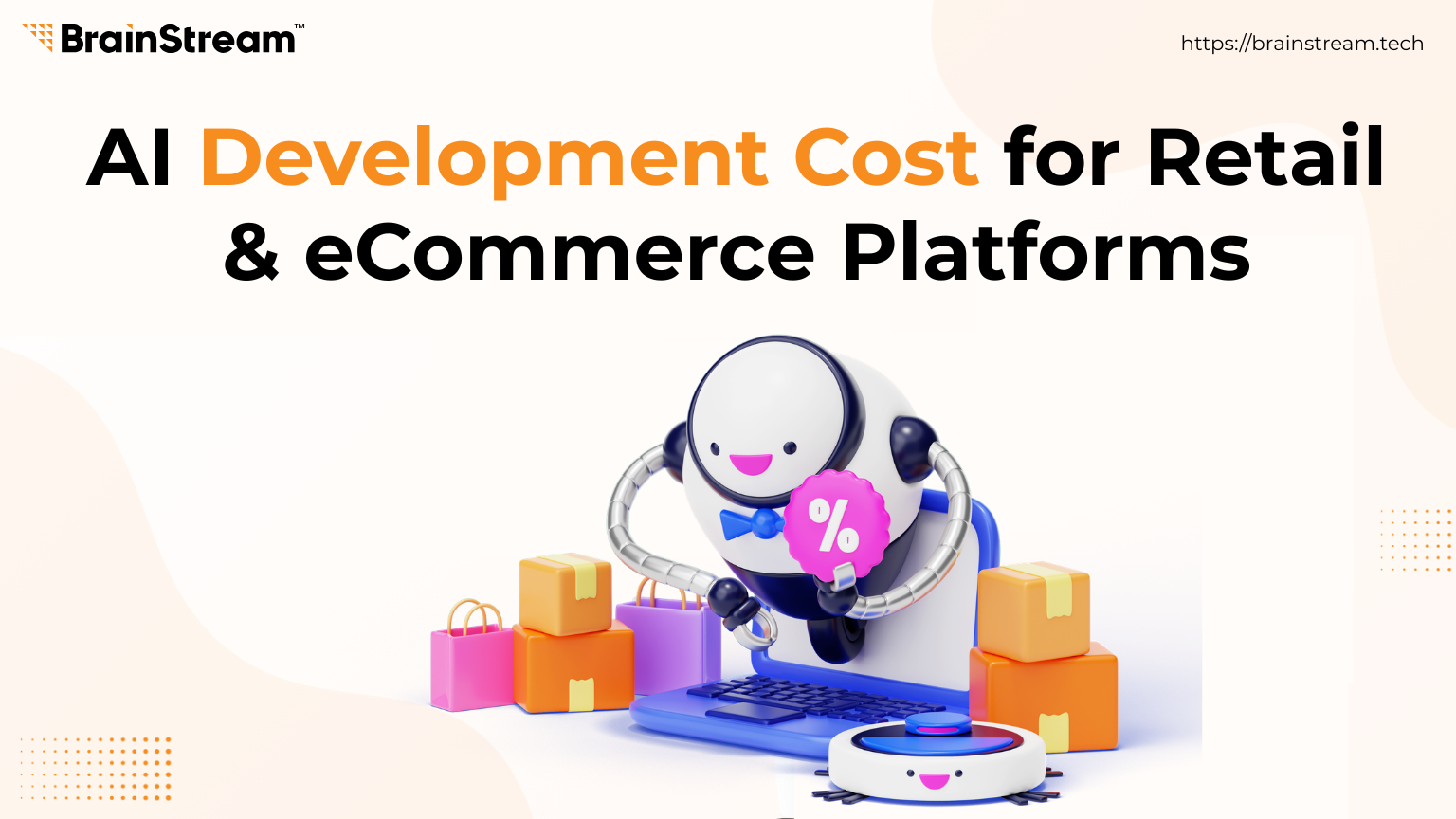
AI Development Cost for Retail & eCommerce Platforms
Modern retail and eCommerce businesses are investing heavily in AI. From personalized shopping experiences to automated inventory management, AI now drives many online shopping platforms.
However, one question still concerns most business owners:
How much does AI development cost for retail and eCommerce platforms?
The answer depends on several factors. Project complexity, AI features, data infrastructure, integrations, and development timelines all affect the final budget.
Some businesses spend a few thousand dollars on basic AI automation. Meanwhile, enterprise retailers may invest hundreds of thousands in advanced AI systems.
In this guide, you will learn:
- What affects AI development cost
- Different types of AI solutions
- Average pricing estimates
- Hidden development expenses
- Ways to reduce AI implementation costs
- How to choose the right AI Development service
If you plan to invest in AI for your retail business, this article will help you make smarter decisions.
Why Retail & eCommerce Businesses Are Investing in AI
Customer expectations continue to grow. Shoppers now expect personalized experiences, fast support, and intelligent recommendations.
Traditional systems often fail to meet these expectations. Therefore, retailers are turning to AI-powered solutions.
AI helps businesses improve:
- Customer experience
- Inventory management
- Product recommendations
- Fraud detection
- Customer support
- Demand forecasting
- Marketing automation
As a result, many businesses see higher conversions and lower operational costs.
What is AI Development for Retail & eCommerce?
AI development involves building intelligent systems that can analyze data, automate tasks, and improve decision-making.
In retail and eCommerce, AI solutions often include:
| AI Solution | Main Purpose |
|---|---|
| Recommendation Engines | Suggest products to shoppers |
| AI Chatbots | Automate customer support |
| Visual Search | Search products using images |
| Predictive Analytics | Forecast customer behavior |
| Dynamic Pricing | Adjust pricing automatically |
| Inventory Automation | Improve stock management |
| Fraud Detection | Identify suspicious activity |
| AI Search Systems | Improve product discovery |
Each solution requires different technologies. Therefore, development costs can vary significantly.
Main Factors That Affect AI Development Cost
1. Type of AI Solution
The biggest cost factor is the type of AI system you want to build.
Simple AI tools cost less because they require fewer features and integrations.
For example:
- Basic chatbot → Lower cost
- Recommendation engine → Medium cost
- Computer vision system → Higher cost
Meanwhile, enterprise-grade AI platforms require more development time and infrastructure.
2. Project Complexity
Complex projects require more engineering effort.
A basic AI chatbot may take only a few weeks. However, a custom AI platform with predictive analytics may take several months.
Complexity usually increases when businesses need:
- Real-time data processing
- Multi-platform integrations
- Large product catalogs
- Advanced automation
- Machine learning models
- Custom dashboards
As complexity grows, development costs increase as well.
3. Data Availability and Quality
AI systems depend heavily on data.
Poor-quality data can slow development and reduce AI accuracy.
Many retailers underestimate this part of the process.
Before development begins, teams often need to:
- Clean customer data
- Organize product information
- Remove duplicates
- Structure datasets
- Build data pipelines
This process takes time and increases the overall project cost.
4. Customization Requirements
Some businesses use pre-built AI tools. Others need fully customized AI solutions.
Custom AI systems cost more because developers must build unique models and workflows.
Custom development may include:
- Personalized recommendation engines
- Industry-specific AI automation
- Advanced reporting systems
- Custom integrations
- Unique customer experiences
Although customization costs more initially, it often provides better long-term value.
5. Integration with Existing Platforms
Most retailers already use platforms like:
- Shopify
- Magento
- WooCommerce
- Shopware
- Salesforce
- ERP systems
- CRM software
AI systems must integrate smoothly with these platforms.
Complex integrations increase development effort because developers need to manage:
- APIs
- Security layers
- Data synchronization
- Platform compatibility
Therefore, integration complexity directly affects AI Development Cost.
Average AI Development Cost for Retail Platforms
The table below shows estimated pricing ranges for common AI solutions.
| AI Feature | Estimated Cost |
|---|---|
| AI Chatbot | $5,000 – $20,000 |
| Recommendation Engine | $15,000 – $50,000 |
| AI Search System | $20,000 – $60,000 |
| Predictive Analytics | $25,000 – $100,000 |
| Visual Search | $30,000 – $120,000 |
| Dynamic Pricing System | $20,000 – $80,000 |
| Inventory Forecasting AI | $15,000 – $70,000 |
| Enterprise AI Platform | $100,000+ |
These numbers vary depending on project scope and technical requirements.
AI Development Cost Based on Business Size
Small Businesses and Startups
Small retailers usually start with basic AI features.
Common investments include:
- AI chatbots
- Product recommendations
- Email automation
- Smart search
Estimated budget:
$5,000 to $30,000
This approach helps startups improve customer experience without overspending.
Mid-Sized eCommerce Brands
Growing brands often need more advanced automation.
Their AI systems may include:
- Predictive analytics
- Personalized recommendations
- Inventory forecasting
- Customer segmentation
Estimated budget:
$30,000 to $100,000
At this stage, scalability becomes very important.
Enterprise Retail Businesses
Large retailers need enterprise-grade AI infrastructure.
These systems often support:
- Millions of users
- Real-time analytics
- Omnichannel operations
- Advanced security
- Massive product catalogs
Estimated budget:
$100,000 to $500,000+
Enterprise AI projects also require long-term optimization and maintenance.
Hidden Costs Businesses Often Ignore
Many companies focus only on development costs. However, several hidden expenses appear during implementation.
Data Preparation
AI systems need clean and organized data.
Data preparation can consume a large part of the budget.
Cloud Infrastructure
AI applications often require cloud hosting for:
- Data storage
- Machine learning processing
- Real-time analytics
Monthly cloud expenses can grow quickly as usage increases.
AI Training and Optimization
Machine learning models improve over time.
Developers must regularly:
- Retrain models
- Monitor accuracy
- Optimize performance
This ongoing process adds recurring costs.
Security and Compliance
Retail businesses handle sensitive customer information.
Therefore, AI systems must follow strict security standards.
Additional costs may include:
- Data encryption
- Security audits
- Compliance testing
- Fraud prevention tools
Benefits of Investing in AI for eCommerce
Although AI development requires investment, the long-term benefits are substantial.
Better Customer Experience
AI personalizes shopping experiences based on user behavior.
As a result, customers find products faster and engage more with the platform.
Higher Conversion Rates
Recommendation engines and smart search improve conversions significantly.
Customers often buy more when product suggestions feel relevant.
Reduced Operational Costs
Automation reduces manual work across multiple departments.
Businesses save time on:
- Customer support
- Inventory management
- Marketing tasks
- Data analysis
Smarter Business Decisions
Predictive analytics helps businesses understand customer trends.
This improves:
- Inventory planning
- Marketing performance
- Sales forecasting
- Pricing strategies
How to Reduce AI Development Cost
AI implementation does not always require massive budgets.
Businesses can reduce costs using smart strategies.
Start with MVP Development
Begin with a small AI feature first.
For example:
- Chatbot
- Recommendation engine
- AI search
This approach reduces risk and helps validate results early.
Use Existing AI Frameworks
Developers can use frameworks like:
- TensorFlow
- OpenAI APIs
- PyTorch
- Azure AI
- Google AI tools
Using existing technologies lowers development time and cost.
Prioritize High-Impact Features
Focus on AI features that directly improve revenue or efficiency.
Avoid unnecessary complexity during the early stages.
Choose the Right AI Development Service
An experienced AI Development service can help businesses avoid costly mistakes.
The right partner improves:
- Project planning
- Scalability
- Integration quality
- Security
- Long-term performance
Choosing the wrong development team often increases expenses later.
Common Mistakes Businesses Make
Trying to Build Everything at Once
Many retailers attempt large AI implementations immediately.
This creates delays, budget overruns, and technical complexity.
Instead, businesses should scale gradually.
Ignoring Data Quality
Poor data leads to weak AI performance.
Businesses must organize data properly before implementation begins.
Choosing Cheap Development Without Expertise
Low-cost development teams may lack AI expertise.
As a result, businesses often face:
- Poor scalability
- Security issues
- Weak performance
- Expensive rebuilds
Quality development provides better long-term ROI.
Step-by-Step AI Implementation Process
Step 1: Identify Business Goals
Define what problems AI should solve.
Examples include:
- Increasing sales
- Improving support
- Reducing operational costs
Step 2: Analyze Existing Infrastructure
Review current systems, platforms, and data availability.
Step 3: Choose AI Features
Select the most valuable AI capabilities first.
Step 4: Develop and Test
Build the solution and test performance carefully.
Step 5: Optimize Continuously
AI systems require ongoing improvement and monitoring.
Continuous optimization improves long-term results.
Future Trends Affecting AI Development Cost
AI technologies continue to evolve rapidly.
Several trends may affect pricing in the future.
Generative AI
Generative AI tools now automate content, product descriptions, and customer support.
These tools reduce operational costs for retailers.
Edge AI
Edge AI processes data locally instead of relying fully on cloud servers.
This improves speed and reduces infrastructure costs.
AI-as-a-Service Platforms
Many providers now offer ready-made AI services.
Businesses can integrate these solutions faster and at lower costs.
Conclusion
AI is transforming the retail and eCommerce industry faster than ever.
Businesses now use AI to improve customer experiences, automate operations, and increase revenue. However, AI Development Cost depends on many factors, including complexity, customization, integrations, and infrastructure.
Small businesses can begin with affordable AI features. Meanwhile, larger enterprises often invest in advanced AI ecosystems.
The key is to start strategically.
Focus on high-impact AI solutions first. Additionally, work with an experienced AI Development service provider that understands scalability, security, and long-term growth.
With the right approach, AI can become one of the most valuable investments for modern retail businesses. AI technologies continue to evolve rapidly.
FAQs
How much does AI development cost for eCommerce platforms?
Costs usually range from $5,000 to $500,000+, depending on complexity and business size.
What is the cheapest AI solution for retailers?
AI chatbots and recommendation engines are often the most affordable starting points.
How long does AI development take?
Simple AI projects may take a few weeks. Advanced systems can require several months.
Can small businesses afford AI development?
Yes. Many startups begin with small AI features and scale gradually over time.
Is custom AI development better than pre-built tools?
Custom AI provides better flexibility and scalability. However, pre-built tools reduce initial costs.

Manish Khilwani
Author
Co-Founder at BrainStream Technolabs, he focuses on building people-first, scalable eCommerce and digital products that help brands grow with clarity and innovation.
Table of contents
BLOGS
Learn & Grow with Us
Get the latest updates on trends and strategies that shape the business world. Our insights are here to keep you informed and inspired.
How Much Does AI Integration into a Symfony Application Cost in 2026?
Adding artificial intelligence to your Symfony application can improve customer…
Modernizing Legacy Symfony Applications with AI: Where to Start
Your Symfony application still runs your business. However, adding features…
Agentic Commerce in 2026: How AI Agents Are Changing Online Shopping
Online shopping is entering a new phase. For years, shoppers…
Top 7 Must-Have Bagisto Extensions to Improve Your eCommerce Store in 2026
Running an online store takes more than adding products and…