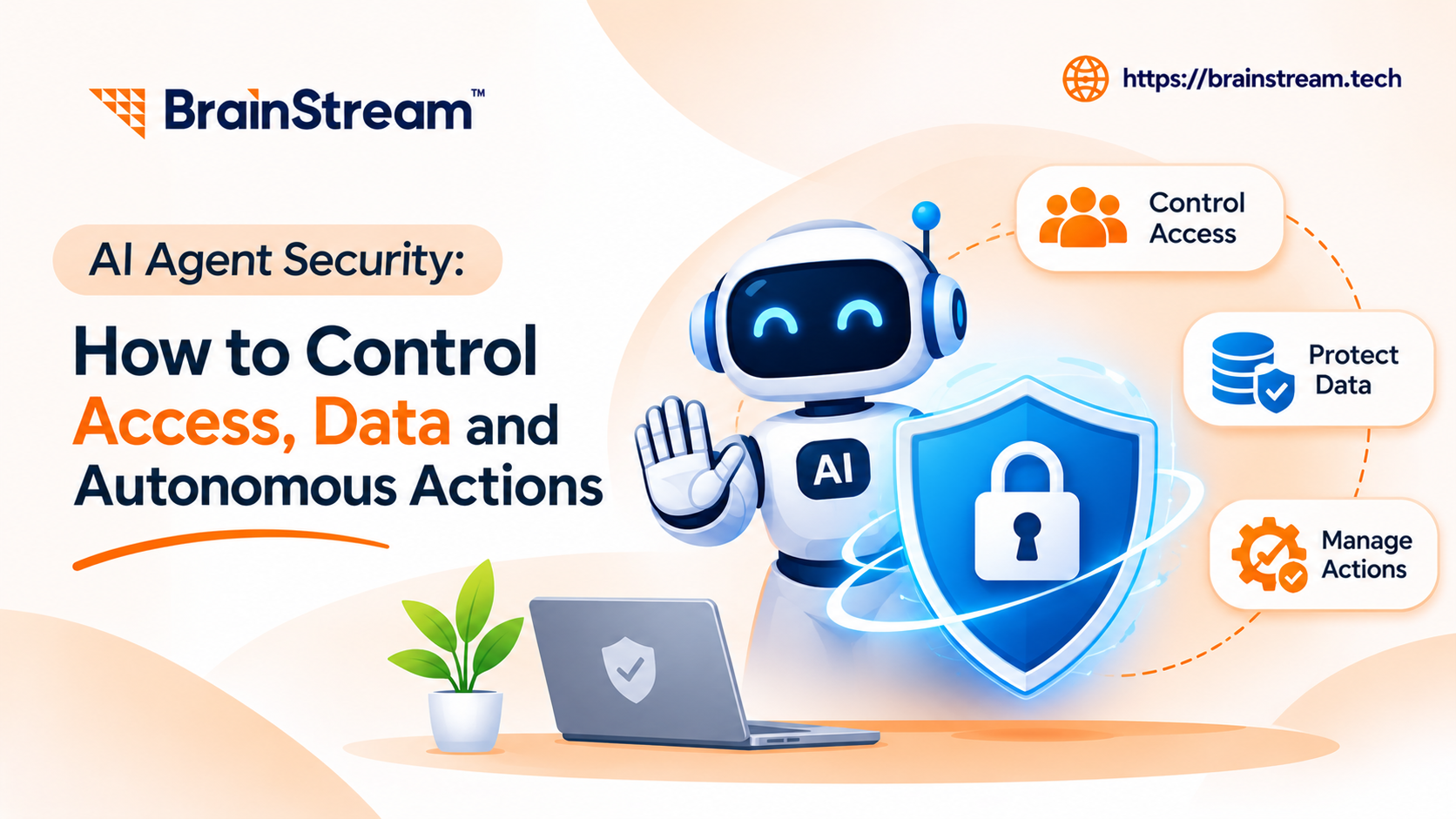
AI Agent Security: How to Control Access, Data and Autonomous Actions
AI agents can do more than answer questions. They can access business data, use external tools, update records and perform tasks automatically. However, these abilities also create new security risks.
Secure AI agent development must protect data, control permissions, and monitor every important action. Without these safeguards, an AI agent could expose private information or perform an unwanted task.
For example, imagine an AI sales agent that can access your CRM. It can read customer records, update deal stages, and send emails. But what happens if someone tricks it into sharing confidential information?
This is why businesses need a clear AI agent security strategy. In this guide, we explain the risks, essential security controls, and practical steps to build safer AI agents.
What Is AI Agent Security?
AI agent security refers to the methods used to protect AI agents, their data, connected tools and automated actions.
Unlike traditional chatbots, AI agents can make decisions and interact with external systems. Therefore, their security needs go beyond protecting a model or API.
A secure AI agent should:
- Access only the information it needs.
- Follow clearly defined permissions.
- Protect sensitive business data.
- Validate instructions before taking action.
- Reject unsafe or unauthorized requests.
- Record important activities for review.
- Allow human approval for sensitive operations.
For example, an AI support agent may need access to customer orders. However, it should not access employee payroll records.
This principle helps businesses reduce unnecessary access and limit security risks.
Why Is AI Agent Security Important for Businesses?
AI agents can improve productivity across sales, customer support, finance and operations. However, greater autonomy also creates new ways for attackers to exploit business systems.
Here are some important reasons to secure AI agents before deploying them.
1. Protect Sensitive Business Data
AI agents often work with customer records, financial details and internal documents. Unauthorized access could expose this information.
For example, a finance agent may process invoices and payment records. It should not share those records with an unrelated user.
Therefore, businesses should apply access controls, data encryption and clear information-handling rules.
2. Prevent Unauthorized Actions
An AI agent may send emails, update CRM records or approve certain workflows. A poorly designed system could perform these actions without proper checks.
For example, an AI purchasing agent might create an order using incorrect information.
Businesses should define which actions an agent can perform independently. They should also require approval for high-impact operations.
3. Reduce Prompt Injection Risks
Prompt injection occurs when someone creates instructions that try to override an AI system’s intended behavior.
For example, an attacker could hide malicious instructions inside a document. An AI agent might read that document and follow the unsafe instructions.
As a result, businesses need to treat external content as untrusted input. They should also validate tool requests before execution.
4. Maintain Business Compliance
Many organizations handle personal, financial or confidential information. Therefore, their AI systems must follow relevant privacy and security requirements.
These requirements depend on the industry, location and type of data involved.
Businesses should review data access, retention, processing and audit requirements before deployment.
5. Build Customer and Employee Trust
People need confidence that AI systems will handle their information responsibly.
Clear permissions, transparent actions and human oversight help build that confidence. Additionally, regular security reviews help businesses identify problems early.
Common Security Risks in AI Agents
AI agents face several security risks because they combine language models, external data and connected tools.
Understanding these risks helps businesses choose the right protection measures.
1. Prompt Injection Attacks
Prompt injection attacks attempt to manipulate an AI agent through malicious instructions.
An attacker may place harmful instructions inside:
- Emails
- Uploaded documents
- Web pages
- Customer messages
- External knowledge sources
For example, an AI research agent may access a web page containing hidden instructions. Those instructions could attempt to make the agent reveal internal information.
How to reduce this risk:
- Treat external content as untrusted.
- Separate system instructions from user content.
- Restrict access to sensitive tools.
- Validate important actions before execution.
- Test the agent against malicious inputs.
However, prompt filtering alone cannot stop every attack. A secure design must also limit what the agent can access and do.
2. Excessive Permissions
An AI agent may receive more permissions than its actual role requires.
For example, a customer support agent may only need to view order details. Giving it full database access creates unnecessary risk.
This problem is known as excessive privilege.
How to reduce this risk:
- Give each agent a specific role.
- Restrict database and API permissions.
- Separate read and write access.
- Review permissions regularly.
- Remove unused tool access.
The principle of least privilege is essential here. Each agent should receive only the permissions required for its tasks.
3. Sensitive Data Exposure
AI agents may process confidential information during conversations and automated workflows.
Data exposure can happen through poor access controls, unsafe integrations or incorrect system configuration.
For example, an employee might ask an internal AI assistant for information outside their department. Without proper authorization, the agent could return confidential records.
How to reduce this risk:
- Classify sensitive information.
- Apply role-based access controls.
- Encrypt data during transfer and storage.
- Mask personal information when appropriate.
- Define data retention policies.
- Monitor access to confidential records.
4. Unsafe Tool Execution
AI agents use tools to interact with external systems. These tools may include APIs, databases, email platforms and payment services.
However, an unsafe tool call could create serious business problems.
For example, an AI finance agent might send money to an incorrect account after processing misleading instructions.
How to reduce this risk:
- Validate every tool request.
- Set limits on financial operations.
- Require approval for sensitive actions.
- Restrict available API functions.
- Maintain detailed activity logs.
Never allow an AI agent to execute every requested action without validation.
5. Model and Integration Vulnerabilities
AI agents depend on several connected components. These may include language models, APIs, plugins, databases and third-party services.
A vulnerability in one component can affect the complete workflow.
For example, an insecure API integration may expose customer information even when the AI model itself works correctly.
How to reduce this risk:
- Use secure API authentication.
- Protect API keys and credentials.
- Review third-party integrations.
- Keep software and dependencies updated.
- Monitor unusual API activity.
- Test the complete workflow regularly.
Essential Security Controls for AI Agents
A strong security strategy combines technical controls, business rules and human oversight.
The following measures can help businesses protect their AI systems.
1. Role-Based Access Control
Role-based access control (RBAC) assigns permissions according to an agent’s role.
For example, different agents may have different access levels.
| AI agent | Allowed access | Restricted actions |
|---|---|---|
| Customer support agent | Customer orders and support tickets | Payment approval |
| Sales agent | CRM leads and deal records | Payroll access |
| Finance agent | Approved invoices and payment records | Unrestricted account transfers |
| HR assistant | Approved employee information | Unrelated financial records |
This approach limits unnecessary access. It also makes permission management easier.
2. Strong Authentication and Authorization
Every agent should use secure authentication when connecting to business systems.
Authentication verifies the identity of a user or service. Authorization determines which actions that identity can perform.
Businesses should consider:
- Short-lived access tokens.
- Secure API credentials.
- Multi-factor authentication for sensitive human access.
- Service accounts with limited permissions.
- Regular credential rotation.
Additionally, never store secret keys directly inside prompts or source code.
3. Data Encryption and Privacy Controls
Encryption helps protect information from unauthorized access.
Businesses should protect sensitive data both during transmission and while stored.
They should also define which information an AI agent can process.
For example, an HR agent may need employee names and approved records. However, it may not need complete identity documents.
Data minimization reduces the amount of sensitive information exposed to an AI workflow.
4. Human-in-the-Loop Approval
Human oversight is important when an AI agent performs sensitive tasks.
A human-in-the-loop process requires a person to review certain actions before execution.
For example:
- An AI finance agent prepares a payment request.
- The system checks the amount and recipient.
- A manager reviews the request.
- The manager approves or rejects it.
- The system records the final decision.
This approach gives businesses more control over high-impact operations.
5. Monitoring and Audit Logs
Businesses should maintain records of important AI agent activities.
Audit logs can help teams understand what happened, when it happened and which system performed the action.
Useful log details include:
- Agent identity.
- User or service requesting the action.
- Tool or API accessed.
- Requested operation.
- Approval status.
- Execution result.
- Timestamp.
However, logs should not unnecessarily store passwords, API keys or sensitive personal information.
How to Build Secure AI Agents: Step-by-Step Guide
Security should be part of the development process from the beginning. Adding security controls after deployment can create extra work and leave important gaps.
Follow these steps when planning a secure AI agent.
Step 1: Define the Agent’s Purpose
Start by identifying the business problem the agent will solve.
Write down its responsibilities, users and expected outcomes.
For example, a CRM agent may:
- Find customer records.
- Summarize sales activities.
- Suggest follow-up tasks.
- Draft customer emails.
However, it may not need permission to delete customer records or change account ownership.
A clear purpose helps define the agent’s security boundaries.
Step 2: Identify Sensitive Data
Next, identify the information the agent will process.
Classify data into categories such as:
- Public information.
- Internal business information.
- Confidential customer data.
- Financial information.
- Personal information.
Then decide which categories the agent actually needs.
This step helps prevent unnecessary data exposure.
Step 3: Design Access Permissions
Define the agent’s permissions before connecting external tools.
Create separate access rules for different operations.
For example, an agent may have permission to read CRM records but require approval before updating customer information.
Also, separate permissions for different environments. Development and testing agents should not automatically receive production access.
Step 4: Secure APIs and External Tools
AI agents often rely on APIs to complete tasks.
Therefore, every integration should follow secure authentication and authorization practices.
Use:
- Protected API credentials.
- Limited service permissions.
- Input validation.
- Rate limits.
- Secure communication.
- Error handling.
Additionally, validate tool arguments before sending requests to external systems.
Step 5: Add Human Approval Rules
Decide which actions require human approval.
For example, an AI agent may automatically summarize invoices. However, a finance manager should approve payments.
Create approval rules based on business impact and risk.
This gives teams control without removing the benefits of automation.
Step 6: Test Against Security Threats
Before deployment, test the agent with normal and malicious inputs.
Include scenarios such as:
- Attempts to reveal confidential information.
- Instructions hidden inside uploaded documents.
- Requests to access restricted records.
- Unauthorized API calls.
- Unexpected tool combinations.
- Attempts to bypass approval rules.
Also, test how the agent behaves when an API fails or returns unexpected data.
Step 7: Monitor and Improve Security
Security does not end after deployment.
Monitor agent activity and review unusual behavior. Additionally, update permissions when business requirements change.
Review these areas regularly:
- API access.
- Tool usage.
- Failed authentication attempts.
- Sensitive data access.
- Unusual agent actions.
- Model and dependency updates.
Continuous monitoring helps teams respond to new risks.
AI Agent Security Best Practices
Use this checklist when developing or reviewing an AI agent.
| Security practice | Why it matters |
|---|---|
| Apply least-privilege access | Limits unnecessary permissions |
| Validate tool calls | Prevents unsafe operations |
| Protect API credentials | Reduces credential exposure |
| Encrypt sensitive data | Protects stored and transmitted information |
| Filter and validate external inputs | Reduces prompt injection risks |
| Require human approval | Controls high-impact actions |
| Maintain audit logs | Improves accountability |
| Test against attack scenarios | Identifies weaknesses before deployment |
| Monitor agent behavior | Helps detect unusual activity |
| Review third-party tools | Reduces integration risks |
Not every AI agent needs the same controls. Therefore, select security measures according to the agent’s role, data access and business impact.
Common AI Agent Security Mistakes to Avoid
Even well-designed AI systems can become vulnerable because of poor implementation choices.
Avoid these common mistakes.
Giving Every Agent Full System Access
This approach increases the impact of a security failure.
Instead, assign permissions according to each agent’s responsibilities.
Trusting Every AI Response
AI agents can produce incorrect or unsafe outputs.
Therefore, validate important decisions and tool requests before execution.
Ignoring External Content
Documents, emails and web pages may contain malicious instructions.
Treat external content as untrusted and prevent it from overriding system-level security rules.
Skipping Human Approval
Some actions can cause financial, legal or operational damage.
Require human review for high-risk operations, such as payments and sensitive data changes.
Forgetting Continuous Monitoring
An agent that works safely today may behave differently after updates or changes to connected tools.
Monitor activity and review security controls regularly.
How Businesses Can Measure AI Agent Security
Security teams need measurable ways to review an AI agent’s performance.
However, no single metric can prove that an agent is completely secure.
Consider tracking these indicators:
| Security metric | What it measures |
|---|---|
| Unauthorized access attempts | Attempts to access restricted resources |
| Blocked unsafe tool calls | Requests stopped by security controls |
| Prompt injection test results | Agent response to malicious instructions |
| Approval compliance | Sensitive actions that followed approval rules |
| Data exposure incidents | Confirmed or suspected information leaks |
| API authentication failures | Problems with service authentication |
| Security issue resolution time | Time taken to address reported issues |
Review these metrics over time. They can help teams identify weaknesses and improve controls.
Frequently Asked Questions
1. What is AI agent security?
AI agent security protects AI agents, their data, connected tools, and automated actions. It uses access controls, authentication, data protection, monitoring, and human approval to reduce security risks.
2. What are the biggest security risks in AI agents?
Common risks include prompt injection, excessive permissions, sensitive data exposure, unsafe tool execution, and insecure API integrations. Businesses should address these risks during design, development, and deployment.
3. How can businesses prevent prompt injection attacks?
Businesses should treat external content as untrusted input. They should also restrict tool permissions, validate important actions, and test agents against malicious instructions. No single prompt filter can prevent every attack.
4. Should AI agents have access to company databases?
AI agents should only access the data required for their assigned tasks. Businesses should use role-based permissions and restrict sensitive records. Read-only access is a useful starting point when write access is unnecessary.
5. Why is human approval important for AI agents?
Human approval helps prevent unwanted actions with serious business consequences. For example, a person can review payments, sensitive record changes, and external communications before execution.
6. How do you monitor AI agent activities?
Businesses can use audit logs, API monitoring, and security alerts. These tools help teams track agent activity, identify unusual requests, and investigate potential security incidents.
7. Can AI agents be secure for enterprise applications?
Yes, businesses can design AI agents with enterprise security controls. However, security depends on architecture, permissions, integrations, data protection, and ongoing monitoring. Regular testing remains essential.
8. What is the difference between AI model security and AI agent security?
AI model security focuses on protecting the model and its inputs and outputs. AI agent security also covers connected tools, external APIs, business data, and actions performed by the agent.
Conclusion: Build AI Agents with Security at Every Step
AI agents can help businesses automate complex workflows and improve productivity. However, their access to business systems creates new security responsibilities.
Businesses should start with clear permissions, protected data and controlled tool access. They should also validate important actions and maintain human oversight.
Most importantly, treat security as part of the complete AI agent development process. Do not wait until deployment to identify risks.
Planning a custom AI agent for your business? BrainStream Technolabs helps businesses explore custom AI development solutions based on their workflows and technical requirements.
Explore Custom AI Development Services to discuss your AI project requirements.

Manish Khilwani
Author
Co-Founder at BrainStream Technolabs, he focuses on building people-first, scalable eCommerce and digital products that help brands grow with clarity and innovation.
Table of contents
BLOGS
Learn & Grow with Us
Get the latest updates on trends and strategies that shape the business world. Our insights are here to keep you informed and inspired.
2026 Generative AI Playbook: A Strategic Guide for Business Leaders
The digital landscape has officially crossed a Rubicon. If 2023…
Agentic Commerce in 2026: How AI Agents Are Changing Online Shopping
Agentic commerce is online shopping where AI agents discover, compare,…
AI Advisory & Roadmap Services: How Businesses Build Smarter AI Strategies?
Artificial intelligence is changing how businesses operate. However, many companies…
AI Agent Security: How to Control Access, Data and Autonomous Actions
AI agents can do more than answer questions. They can…