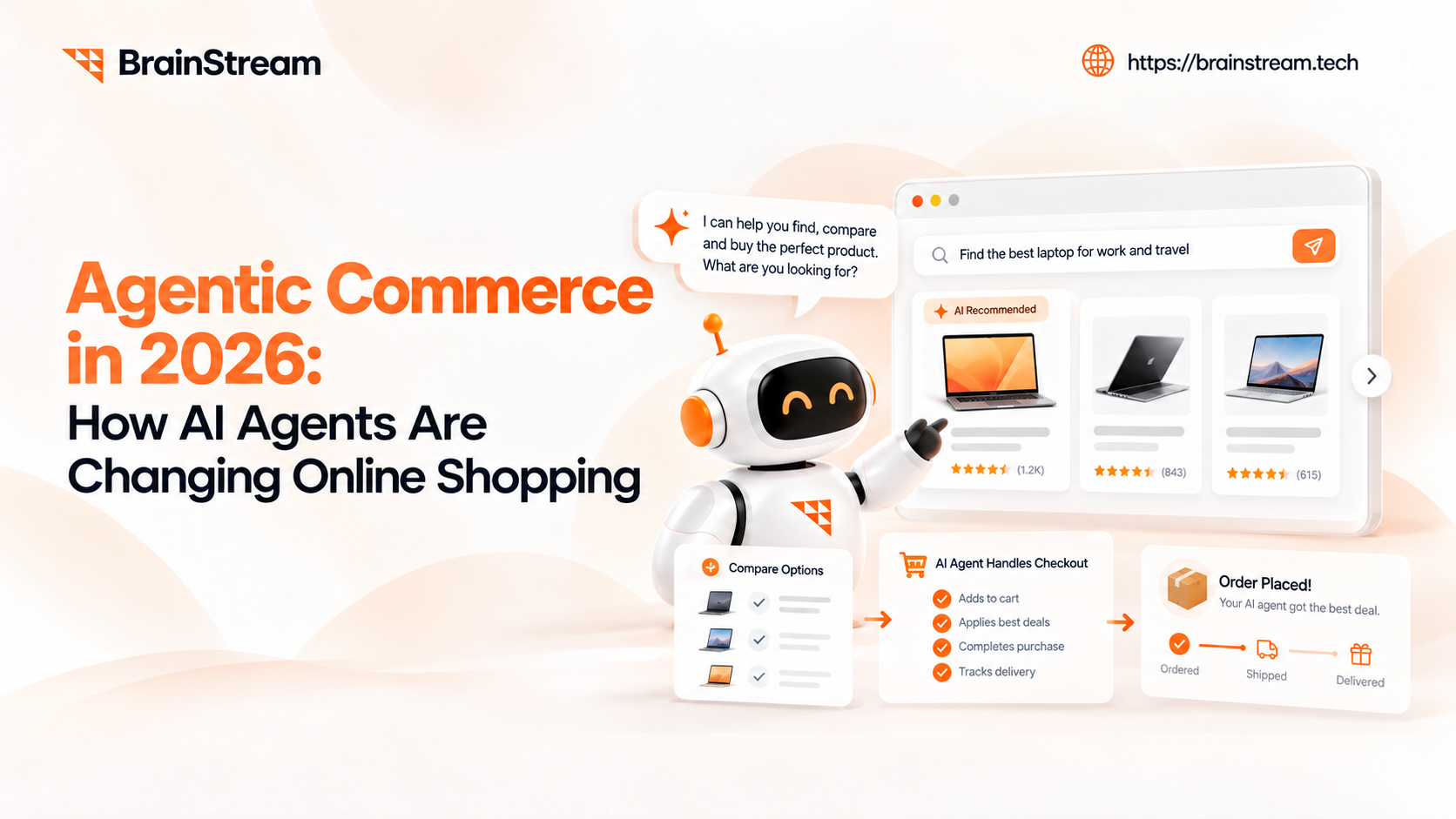
Agentic Commerce in 2026: How AI Agents Are Changing Online Shopping
Agentic commerce is online shopping where AI agents discover, compare, and buy products on a shopper’s behalf, often through conversational experiences such as ChatGPT, Gemini, or Copilot. For eCommerce businesses, this means product data must be clear enough for AI agents, not just human visitors, to understand.
For years, shoppers searched Google, visited online stores, compared products, and completed checkout themselves. AI is now changing that journey.
With agentic commerce, AI agents can help shoppers discover products, compare choices, check prices, and complete shopping tasks. In supported environments, more of the shopping journey can take place within an AI conversation.
This shift is already gaining momentum. Shopify reported that AI-referred orders grew nearly 13 times year over year in Q1 2026. Referral sessions from AI chatbots also grew more than eight times.
For eCommerce businesses, this creates a new opportunity. Stores must now serve both human shoppers and AI agents.
What Is Agentic Commerce?
Agentic commerce is a form of online shopping in which AI agents help customers discover, compare, select, and purchase products.
Unlike a standard chatbot, an AI agent can take actions based on a shopper’s goals.
For example, a customer could ask:
“Find a waterproof travel backpack under $100 that can arrive before Friday.”
An AI shopping agent could understand the request and compare suitable products. It could check price, features, availability, and delivery details.
Depending on the platform, it may also help the customer complete the purchase.
Therefore, shoppers may need fewer searches, clicks, and website visits.
How Does Agentic Commerce Work?
Agentic commerce connects AI systems with eCommerce data and shopping tools.
The process can be simple from the customer’s point of view.
1. The customer explains what they need
Instead of typing several keywords, shoppers can use natural language.
They might ask for a product based on budget, size, colour, purpose, or delivery date.
2. The AI understands the intent
The AI agent identifies important details within the request.
For example, it may recognise a $100 budget, a preferred brand, and a required delivery date.
3. The agent finds suitable products
Next, the agent searches available product information.
It may consider descriptions, specifications, prices, stock, reviews, shipping, and other relevant data.
4. It compares the options
The AI can narrow down the available choices.
Instead of reviewing 30 products, the shopper may receive three highly relevant recommendations.
5. The shopper takes action
Depending on the shopping platform, the customer may continue to the store or complete more of the journey through AI.
This makes online shopping more conversational and goal-focused.
Traditional eCommerce vs Agentic Commerce
Traditional eCommerce requires shoppers to complete most steps themselves.
Agentic commerce can reduce that work.
| Traditional eCommerce | Agentic Commerce |
|---|---|
| Shopper searches using keywords | Shopper describes what they need |
| Customer browses many products | AI finds relevant products |
| Customer compares features | AI can compare options |
| Shopper checks availability | AI can use current product data |
| Customer navigates several pages | Journey may happen within a conversation |
| SEO helps attract search traffic | SEO, GEO, and product data support discovery |
Traditional online stores will not disappear. However, the way customers reach those stores is changing.
Whether a business uses Shopify, Shopware, Magento, or another platform, choosing from the best eCommerce platforms is still important for scalability, integrations, and long-term growth.
How AI Agents Discover and Recommend Products
AI agents need reliable information before they can recommend a product.
They may use product feeds, structured data, APIs, platform catalogs, website content, and other trusted sources.
For example, an agent looking for running shoes may need to understand:
- Product name
- Category
- Size
- Colour
- Price
- Availability
- Material
- Key features
- Shipping information
- Returns information
The clearer this information is, the easier it becomes for AI systems to understand the product.
This creates an important change for eCommerce teams. Product pages should no longer focus only on convincing human visitors.
They must also make product information clear to machines.
How AI Agents Complete Shopping Tasks
AI shopping agents can support more than product discovery.
Agentic AI for eCommerce goes beyond traditional chatbots by enabling AI agents to take actions, such as searching for products, comparing options, building shopping carts, and guiding customers through checkout.
Depending on the platform and available integrations, an agent may help with several tasks.
For example, it could:
- Search for suitable products
- Compare prices and features
- Check product availability
- Review delivery options
- Create or manage a cart
- Guide the shopper toward checkout
- Assist with completing a purchase
Shopify’s agentic commerce infrastructure now supports the journey from product discovery through checkout. Its Universal Commerce Protocol provides a standard for interactions between AI agents and merchants.
However, businesses still need clear controls around payments, customer data, and agent permissions.
Why Product Data Matters for AI Shopping
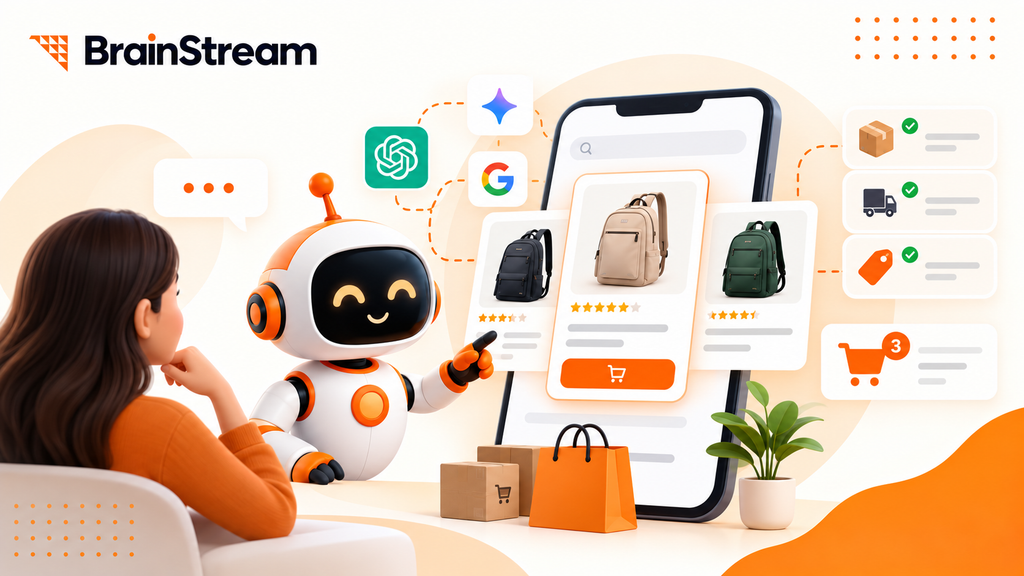
Product data has always mattered in eCommerce. In agentic commerce, it becomes even more important.
An AI agent cannot confidently recommend information it cannot understand.
Imagine two stores selling the same jacket.
One product listing only says:
“Premium Winter Jacket.”
The other includes:
“Men’s waterproof insulated winter jacket, navy blue, available in sizes S–XXL.”
The second description gives the AI much more useful information.
Keep product information complete
Important data can include:
- Accurate product titles
- Detailed descriptions
- Product categories
- Prices
- Current inventory
- Sizes and variants
- Images
- Delivery estimates
- Product specifications
Information should also stay consistent across different channels.
Shopify says its Catalog structures product titles, descriptions, options, images, prices, availability, and other attributes so AI agents can understand them.
Therefore, clean product data is becoming part of an eCommerce store’s AI visibility strategy.
How Agentic Commerce Is Changing Shopify
Shopify has moved quickly into agentic commerce.
In 2026, it expanded its infrastructure to help merchants sell through AI-powered channels.
Shopify Catalog organises product information so AI systems can understand and discover products. Meanwhile, the Universal Commerce Protocol (UCP) helps AI agents interact with commerce systems.
Shopify also introduced Agentic Storefronts.
These allow eligible merchants to reach shoppers across AI experiences, including ChatGPT, Microsoft Copilot, Google AI Mode, and Gemini.
This changes the idea of an online storefront.
A customer’s first interaction with a product may no longer happen on the merchant’s website. Instead, it could happen inside an AI conversation.
For Shopify merchants, this makes accurate product information more important than ever.
Alongside AI-powered shopping experiences, merchants can explore Shopify apps that boost sales to improve conversions, product discovery, and customer engagement.
Agentic Commerce for Shopware and Magento Stores
Agentic commerce is not limited to Shopify. Businesses using Shopware or Magento (Adobe Commerce) can also prepare their online stores for AI-powered product discovery and shopping experiences.
However, these platforms need accurate, accessible product information. For example, AI agents may rely on structured product feeds, Schema.org Product markup, and APIs to understand product details, availability, pricing, and variations.
For Shopware businesses, maintaining clean product attributes and reliable integrations is an important starting point. Our Shopware development services can help businesses improve their eCommerce architecture and integrations.
Similarly, Magento stores should ensure their product catalogue, inventory, and pricing information remain consistent across channels. Secure APIs and reliable data synchronization can support future AI shopping integrations.
BrainStream Technolabs also provides AI solutions for retail and eCommerce to help businesses explore intelligent product discovery, automation, and AI-powered shopping experiences.
How to Prepare Your eCommerce Store for Agentic Commerce
Businesses do not need to rebuild their entire store for AI shopping.
However, they should start improving the foundations now.
Improve your product data
Review titles, descriptions, categories, specifications, variants, prices, and stock information.
Avoid vague product descriptions.
Instead, provide clear details that answer common customer questions.
Use structured data
Structured data helps search engines and other systems understand website content.
Make sure your product markup reflects important information accurately.
Keep prices and stock updated
AI recommendations lose value when they contain outdated information.
Therefore, pricing, inventory, and availability should remain accurate across your systems.
Answer real customer questions
Add useful FAQs and buying information to relevant pages.
Cover topics such as product compatibility, delivery, returns, materials, sizes, and use cases.
Review your technical setup
Check whether important content can be accessed and understood without unnecessary barriers.
Additionally, review your feeds, APIs, platform integrations, and product taxonomy.
Measure AI-driven traffic
Track visitors and conversions coming from AI platforms where possible.
This data can help you understand how AI discovery affects your sales journey.
SEO vs GEO for Agentic Commerce
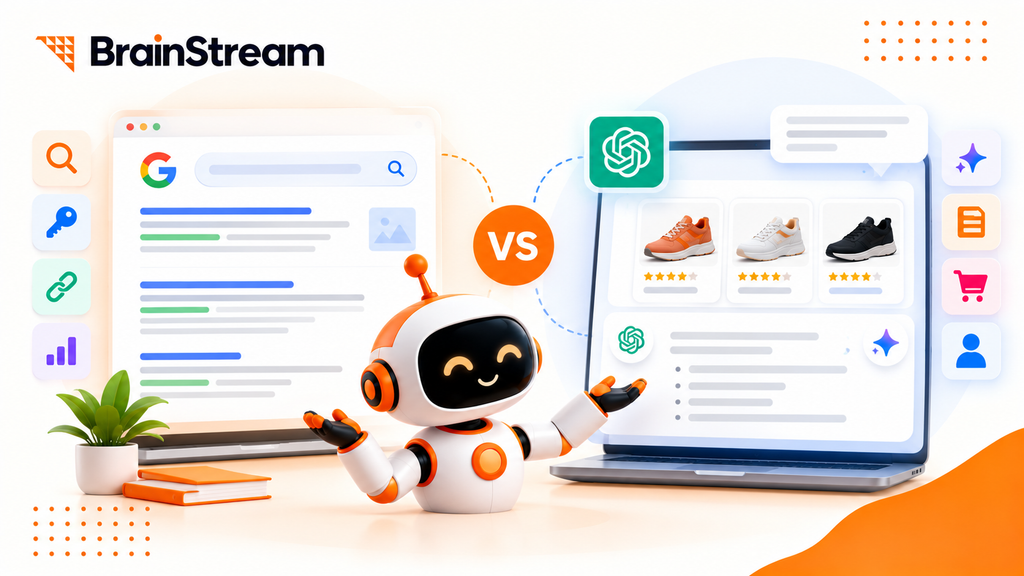
SEO remains important. However, businesses should also understand GEO, or Generative Engine Optimization.
What does SEO do?
Search Engine Optimization helps websites improve visibility in traditional search results.
SEO usually focuses on:
- Keywords
- Helpful content
- Internal links
- Backlinks
- Technical performance
- Structured data
- Search intent
What does GEO do?
Generative Engine Optimization focuses on making content easier for AI systems to understand, trust, and reference.
For eCommerce, GEO may involve:
- Clear product information
- Strong brand signals
- Direct answers
- Consistent product attributes
- Structured content
- Useful FAQs
- Trusted mentions and sources
- Machine-readable product data
SEO and GEO should work together.
SEO helps customers find you through search engines. GEO can improve your chances of appearing during AI-led discovery.
However, neither guarantees an AI platform will recommend a particular product.
Benefits of Agentic AI for eCommerce Businesses
Agentic commerce can create several opportunities for online retailers.
Reach customers through new channels
Customers increasingly use AI tools to research products.
Being accessible to these systems can create another discovery channel.
Connect with high-intent shoppers
AI conversations can contain detailed purchase intent.
For example, “best laptop for video editing under $1,500” tells a retailer much more than the keyword “laptop.”
Reduce shopping friction
AI can help customers narrow down choices quickly.
As a result, shoppers may spend less time searching through large product catalogs.
Improve product discovery
Detailed product data can help AI match products with specific customer needs.
This may give niche products more opportunities to appear for relevant requests.
Create more personalised journeys
AI can consider several requirements at once.
That makes recommendations more useful than simple category or keyword filters in many situations.
Challenges and Security Considerations
Agentic commerce also introduces new risks.
Businesses should not give AI agents unlimited access to systems or customer data.
Customer privacy
AI shopping may involve personal preferences, addresses, payment details, and order information.
Businesses must handle this data carefully.
Incorrect recommendations
AI can misunderstand a request or use incomplete information.
Therefore, accurate and current product data remains essential.
Fraud and malicious agents
Not every automated agent should receive the same access.
Retailers need ways to identify, authenticate, and control automated activity.
Payment security
Purchasing involves sensitive financial actions.
Strong authentication and secure checkout systems remain essential.
Brand experience
Customers may discover a product without visiting the brand’s website first.
Businesses must therefore communicate accurate product information across every supported channel.
Security is becoming a major part of the agentic commerce discussion. Retailers are balancing AI-driven shopping opportunities against concerns around privacy, fraud, data access, and customer experience.
Future of Agentic Commerce
Agentic commerce is still developing, but the direction is becoming clearer.
Shopping is moving from search and browse toward ask, compare, and act.
Customers may increasingly start with requests such as:
“Find the best office chair for back support under $300.”
Instead of visiting several websites, an AI agent could compare available products and present suitable choices.
For businesses, this means the traditional website will remain important. However, it may become one part of a much larger commerce ecosystem.
Product information will travel across search engines, AI assistants, shopping platforms, and other digital experiences.
Shopify is already building around this model. Its current agentic commerce tools are designed to help merchants make products discoverable across supported AI shopping channels.
Businesses that prepare early will be better positioned to adapt as customer behaviour changes.
Businesses planning AI-powered retail solutions should also understand the cost of AI development for eCommerce before investing in automation and AI integrations.
Frequently Asked Questions
Agentic commerce uses AI agents to help people shop online. The agent can discover products, compare options, and assist with buying tasks.
Traditional eCommerce requires customers to search, browse, and compare products themselves. Agentic commerce allows AI to handle more of these steps.
In supported environments, AI agents can assist with actions across the shopping journey. The exact capabilities depend on the platform, merchant, and checkout setup.
Not exactly. Conversational commerce focuses on shopping through conversations. Agentic commerce goes further because an AI agent can take actions on the shopper’s behalf. Businesses exploring conversational shopping experiences can compare AI chatbot options for eCommerce before selecting a solution.
AI agents need accurate product information to understand and compare products. Clear data about price, availability, variants, and features improves that understanding.
No. SEO remains important for search visibility and website discovery. However, businesses should also consider GEO and AI-readable product data.
Start with accurate product data, clear descriptions, correct categories, current inventory, and useful product attributes. Shopify also provides Catalog and Agentic Storefront capabilities for AI commerce.
Conclusion
Agentic commerce is changing online shopping from a browsing experience into a more conversational and action-driven journey.
AI agents can help customers find products, compare options, and complete shopping tasks with fewer steps.
For eCommerce businesses, the message is simple. Keep your product data accurate, improve machine-readable information, and continue investing in SEO.
At the same time, start preparing for GEO and AI-driven product discovery.
You do not need to predict exactly how customers will shop tomorrow. However, you should make sure your products can be understood wherever those customers choose to shop.
For practical implementation steps, read our guide on how to prepare your online store for AI shopping agents in 2027.
Is Your eCommerce Store Ready for AI Shopping Agents?
Want your store ready for AI shopping agents? BrainStream Technolabs builds AI agents, product data pipelines, and agent-ready Shopware and Magento stores.
Talk to Our eCommerce AI Team

Manish Khilwani
Author
Co-Founder at BrainStream Technolabs, he focuses on building people-first, scalable eCommerce and digital products that help brands grow with clarity and innovation.
Table of contents
BLOGS
Learn & Grow with Us
Get the latest updates on trends and strategies that shape the business world. Our insights are here to keep you informed and inspired.
2026 Generative AI Playbook: A Strategic Guide for Business Leaders
The digital landscape has officially crossed a Rubicon. If 2023…
Agentic Commerce in 2026: How AI Agents Are Changing Online Shopping
Agentic commerce is online shopping where AI agents discover, compare,…
AI Advisory & Roadmap Services: How Businesses Build Smarter AI Strategies?
Artificial intelligence is changing how businesses operate. However, many companies…
AI Chatbots in Healthcare: Benefits and Use Cases That Are Transforming Patient Care
AI Chatbots in Healthcare are changing faster than ever. Patients…