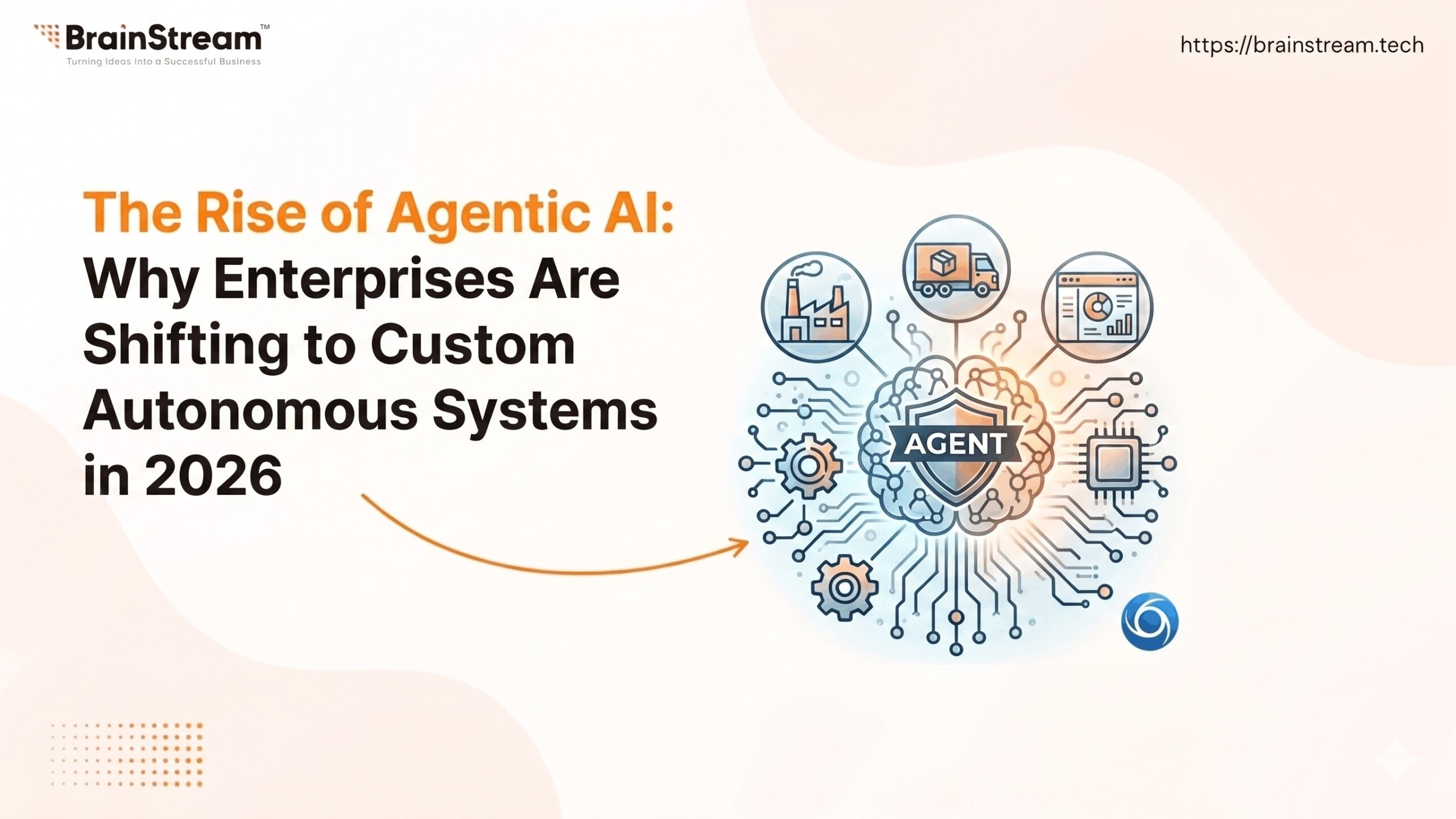
The Rise of Agentic AI: Why Enterprises Are Shifting to Custom Autonomous Systems in 2026
In 2026, the architecture of the artificial intelligence landscape changed completely. We have officially moved past the time of “chatbots” that could only talk to people and generative tools that could only work on their own. Agentic AI is what defines the cutting edge of enterprise IT today. These are autonomous systems that can reason, plan, and carry out complex multi-step workflows across different software environments without human intervention.
For CTOs and other tech leaders, the question is no longer whether to use AI, but how to safely integrate it into their core infrastructure. Basic API wrappers and off-the-shelf generative models aren’t enough for organisations that want to grow. Businesses need custom AI development to really be able to run their own operations, especially in the B2B and B2C SaaS models or in high-volume eCommerce.
Here is a deep dive into why custom autonomous systems are replacing generic AI tools, and how IT leaders are architecting the next generation of enterprise intelligence.
What does “Agentic AI” mean?
Agentic AI is a type of artificial intelligence that can work on its own, understand a big goal, break it down into smaller tasks, connect to external databases and APIs, and take actions to reach that goal. Agentic AI is different from regular Generative AI because it has “agency.” Regular Generative AI just makes text or images based on a prompt. It can use tools, write and run code, query SQL databases, and fix itself if its first attempt doesn’t work.
The Growth of Enterprise AI Architecture
- Phase 1: Generative (2023–2024): AI as a helper. Users tell an LLM to write an email, summarize a document, or make code snippets.
- Phase 2: RAG-Enabled (2025): AI as a source of information. Retrieval-Augmented Generation lets models “read” internal company documents before they answer, which cuts down on hallucinations but still needs a person to start the process.
- Phase 3: Agentic & Autonomous (2026): AI as a worker. An agent is told to do something, like “Audit this eCommerce inventory, find supply chain bottlenecks, and automatically create purchase orders for stock that is running low.” The system runs the whole workflow on its own.
The Limitations of Off-the-Shelf AI for Enterprises
Plug-and-play AI solutions are quick to set up, but they don’t work well in mature IT ecosystems. Companies that use highly customized ERPs, complicated cloud infrastructures, or proprietary SaaS platforms quickly reach the limits of what generic AI can do.
1. Weaknesses in Data Privacy and Security
For businesses that deal with sensitive user data, financial records, or proprietary source code, public LLM APIs are often too risky. Off-the-shelf models send data to external servers, which goes against strict compliance rules like GDPR, HIPAA, or SOC 2. IT teams can use custom AI development to deploy localized, open-source models like Llama 3 or Mistral directly in a private cloud or on-premise environment. This makes sure that no data leaks out.
2. The “Context Window” Bottleneck
Generic models don’t have a strong, long-lasting memory of the specific business logic of an organization. Even though context windows have gotten bigger, constantly feeding a pre-made model a huge amount of documentation for every single query is very expensive and causes significant latency. Custom systems use advanced vector databases (like Pinecone or Milvus) and carefully tuned embeddings to make recall instant and context-aware.
3. Inability to Execute Workflows (Lack of Tool Use)
A regular ChatGPT interface can’t log into your custom Odoo ERP, change a database, and send a message to a certain Slack channel. Custom Agentic AI is built with “Tool Calling” features, which means that developers create specific endpoints that let the AI model safely trigger internal functions and change the whole software ecosystem.
Key IT Use Cases for Custom AI Agents
When custom AI agents are built right into a company’s architecture, the company’s operational capabilities grow by a huge amount.
1. Intelligent eCommerce and Retail Automation
Static algorithms are no longer useful for complicated eCommerce fields. Custom AI agents can take in real-time market data, competitor prices, and past sales trends to change pricing models on the fly. Also, AI agents can automatically look at product images from vendors, create metadata, make sure that the brand is in compliance, and post listings directly to platforms like Shopware or Shopify without having to enter the data by hand.
2. Advanced orchestration for B2B SaaS
Customer churn is closely linked to onboarding problems and complicated interfaces in B2B SaaS settings. IT teams are now putting AI agents right into their SaaS products. An embedded agent lets users control the software with natural language instead of making them use complicated dashboards. The agent takes the user’s request and turns it into backend API calls, which means that the user can use the SaaS platform.
3. Automated Cloud and Infrastructure Triage
DevOps teams are using custom autonomous agents to keep an eye on the health of servers and cloud infrastructure. When a microservice fails, the agent doesn’t just send an alert. It looks through the logs, finds the root cause (like a memory leak), searches the documentation for a fix, and can even restart the node or roll back the most recent deployment on its own, which greatly lowers the Mean Time to Resolution (MTTR).
The Tech Stack: Building an Autonomous Enterprise
To make custom AI agents, you need a special tech stack that combines traditional software engineering with advanced machine learning orchestration. At the level of an IT agency, this usually means:
- Foundation Models: Using fine-tuned open-weight models (like Llama, Claude, and Gemini) based on how much computing power is needed.
- Orchestration Frameworks: Using LangChain, LlamaIndex, or AutoGen to figure out how the agent thinks and how to have conversations with more than one agent.
- Vector Data Infrastructure: Using vector databases that can grow to handle a lot of data to manage enterprise embeddings and run RAG pipelines.
API Middleware: Making middleware that is safe, has a limited number of requests, and requires authentication so that the AI can safely work with old systems, CRMs, and ERPs.
Conclusion: Designing the Future
In 2026, the companies that have AI built into their operational DNA will have the edge over their competitors. When you move from using pre-made tools to building your own Agentic AI, you turn AI from a passive helper into an active, independent worker.
To do this, companies need an IT partner understands about cloud security, complex software architecture, and the latest machine learning frameworks. Businesses can automate complicated tasks, protect their private data, and grow their operations far beyond what humans can do by investing in custom AI development.
FAQs
What is the difference between Generative AI and Agentic AI?
Generative AI makes things like text, code, and images based on what the user tells it to do. Agentic AI, on the other hand, is meant to act on its own. Agentic systems can think, plan multi-step processes, interact with other software through APIs, and finish complicated workflows without needing help from people all the time.
Why should a company invest in custom AI development instead of using existing AI tools?
Companies invest in custom AI development to protect their proprietary data, reduce latency, and make AI a core part of their business logic. Businesses can run models locally for strict compliance, fine-tune models on their own data sets, and build agents that can do tasks in their own ERP, SaaS, or eCommerce environments with custom development.
How does an AI agent interact with existing enterprise software?
AI agents use a method called “Tool Calling” to talk to existing business software. Developers make secure API bridges that let the language model turn natural language intentions into specific programming commands. This lets the AI read, write, and carry out tasks in databases, CRMs, and cloud infrastructures.
What does RAG (Retrieval-Augmented Generation) mean in custom AI?
Retrieval-Augmented Generation (RAG) is a way to build a language model that uses a company’s private, verified data to support its answers. The AI system looks through an internal vector database for relevant facts before answering a question. This makes sure that the answer is accurate, company-specific, and not a hallucination.

Manish Khilwani
Author
Co-Founder at BrainStream Technolabs, he focuses on building people-first, scalable eCommerce and digital products that help brands grow with clarity and innovation.
Table of contents
BLOGS
Learn & Grow with Us
Get the latest updates on trends and strategies that shape the business world. Our insights are here to keep you informed and inspired.
How Much Does AI Integration into a Symfony Application Cost in 2026?
Adding artificial intelligence to your Symfony application can improve customer…
Modernizing Legacy Symfony Applications with AI: Where to Start
Your Symfony application still runs your business. However, adding features…
Agentic Commerce in 2026: How AI Agents Are Changing Online Shopping
Online shopping is entering a new phase. For years, shoppers…
Top 7 Must-Have Bagisto Extensions to Improve Your eCommerce Store in 2026
Running an online store takes more than adding products and…