











Summary:
Customer Acquisition Cost is rising across industries due to increasing competition and inefficient marketing processes. This guide explains how businesses can use automation and AI tools to reduce CAC by improving lead qualification, optimizing ad spend, personalizing customer journeys, and streamlining sales workflows for sustainable growth.
January 9, 2026
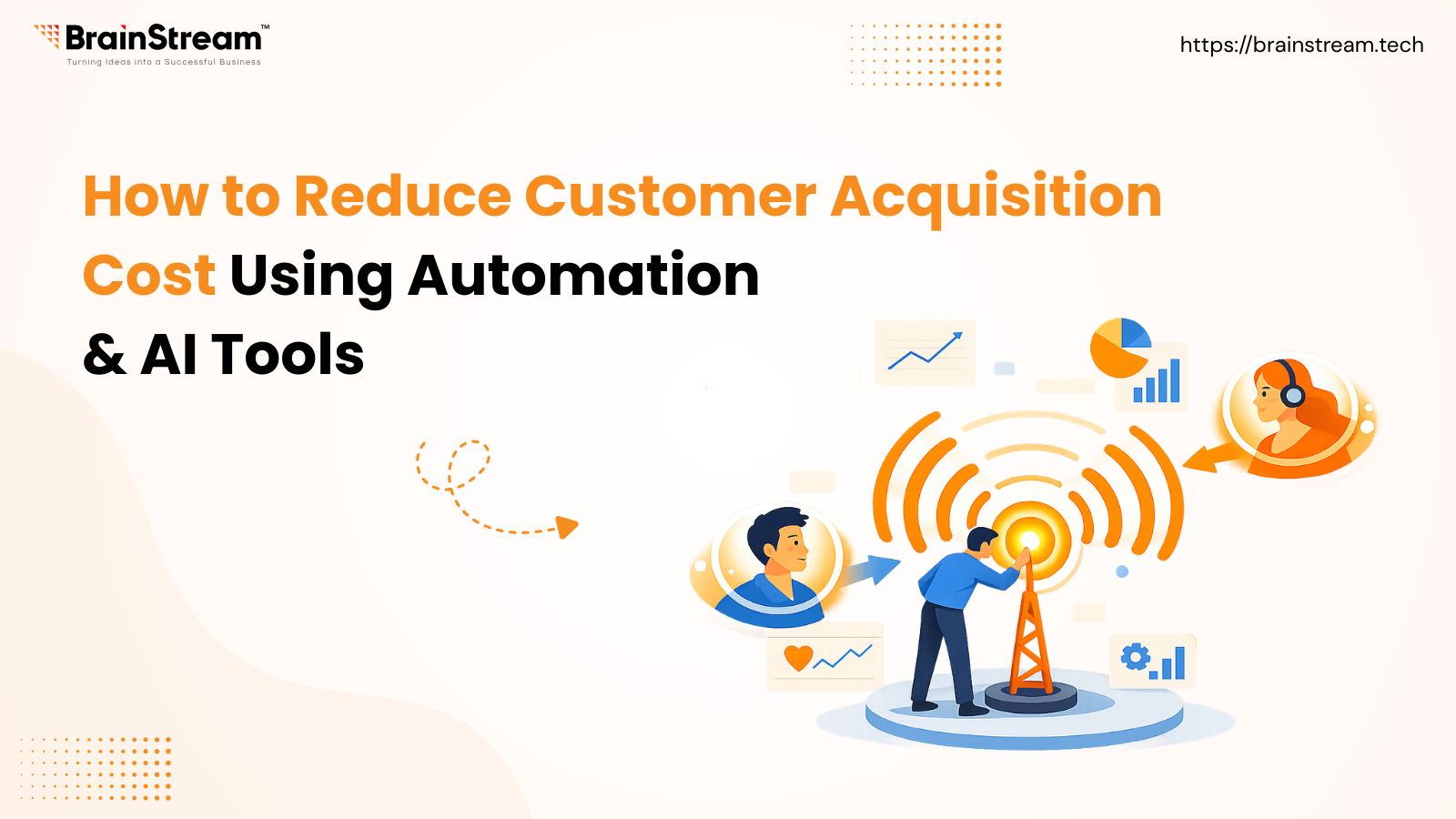
A Practical Growth Guide for Modern Businesses, Customer Acquisition Cost (CAC) is one of the most important metrics for any growing business. No matter how strong your product or service is, high acquisition costs can silently kill profitability and slow down long-term growth.
With rising ad costs, increasing competition, and shorter attention spans, traditional customer acquisition methods are becoming expensive and inefficient. This is where automation and AI-powered tools are transforming the way businesses acquire customers, helping them reduce CAC while improving conversion rates.
In this guide, we’ll explore how automation and AI can practically help reduce Customer Acquisition Cost (CAC), which processes to automate, and how modern businesses can build a scalable, cost-efficient acquisition engine.
What Is Customer Acquisition Cost (CAC)?
Customer Acquisition Cost refers to the total amount a business spends to acquire a new customer.
CAC Formula:
Customer Acquisition Cost = Total Sales & Marketing Spend ÷ Number of New Customers Acquired
This includes:
- Advertising costs
- Marketing software and tools
- Sales team salaries
- Agency or consulting fees
- Automation and CRM expenses
A healthy CAC ensures sustainable growth, while a rising CAC indicates inefficiencies in marketing, sales, or targeting strategies.
Why CAC Is Increasing Across Industries
Many businesses are experiencing higher CAC due to:
- Increasing competition on paid advertising platforms
- Poor-quality leads entering sales pipelines
- Manual marketing and sales processes
- Low conversion rates and slow follow-ups
- Limited data-driven decision-making
Automation and AI directly address these challenges by eliminating inefficiencies and improving precision.
How Automation & AI Help Reduce CAC
The core purpose of automation and AI is simple:
- Reduce manual effort
- Improve lead quality
- Increase conversion rates
- Minimize wasted marketing spend
When applied strategically, they help businesses acquire customers faster and at a lower cost.
1. AI-Based Lead Scoring & Qualification
One of the biggest contributors to high CAC is spending time and money on unqualified leads.
AI-powered lead scoring systems analyze:
- Website behavior
- Email engagement
- Page visits and session duration
- Past conversion data
Using this data, AI assigns a score to each lead based on purchase intent.
Why this matters: Sales teams focus only on high-intent leads, improving close rates and reducing time wasted on cold prospects.
2. Marketing Automation for Lead Nurturing
Manual follow-ups often lead to missed opportunities and inconsistent communication.
Marketing automation enables:
- Automated email sequences
- Behavior-triggered follow-ups
- Personalized nurturing workflows
- Timely engagement without manual effort
Leads stay engaged throughout the buyer journey, increasing the likelihood of conversion without additional marketing spend.
3. AI-Powered Advertising Optimization
Traditional advertising relies heavily on manual testing and assumptions. AI changes that.
AI-driven ad platforms:
- Identify top-performing ads automatically
- Optimize bidding strategies in real time
- Pause low-performing campaigns
- Continuously refine audience targeting
Result: Less budget wasted on underperforming ads and a lower cost per acquisition.
4. Chatbots & Conversational AI for Faster Conversions
Many potential customers leave websites due to delayed responses or unanswered questions.
AI-powered chatbots:
- Provide instant responses 24/7
- Answer FAQs and qualify leads
- Capture visitor information automatically
- Push leads directly into CRM systems
Chatbots significantly improve engagement rates and convert visitors who would otherwise leave, without increasing sales staff costs.
5. AI-Driven Personalization to Improve Conversion Rates
Generic messaging no longer works in competitive markets.
AI enables personalization by:
- Adapting content based on user behavior
- Delivering personalized email subject lines
- Showing relevant services or solutions dynamically
Higher personalization leads to higher conversion rates, meaning you acquire more customers using the same marketing budget, lowering CAC.
6. Sales & CRM Automation for Faster Deal Closures
Manual CRM management is time-consuming and error-prone.
CRM automation helps by:
- Automatically assigning leads
- Scheduling follow-ups
- Updating deal stages
- Sending reminders and notifications
This speeds up the sales cycle and reduces customer acquisition costs by converting leads faster and more efficiently.
7. Predictive Analytics for Smarter Budget Allocation
AI doesn’t just analyze past data; it predicts future outcomes.
Predictive analytics helps businesses:
- Identify the most profitable acquisition channels
- Forecast customer lifetime value
- Detect churn risks early
- Allocate budgets more effectively
This prevents unnecessary experimentation and ensures marketing spend is focused on high-return channels.
Best Automation & AI Use Cases for Lower CAC
While tools matter, strategy matters more.
Successful businesses typically automate:
- Lead qualification and routing
- Email and follow-up campaigns
- Advertising optimization
- Website engagement
- CRM and pipeline management
- Performance analytics and reporting
When these systems work together, CAC naturally declines.
Common Mistakes to Avoid
Automation and AI can increase CAC if used incorrectly.
Avoid:
- Over-automation without personalization
- Using multiple tools without integration
- Ignoring data quality
- Removing human interaction where it’s still needed
Automation should enhance human decision-making, not replace it entirely.
Final Thoughts
Reducing CAC is not about spending less; it’s about spending smarter.
Automation and AI allow businesses to:
- Target the right audience
- Engage leads more effectively
- Convert customers faster
- Eliminate marketing and sales inefficiencies
Companies that adopt AI-driven automation today gain a long-term competitive advantage by achieving sustainable growth with lower acquisition costs.
FAQs
1. What is Customer Acquisition Cost (CAC)?
Customer Acquisition Cost (CAC) is the total amount a business spends on sales and marketing to acquire a single new customer. It includes advertising costs, tools, salaries, and operational expenses.
2. How does automation help reduce CAC?
Automation reduces CAC by eliminating manual tasks, improving follow-ups, nurturing leads efficiently, and ensuring faster conversions—without increasing marketing or sales costs.
3. Can AI really lower marketing and advertising costs?
Yes. AI optimizes ad targeting, bidding strategies, and campaign performance in real time, reducing wasted spend and improving conversion rates.
4. Which AI tools are most effective for reducing CAC?
AI-powered CRMs, marketing automation platforms, ad optimization tools, chatbots, and predictive analytics systems are most effective when integrated into a unified growth strategy.
5. Is automation suitable for small and mid-sized businesses?
Absolutely. Automation and AI help small and mid-sized businesses compete with larger companies by reducing manual effort, improving efficiency, and lowering customer acquisition costs.
6. What mistakes should businesses avoid when using AI for CAC reduction?
Common mistakes include over-automation, poor data quality, lack of tool integration, and removing the human touch where personal interaction is still important.

Manish Khilwani 

Co-Founder at BrainStream Technolabs, he focuses on building people-first, scalable eCommerce and digital products that help brands grow with clarity and innovation.
Share :


Related Blog
Automation
AI-Driven Product Optimization App – Supercharging E-Commerce with OpenAI & N8N
E-commerce product content isn't words. It's the bond between your products and your buyers. Your product title is seen, your detailed description is trusted, and correctly structured metadata makes your products found on search engines. But creating optimised content for...
Automation
n8n vs Make.com: Which Low-Code Automation Tool Is Best for 2026?
n8n vs Make.com – In today's era of no-code and low-code tools, automating workflows is easier than ever. Whether you are automating marketing tasks, syncing databases, or integrating your favourite SaaS apps, automation platforms like n8n and Make.com (previously Integromat)...
Automation
Lead Management on Autopilot: A No-Code Blueprint for Busy Teams
In today's fast-paced world, staying on top of user data and having everything run smoothly from one platform to the next is the key to having a seamless business. If you're like us and wish to automate without going into...


Keep up-to-date with our newsletter.
Sign up for our newsletter to receive weekly updates and news directly to your inbox.