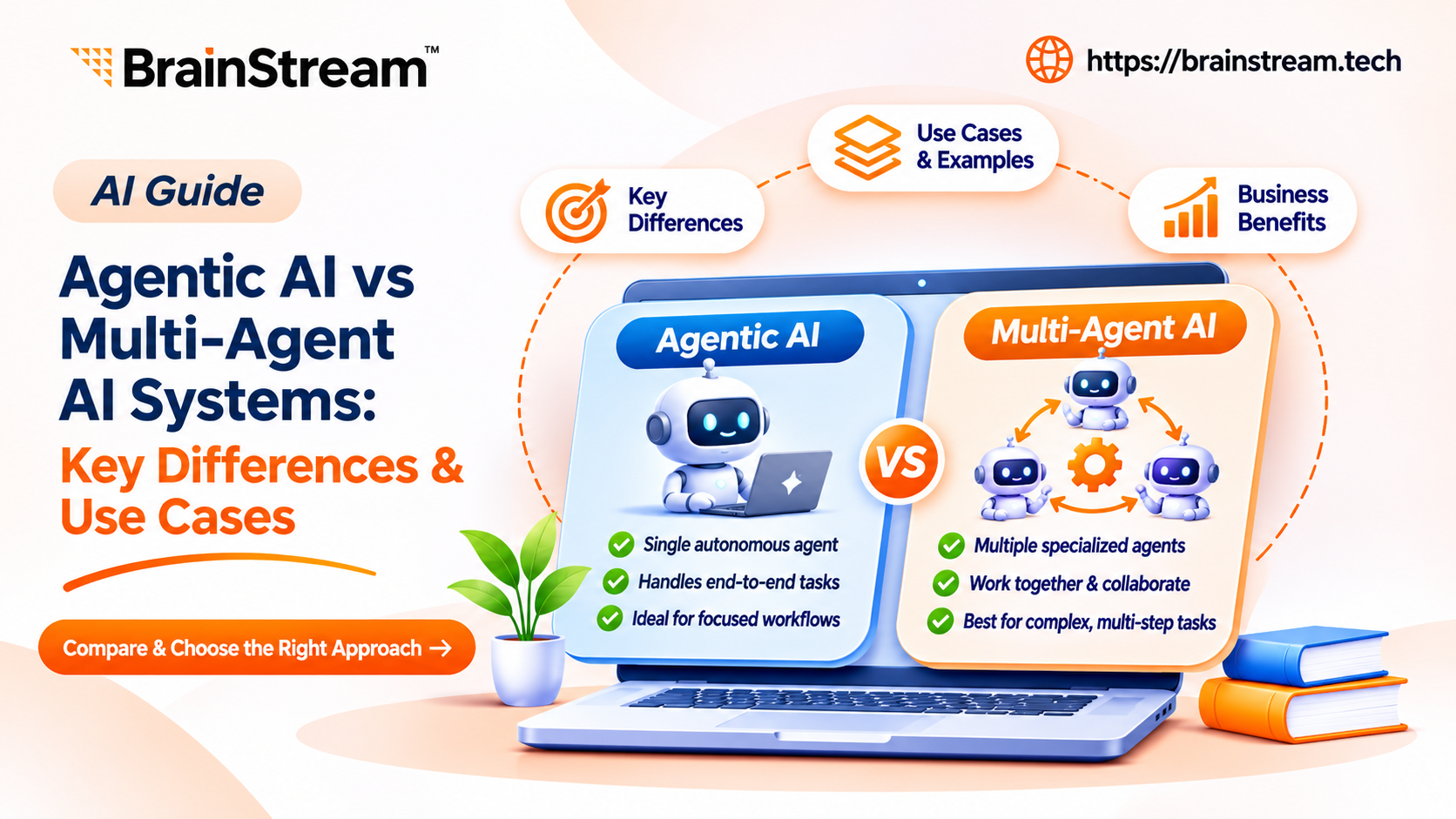
Agentic AI vs Multi-Agent AI Systems
Understanding Agentic AI vs Multi-Agent AI systems can help businesses choose the right automation strategy.
Traditional AI tools often respond to instructions. However, modern AI agents can plan tasks, use tools, and work towards specific goals.
Some applications use a single intelligent agent. Meanwhile, others use multiple agents that collaborate to complete complex tasks.
But which approach is right for your business?
This guide explains their differences, benefits, challenges, costs, and practical business applications.
Agentic AI vs Multi-Agent AI: Quick Answer
Agentic AI describes artificial intelligence that can plan, make decisions, and take actions towards defined goals.
In contrast, multi-agent AI describes an architecture where multiple agents interact to complete tasks.
However, these concepts are not mutually exclusive. A multi-agent system can also be agentic.
What Is Agentic AI?
Agentic AI refers to AI systems that pursue specific goals with a degree of autonomy.
Instead of simply answering questions, these systems can select tools, perform tasks, and adjust their actions based on results.
For example, an AI sales agent can review customer enquiries, qualify leads, and schedule follow-up activities within approved permissions.
Additionally, it can connect with existing CRM software to update customer records.
How Does Agentic AI Work?
A typical agentic AI workflow includes five stages:
- Receive a goal or business instruction.
- Create a plan to achieve the goal.
- Select suitable tools and information sources.
- Perform actions within defined permissions.
- Review results and adjust the plan when necessary.
As a result, businesses can automate workflows that require flexible decision-making.
Benefits of Agentic AI
- Reduces repetitive manual tasks.
- Supports goal-based automation.
- Adapts to changing workflow conditions.
- Connects with existing business applications.
- Helps employees manage routine activities.
However, businesses must establish clear permissions and human approval rules.
Businesses can explore agentic AI for enterprise automation to understand how autonomous systems support business operations.
What Are Multi-Agent AI Systems?
Multi-agent AI systems use multiple intelligent agents that interact within a shared environment.
Each agent can handle a specific responsibility. Together, they can complete tasks that require different capabilities.
For example, an eCommerce business may use separate agents for inventory management, customer support, and order processing.
Meanwhile, a coordinating agent can manage communication between these agents.
How Do Multi-Agent AI Systems Work?
Consider an automated order management workflow.
- An order agent receives a customer order.
- Next, an inventory agent checks product availability.
- A payment agent verifies payment status.
- Then, a logistics agent prepares delivery arrangements.
- Finally, a support agent provides order updates.
This approach divides complex workflows into smaller responsibilities.
Developers can use suitable agentic AI frameworks to manage communication, tool access, and collaboration between multiple agents.
Benefits of Multi-Agent AI Systems
- Supports complex business workflows.
- Allows agents to specialize in specific tasks.
- Enables parallel task execution where appropriate.
- Supports automation across multiple departments.
- Makes individual agent responsibilities easier to define.
However, agent coordination requires careful planning and monitoring.
Agentic AI vs Multi-Agent AI: Key Differences
Both approaches can support intelligent automation. However, they describe different aspects of AI system design.
The following comparison uses a single-agent implementation of agentic AI to illustrate the architectural differences.
| Feature | Single-Agent Agentic AI | Multi-Agent AI |
|---|---|---|
| Architecture | One primary agent | Multiple interacting agents |
| Task management | Centralized | Distributed or coordinated |
| Decision-making | One agent handles decisions | Agents share responsibilities |
| Development complexity | Generally lower | Generally higher |
| Communication | Limited internal coordination | Inter-agent communication |
| Maintenance | Usually simpler | Requires additional monitoring |
| Best suited for | Focused workflows | Complex, interconnected workflows |
Therefore, businesses should choose an architecture based on their workflow requirements rather than the number of agents alone.
Business Use Cases of Agentic AI
Agentic AI can help businesses automate tasks that require independent planning and tool usage.
For example, common applications include:
- Automated lead qualification.
- Intelligent customer support.
- Business report generation.
- Employee knowledge assistants.
- Automated appointment scheduling.
Additionally, businesses can connect these agents with CRM, ERP, and other software platforms.
A single agent often provides a practical starting point for focused business automation.
Business Use Cases of Multi-Agent AI Systems
Multi-agent systems can support workflows that involve several departments or specialized tasks.
eCommerce Automation
Different agents can manage product information, inventory, orders, and customer enquiries.
As a result, businesses can coordinate multiple commerce activities.
Enterprise Resource Planning
Specialized agents can support purchasing, inventory management, and financial reporting.
Additionally, these agents can share relevant information across connected systems.
Software Development
Separate agents can assist with code generation, testing, documentation, and code review.
However, developers should validate outputs before deploying changes.
Customer Relationship Management
Multiple agents can support lead qualification, sales follow-ups, and customer service.
Together, they can help businesses manage different stages of the customer journey.
Agentic AI vs Multi-Agent AI: Cost Comparison
Development costs depend on workflow complexity, integrations, model usage, and security requirements.
| Cost factor | Single-Agent AI | Multi-Agent AI |
|---|---|---|
| Initial development | Generally lower | Generally higher |
| System integration | Fewer components | Multiple components |
| AI model usage | Depends on task volume | May increase with agent interactions |
| Testing | Focused workflow testing | Agent and coordination testing |
| Maintenance | Usually simpler | More coordination and monitoring |
For detailed budget planning, review the factors that influence AI agent development costs.
However, adding more agents does not automatically improve business results.
Therefore, businesses should measure task accuracy, operating costs, and time savings before expanding their AI systems.
Common Implementation Challenges
Both approaches require reliable data, clear instructions, and appropriate security controls.
For instance, AI agents may misunderstand instructions or generate incorrect outputs.
Meanwhile, multi-agent systems can introduce communication errors, conflicting decisions, and unnecessary processing costs.
To reduce these risks, businesses should define agent responsibilities, limit tool permissions, and monitor important actions.
Additionally, human approval should remain mandatory for sensitive or high-impact decisions.
Which AI Approach Should Your Business Choose?
Start with a single-agent architecture when your business needs to automate a focused workflow.
In contrast, consider a multi-agent architecture when different tasks require specialized tools, responsibilities, or independent processing.
However, avoid unnecessary complexity during the early development stages.
First, build a small pilot project. Next, evaluate its performance against measurable business goals.
Finally, introduce additional agents only when they provide clear operational value.
FAQs
1. What is the difference between Agentic AI and Multi-Agent AI?
Agentic AI describes goal-oriented AI behavior. Multi-Agent AI describes an architecture involving multiple interacting agents. A multi-agent system can also use agentic AI.
2. Is Multi-Agent AI better than Agentic AI?
Not necessarily. Multiple agents can help with complex workflows. However, a single agent may offer better simplicity and lower operating costs.
3. Can Agentic AI and Multi-Agent AI work together?
Yes. Businesses can build multi-agent systems where individual agents independently plan and perform specialized tasks.
4. Are multi-agent systems more expensive?
Generally, they require additional development, testing, and coordination. However, actual costs depend on the system architecture and workload.
5. Can small businesses use Agentic AI?
Yes. Small businesses can start with focused AI agents for customer support, sales automation, or internal knowledge management.
Conclusion
The Agentic AI vs Multi-Agent AI comparison highlights two important concepts in modern business automation.
While agentic AI focuses on goal-oriented behavior, multi-agent systems focus on collaboration between multiple agents.
At BrainStream Technolabs, we provide AI agent development services to help businesses build intelligent agents, automate workflows, and implement multi-agent systems.
Start with the right architecture to build a reliable AI solution that supports your business goals.

Manish Khilwani
Author
Co-Founder at BrainStream Technolabs, he focuses on building people-first, scalable eCommerce and digital products that help brands grow with clarity and innovation.
Table of contents
BLOGS
Learn & Grow with Us
Get the latest updates on trends and strategies that shape the business world. Our insights are here to keep you informed and inspired.
2026 Generative AI Playbook: A Strategic Guide for Business Leaders
The digital landscape has officially crossed a Rubicon. If 2023…
Agentic AI vs Multi-Agent AI Systems
Understanding Agentic AI vs Multi-Agent AI systems can help businesses…
Agentic Commerce in 2026: How AI Agents Are Changing Online Shopping
Agentic commerce is online shopping where AI agents discover, compare,…
AI Advisory & Roadmap Services: How Businesses Build Smarter AI Strategies?
Artificial intelligence is changing how businesses operate. However, many companies…