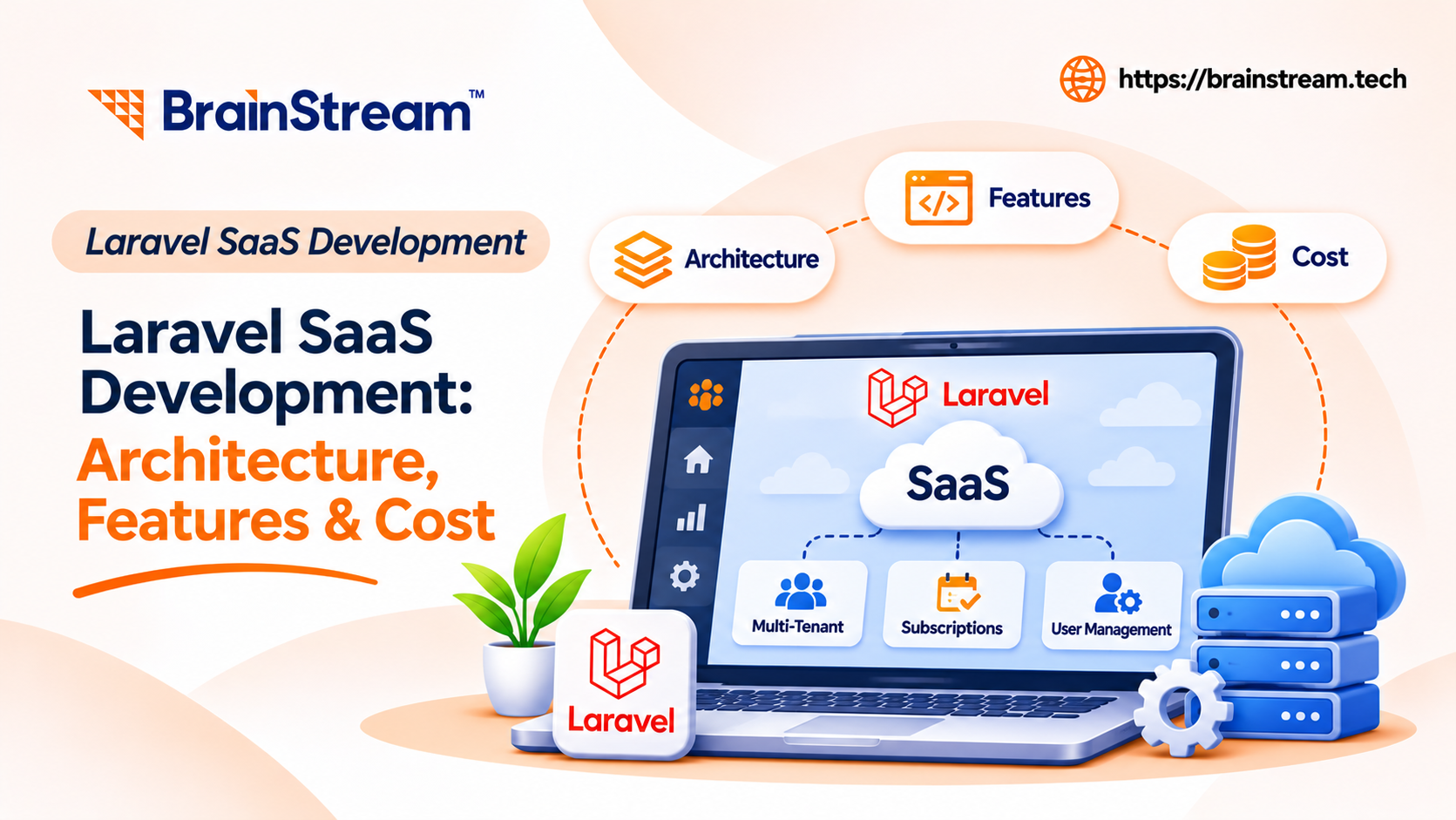
Laravel SaaS Development: Architecture, Features & Cost
Building a software product is exciting. However, turning that idea into a successful business requires the right technology.
Many startups struggle with development costs, security, and future growth. That’s where Laravel SaaS development becomes useful.
Laravel helps businesses create subscription-based applications with flexible features and reliable performance.
In this guide, we’ll explore Laravel SaaS architecture, essential features, development steps, and estimated costs.
What Is Laravel SaaS Development?
Laravel SaaS development involves building cloud-based software applications using the Laravel PHP framework.
SaaS stands for Software as a Service. Instead of installing software, customers access applications online through subscriptions.
For example, project management tools, CRM platforms, and accounting applications often use SaaS models.
Laravel provides useful tools for authentication, database management, APIs, and background tasks.
Businesses planning custom SaaS platforms can explore Laravel development services to build secure and scalable applications.
As a result, developers can build custom SaaS applications without creating every component from scratch.
Why Choose Laravel for SaaS Development?
Laravel offers several advantages for startups and growing businesses.
Faster Development
Laravel includes ready-to-use development tools. Therefore, developers can focus on building features rather than repetitive coding tasks.
Flexible Architecture
Professional web development services can also help businesses design flexible applications that support changing requirements.
Businesses can start with basic features and expand their applications later.
Additionally, Laravel supports third-party integrations and custom business workflows.
Strong Security Features
Laravel provides authentication, authorization, encryption, and protection against common web attacks.
However, developers must still follow secure coding practices.
Easier Maintenance
Laravel’s organized structure helps development teams manage updates, fix issues, and improve applications over time.
Understanding Laravel SaaS Architecture
A strong architecture helps your application support multiple customers while protecting their information.
Multi-Tenant Architecture
Multi-tenancy allows multiple businesses to use one application while keeping their data separate.
Developers commonly use two approaches:
- Shared database: Multiple tenants share one database with proper data separation.
- Separate databases: Each tenant uses an individual database for stronger isolation.
The right approach depends on security, budget, and scalability requirements.
Application Layer
This layer handles user requests, business rules, permissions, and application features.
Laravel controllers, services, and middleware help organize these operations.
Database and Storage
SaaS applications store customer records, subscriptions, files, and business information.
Laravel supports relational databases such as MySQL and PostgreSQL.
Background Processing
Some operations require additional processing time.
Laravel queues help manage emails, reports, notifications, and other background tasks without slowing user requests.
Essential Features of a Laravel SaaS Application
A successful SaaS product needs more than an attractive dashboard.
Important features include:
- User authentication: Secure login, registration, and password recovery.
- Subscription management: Monthly or yearly plans with billing options.
- Role-based access: Different permissions for administrators and users.
- Tenant management: Separate customer accounts and business data.
- Payment integration: Secure payments through supported gateways.
- Analytics dashboard: Useful reports and performance insights.
- API integration: Connections with CRM, ERP, and other platforms.
- Notifications: Automated emails and important updates.
For subscription billing, developers can use Laravel Cashier with supported payment providers.
Laravel SaaS Development Process
Building a SaaS application requires proper planning and execution.
Step 1: Define Your Requirements
Identify your target customers, business problems, and essential features.
Start with a minimum viable product (MVP) to test your idea.
Step 2: Plan the Architecture
Choose your database structure, tenant isolation method, and hosting environment.
Also, consider future traffic and security requirements.
Step 3: Develop Core Features
Build authentication, dashboards, subscriptions, and important business workflows.
Keep the interface simple and easy to navigate.
For complex SaaS projects, businesses can work with experienced Laravel developers to build custom features and reliable integrations.
Step 4: Test the Application
Check performance, security, payments, and tenant data isolation.
Additionally, test the application across different devices.
Step 5: Launch and Maintain
Deploy your application to a suitable cloud environment.
Finally, monitor performance, resolve issues, and release improvements.
How Much Does Laravel SaaS Development Cost?
Laravel SaaS development costs vary depending on features, complexity, and team experience.
The following figures are illustrative planning estimates, not fixed market prices.
| Project type | Estimated cost |
|---|---|
| Basic SaaS MVP | $5,000–$15,000 |
| Medium SaaS application | $15,000–$40,000 |
| Complex SaaS platform | $40,000–$100,000+ |
Several factors influence development costs:
- Application complexity
- Number of features
- UI/UX design requirements
- Third-party integrations
- Security and infrastructure
- Ongoing maintenance
Starting with an MVP can help businesses control initial spending.
Common Laravel SaaS Development Mistakes
Avoid these mistakes when building your application:
- Ignoring scalability: Plan for increasing users and data.
- Weak tenant isolation: Protect customer information with proper access controls.
- Adding too many features: Focus on essential functionality first.
- Skipping testing: Test important workflows before launch.
- Underestimating maintenance: Budget for hosting, security, and updates.
Frequently Asked Questions
1. Is Laravel good for SaaS development?
Yes, Laravel is a strong choice for Software as a Service (SaaS) development because it provides a flexible framework, organized application architecture, and built-in tools that simplify development. Laravel supports authentication, authorization, database management, API development, background jobs, and automated testing. These features help developers build subscription-based applications, customer portals, business management systems, and other SaaS products. Laravel also integrates with payment gateways, cloud services, and third-party APIs. With proper planning and architecture, Laravel SaaS development can support secure, maintainable, and scalable applications for businesses of different sizes.
2. Does Laravel support multi-tenancy?
Yes, Laravel supports the development of multi-tenant SaaS applications, although multi-tenancy must be implemented through application architecture or specialized packages. Developers can use a shared database with tenant-specific records, separate databases for individual tenants, or a hybrid approach depending on security, performance, and operational requirements. Laravel packages such as stancl/tenancy and Spatie Laravel Multitenancy can help manage tenant identification, database connections, and tenant-specific application behavior. Choosing the right Laravel multi-tenancy architecture is important for maintaining data isolation, simplifying administration, and supporting future application growth.
3. How long does Laravel SaaS development take?
Laravel SaaS development timelines depend on application complexity, required features, integrations, and team resources. A basic Minimum Viable Product (MVP) with essential functionality may take approximately two to four months to develop. More complex SaaS platforms involving multi-tenancy, subscription billing, advanced dashboards, custom APIs, and third-party integrations can require six months or longer. The development process typically includes requirements gathering, UI/UX design, architecture planning, backend development, frontend implementation, testing, and deployment. Defining clear project requirements and prioritizing essential features can help businesses reduce development delays and launch their SaaS products more efficiently.
4. Can Laravel handle large SaaS applications?
Yes, Laravel can support large SaaS applications when developers implement suitable architecture, database optimization, caching, and scalable infrastructure. Laravel provides features such as queues, scheduled tasks, API development, and integration with caching systems like Redis. Businesses can also use load balancing, cloud hosting, database indexing, and horizontal scaling to manage increasing traffic and application workloads. However, scalability depends on application design, infrastructure capacity, and ongoing performance monitoring rather than the framework alone. With proper Laravel SaaS architecture and optimization, businesses can build applications that support growing user bases and changing operational requirements.
Conclusion
Laravel SaaS development offers businesses a flexible way to build subscription-based software.
Its architecture, development tools, and integration options make it suitable for startups and enterprises.
However, success depends on planning, security, and choosing the right development approach.
BrainStream Technolabs helps businesses build custom Laravel applications that support their goals and future growth.
BrainStream Technolabs offers custom Laravel development services to help businesses create secure SaaS platforms with scalable architecture and reliable performance.

Manish Khilwani
Author
Co-Founder at BrainStream Technolabs, he focuses on building people-first, scalable eCommerce and digital products that help brands grow with clarity and innovation.
Table of contents
BLOGS
Learn & Grow with Us
Get the latest updates on trends and strategies that shape the business world. Our insights are here to keep you informed and inspired.
2026 Generative AI Playbook: A Strategic Guide for Business Leaders
The digital landscape has officially crossed a Rubicon. If 2023…

Agentic Commerce in 2026: How AI Agents Are Changing Online Shopping
Agentic commerce is online shopping where AI agents discover, compare,…
AI Advisory & Roadmap Services: How Businesses Build Smarter AI Strategies?
Artificial intelligence is changing how businesses operate. However, many companies…
AI Agent Security: How to Control Access, Data and Autonomous Actions
AI agents can do more than answer questions. They can…