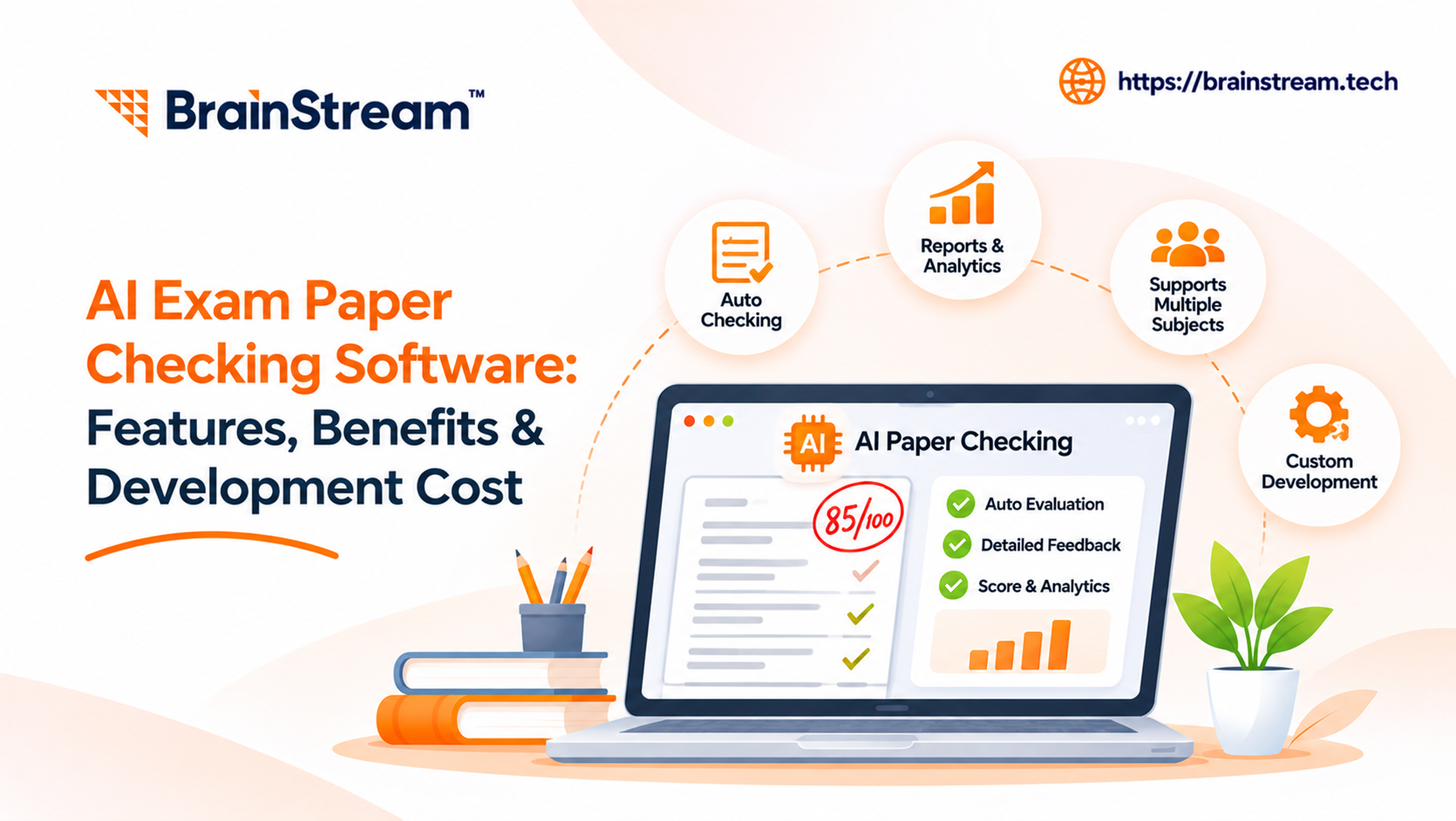
AI Exam Paper Checking Software: Features, Benefits & Development Cost
Checking hundreds or thousands of exam papers takes time, especially when teachers must evaluate handwritten answers, assign marks, and prepare student reports. Schools, universities, and educational institutions often face challenges with manual grading, delayed results, and inconsistent evaluation.
Exam Paper Checking Software helps educational institutions digitize and streamline the assessment process. When powered by artificial intelligence (AI), the software can recognize written answers, compare responses with marking criteria, suggest scores, and generate performance reports.
However, AI does not eliminate the need for teachers. Human review remains important, particularly for subjective answers, complex questions, and high-stakes examinations.
Today, educational institutions can choose to develop custom AI exam paper checking software that aligns with their examination formats, grading policies, and existing learning management systems.
In this guide, we explain how AI-powered exam paper evaluation works, its essential features, benefits, development requirements, and cost considerations.
How We Selected These CRM Development Companies
We considered publicly described CRM capabilities, integration experience, service focus, and suitability for different project requirements.
The companies serve different needs. Some focus on enterprise CRM platforms, while others provide custom development or integration services.
Before selecting a provider, request relevant case studies, technical references, delivery terms, and a project-specific quotation.
What Is Exam Paper Checking Software?
Exam Paper Checking Software is a digital solution that helps schools, colleges, and examination boards evaluate student answer sheets, calculate marks, manage grading workflows, and generate examination results.
Traditional systems primarily support objective assessments and predefined marking rules. Modern AI-powered solutions can also assist with handwritten answer recognition, short-answer evaluation, and feedback generation.
An AI exam paper checking system may use several technologies, including:
- Optical Character Recognition (OCR): Extracts printed text from scanned exam papers.
- Handwriting Recognition: Converts handwritten answers into machine-readable text.
- Natural Language Processing (NLP): Helps interpret written responses and identify relevant concepts.
- Machine Learning (ML): Supports answer classification and pattern recognition.
- Generative AI: Can assist with rubric-based feedback and identifying relevant information in student answers.
- Automated Reporting: Organizes marks, feedback, and student performance data.
For example, a school can upload scanned answer sheets into a custom assessment platform. The system extracts answers, applies predefined evaluation rules, and presents suggested marks for teacher review.
This approach can reduce repetitive administrative work while keeping educators involved in final grading decisions.
How Does AI Exam Paper Checking Software Work?
AI-powered exam paper evaluation combines document processing, answer recognition, grading rules, and human verification.
The process typically includes six steps.
Step 1: Upload or Scan Exam Papers
Teachers or administrators upload student answer sheets as PDF files, scanned documents, or supported image formats.
A custom platform can also receive examination submissions directly from an existing online testing system.
Before evaluation, the software checks document quality, page alignment, and file compatibility.
Step 2: Extract Answers Using OCR and AI
The software identifies question numbers, answer sections, and written responses.
OCR extracts printed text, while handwriting recognition models attempt to interpret handwritten content.
Recognition accuracy depends on handwriting clarity, scanning quality, language, paper layout, and question format.
Unclear or incomplete responses should be flagged for manual verification instead of being evaluated automatically.
Step 3: Match Answers with the Marking Scheme
Once responses are extracted, the system compares them with an approved answer key or grading rubric.
For objective questions, predefined rules can determine correct answers.
For descriptive questions, NLP and AI models may identify relevant concepts, supporting explanations, and similarities to expected responses.
However, matching words alone is not sufficient to judge whether an answer is correct.
A well-designed grading system must consider question context, acceptable alternative answers, and subject-specific requirements.
Step 4: Generate Suggested Scores
The system applies predefined marking criteria to produce suggested scores.
For example, a five-mark question might award separate marks for identifying a concept, explaining it correctly, and providing an appropriate example.
The exact scoring process depends on the approved rubric.
For subjective assessments, AI-generated scores should remain provisional until reviewed according to the institution’s assessment policy.
Step 5: Teacher Reviews and Approves Marks
Teachers access a dashboard that displays:
- Original student answers
- Extracted answer text
- Approved marking criteria
- AI-suggested marks
- Areas requiring manual review
- Options to correct and approve results
This human-in-the-loop approach helps institutions maintain accountability and resolve uncertain evaluations.
Step 6: Generate Results and Performance Reports
After the required approvals, the software calculates grades and prepares reports.
Depending on the implementation, reports may include question-wise marks, subject performance, class averages, and areas where students need improvement.
The platform can also integrate with a school’s existing management system to update academic records.
Key Features of AI Exam Paper Checking Software
The right features depend on the institution’s examination process, student volume, and grading requirements.
Here are eight important capabilities to consider when developing an AI-powered evaluation platform.
1. Automated Answer Sheet Processing
The software can organize uploaded answer sheets, identify document sections, and prepare responses for evaluation.
Batch processing is particularly useful for institutions managing large numbers of examination submissions.
2. Handwritten Answer Recognition
AI-based handwriting recognition can help digitize handwritten responses.
However, handwriting recognition is not perfect. Poor scans, mathematical expressions, diagrams, and unusual handwriting may require human verification.
3. AI-Assisted Descriptive Answer Evaluation
AI models can compare written responses against question-specific marking rubrics and suggest grades.
This functionality may be useful for short answers and selected structured questions.
Complex essays, open-ended arguments, and creative responses need stronger validation and academic oversight.
4. Custom Grading Rules and Rubrics
Different institutions follow different assessment standards.
Custom exam paper checking software allows administrators to configure marking schemes, grade boundaries, partial marks, and teacher approval processes.
These capabilities help the platform match existing academic workflows.
5. Teacher Review Dashboard
A centralized dashboard allows teachers to review suggested scores, compare answers with rubrics, correct mistakes, and approve results.
It should also record changes for accountability and auditing.
6. Student Performance Analytics
The software can organize examination data into useful reports, including:
- Individual student performance
- Question-wise score distribution
- Subject-level performance
- Class or department summaries
- Areas that may require additional teaching support
These reports help educators understand assessment outcomes and identify learning gaps.
7. LMS and School Management Integration
Custom solutions can be designed to integrate with existing Learning Management Systems (LMS), Student Information Systems (SIS), or examination portals.
API-based integrations can support student data synchronization, examination imports, and approved result exports.
8. Data Security and Access Controls
Exam papers and student information require appropriate protection.
Important safeguards include encrypted data transfer, role-based permissions, audit logs, retention controls, and secure storage.
Institutions should also assess applicable privacy requirements, such as GDPR in the European Union and UK, and relevant student-data protection obligations in their operating regions.
What Types of Exam Papers Can AI Evaluate?
Not all examination formats are equally suitable for automated evaluation.
| Exam paper type | AI capability | Recommended approach |
|---|---|---|
| Multiple-choice questions | High suitability for rules-based checking | Automated marking with quality checks |
| True/false questions | High suitability | Predefined answer validation |
| Fill-in-the-blank answers | Suitable for many structured responses | Rules plus accepted variations |
| Short descriptive answers | AI-assisted evaluation is possible | Rubric-based suggestions and teacher review |
| Long-form essays | More complex and context-dependent | Human-led grading with AI assistance |
| Handwritten mathematics | Depends on notation and answer format | Specialist recognition plus manual verification |
| Diagrams and drawings | Limited for many complex cases | Teacher evaluation with selective AI assistance |
The most reliable approach is to select the right level of automation for each question type rather than applying one AI grading method to every examination.
Benefits of AI Exam Paper Checking Software for Schools and Universities
Educational institutions are exploring automated assessment systems to simplify repetitive tasks and improve examination management.
Reduce Manual Evaluation Work
AI-assisted systems can help teachers process documents, organize answers, and prepare draft feedback.
This allows educators to focus more attention on reviewing complex responses and supporting students.
Improve Result Processing
Automated calculations and structured review workflows may help institutions prepare results faster.
Actual time savings depend on document quality, question formats, software performance, and the amount of manual verification required.
Support Consistent Marking Criteria
Using approved grading rubrics can support more consistent evaluation.
However, AI does not guarantee unbiased grading. Institutions must evaluate reliability across different subjects, languages, and student groups.
Provide More Structured Feedback
A properly designed system can help teachers create question-level feedback based on predefined learning objectives.
This can make it easier to identify areas where students require additional guidance.
Manage Growing Examination Volumes
Custom software can be designed with batch processing, cloud infrastructure, and configurable workflows.
These capabilities may help examination boards, universities, and EdTech businesses handle larger volumes of assessments.
Centralize Examination Records
A unified platform can maintain grading records, review histories, approved results, and performance reports in one place.
This supports academic administration and reduces reliance on disconnected spreadsheets or manual documents.
Ready-Made vs Custom Exam Paper Checking Software
Educational institutions generally have two options: adopt an existing assessment platform or develop software tailored to their requirements.
| Comparison | Ready-made software | Custom AI software |
|---|---|---|
| Features | Standard functionality | Tailored to specific requirements |
| Grading rules | Vendor-defined options | Institution-specific rubrics |
| System integration | Available integrations | Custom API integrations |
| Branding | Limited customization | Institution-specific interface |
| Initial investment | Often lower | Usually higher |
| Development control | Managed by provider | Greater control over architecture |
| Maintenance | Typically vendor-managed | Requires an agreed support plan |
| Scalability | Based on provider limits | Designed around expected workloads |
When Should You Choose Custom Software?
Custom AI exam paper checking software may be appropriate when an institution:
- Uses a specialized marking scheme.
- Needs handwritten answer evaluation.
- Manages multiple examination formats.
- Requires integration with an existing LMS or ERP.
- Needs regional language support.
- Wants control over data handling and deployment.
- Plans to offer assessment software as a commercial EdTech product.
Custom development is not necessary for every institution. Organizations with simple examination requirements may find an existing system sufficient.
How Much Does AI Exam Paper Checking Software Development Cost?
The cost of developing AI exam paper checking software depends on its features, examination formats, AI model requirements, integrations, security controls, and expected number of users.
There is no fixed development price that applies to every school or EdTech platform.
A basic system for structured objective questions is generally less complex than an enterprise solution requiring handwriting recognition, descriptive answer evaluation, and multi-institution management.
Factors That Affect Development Cost
1. Examination formats
MCQ-only evaluation requires different capabilities from handwritten descriptive-answer processing.
2. AI and document processing
OCR, handwriting recognition, NLP models, and grading validation add technical complexity.
3. Grading customization
Custom marking rubrics, partial scoring, subject-specific rules, and approval workflows require additional development.
4. User roles and dashboards
Teachers, administrators, examination officers, and students may need different permissions and interfaces.
5. Third-party integrations
Connecting the platform to an LMS, SIS, ERP, or examination management system increases implementation scope.
6. Infrastructure and usage
Cloud hosting, document storage, AI inference, monitoring, and backup requirements affect operating costs.
7. Security and compliance
Access controls, audit trails, secure deployment, and regional data requirements can influence development effort.
8. Testing and model validation
AI-assisted grading requires evaluation against human-marked samples, error analysis, and testing across representative student responses.
Development Scope Comparison
| Development scope | Typical capabilities |
|---|---|
| Basic MVP | Answer uploads, objective checking, result dashboard |
| AI-assisted platform | OCR, selected short-answer evaluation, marking rubrics, teacher review |
| Advanced institutional platform | Handwritten processing, custom workflows, integrations, analytics |
| Enterprise examination platform | Multi-institution management, higher-volume processing, governance and audit capabilities |
The final budget should be based on a detailed requirements assessment and a realistic proof of concept.
Institutions should also consider long-term costs such as cloud hosting, AI processing, model monitoring, maintenance, and technical support.
How to Develop AI Exam Paper Checking Software
Developing a reliable examination evaluation system requires careful planning, not just integrating an AI model.
The following process provides a practical development roadmap.
Phase 1: Define Assessment Requirements
Identify examination formats, subjects, languages, student volumes, grading rules, and existing institutional systems.
Define which questions can be marked automatically and which require human approval.
Phase 2: Build a Proof of Concept
Test a small, representative set of approved and appropriately handled exam papers.
Measure document extraction quality, proposed grading accuracy, and differences between AI and human evaluations.
This phase helps determine whether the selected AI approach is suitable.
Phase 3: Design the Application
Create interfaces for administrators, teachers, and other authorized users.
Design workflows for uploading papers, managing rubrics, reviewing marks, resolving exceptions, and publishing results.
Phase 4: Develop and Integrate AI Components
Integrate document processing, recognition models, grading logic, and analytics.
AI components should be selected based on the actual questions and data rather than using generative AI for every task.
Phase 5: Test Accuracy, Fairness, and Security
Evaluate the platform across different handwriting styles, languages, subjects, and student groups.
Test security controls, system reliability, and teacher review processes.
Phase 6: Deploy, Monitor, and Improve
Launch the system in a controlled environment before expanding usage.
Monitor processing errors, grading disagreements, operational costs, and educator feedback.
Regular evaluation helps maintain software quality as assessment requirements change.
Challenges of AI-Based Exam Paper Evaluation
AI-powered exam evaluation offers useful automation, but institutions must understand its limitations.
Handwriting Recognition Errors
Unclear handwriting, low-quality scans, unusual symbols, and page formatting can affect answer extraction.
Subjective Answer Evaluation
Two students may express the same correct concept differently. AI models can misinterpret valid responses or award inappropriate scores.
Bias and Fairness
Models may behave differently across writing styles, languages, and student populations.
Testing should include representative answer samples and appropriate fairness checks.
Transparency and Accountability
Schools need to understand how marks are generated and how a teacher can correct or challenge them.
An audit trail should record suggested scores, human changes, and final approvals.
Student Data Privacy
Examination documents may contain sensitive personal information. Institutions must evaluate data access, storage, external model providers, and retention policies.
For important academic decisions, AI should support qualified educators rather than replace their professional judgment.
Build Custom AI Exam Paper Checking Software with BrainStream Technolabs
Every educational institution has different examination processes, academic policies, and technical requirements.
A standard assessment platform may not support every marking scheme or integrate easily with existing institutional systems.
At BrainStream Technolabs, we provide custom AI development services to help businesses plan, build, and integrate intelligent software solutions.
Our experience across AI development, machine learning, natural language processing, computer vision, and business software integration provides a technical foundation for developing education-focused solutions.
How We Can Help
Based on your requirements, our development team can help you explore and build capabilities such as:
- Custom exam paper checking platforms
- AI-assisted answer sheet evaluation workflows
- OCR and handwritten document processing
- Rubric-based grading systems
- Teacher approval and verification dashboards
- Examination analytics and reporting
- LMS and school management system integrations
- Secure, scalable cloud-based applications
We can help schools, universities, examination management organizations, and EdTech businesses assess the feasibility of a custom solution and define an implementation roadmap.
Whether you want to automate specific examination tasks or build a larger assessment management platform, the first step is identifying what should be automated and what must remain under educator control.
Looking to Develop AI Exam Paper Checking Software?
Build an assessment solution tailored to your educational requirements.
Discuss your project with BrainStream Technolabs to explore technical feasibility, AI integration options, development scope, and implementation costs.
Frequently Asked Questions
1. What is exam paper checking software?
Exam paper checking software is a digital system that helps educational institutions evaluate answer sheets, calculate marks, manage grading, and prepare examination reports. AI-powered versions can also assist with answer recognition, selected descriptive-answer evaluation, and feedback generation.
2. Can AI check handwritten exam papers?
Yes, AI can assist with handwritten exam paper evaluation using handwriting recognition, OCR, and language processing technologies. However, performance depends on handwriting clarity, subject, language, and document quality. Teachers should verify uncertain recognition and grading results.
3. Can AI evaluate descriptive answers?
AI can suggest scores for certain descriptive answers using approved grading rubrics and natural language processing. However, subjective evaluation is more complex than objective marking, so human review and validation remain important.
4. How much does exam paper checking software cost?
Development costs depend on software features, AI processing requirements, integrations, security, deployment, and user volume. A basic MCQ evaluation system generally requires less development effort than a platform supporting handwritten answers and advanced grading workflows.
5. Is AI exam paper checking software suitable for universities?
Yes, universities can explore AI-assisted evaluation for structured assessments, document processing, feedback preparation, and examination administration. The appropriate level of automation depends on academic policies, subject complexity, and assessment requirements.
6. Can exam paper checking software integrate with an LMS?
Yes. Custom software can be developed with APIs to connect to compatible learning management systems, student information systems, and examination platforms. Integration feasibility depends on the target system’s technical capabilities and access permissions.
7. How long does it take to develop AI exam paper checking software?
Development time varies according to the required features, availability of suitable exam samples, AI model performance, integrations, and testing needs. A focused proof of concept may require substantially less work than a production-ready institutional platform.
8. Can BrainStream Technolabs develop custom AI exam paper checking software?
BrainStream Technolabs offers custom AI software development, NLP, computer vision, and integration services. Educational organizations can discuss their exam paper checking requirements with the team to assess feasibility and plan a tailored AI-powered assessment solution.
Conclusion
Exam paper checking software can help educational institutions modernize assessment workflows, reduce repetitive administrative tasks, and organize examination results more efficiently.
AI-powered capabilities such as document recognition, rubric-based evaluation, and performance analytics create opportunities for further automation. However, accuracy, fairness, data security, and teacher oversight remain essential.
For schools, universities, and EdTech businesses with specialized requirements, custom development offers flexibility to design an evaluation platform around existing academic processes.
Planning to build AI-powered exam paper checking software? Connect with BrainStream Technolabs to explore a custom AI development solution for your educational organization.

Manish Khilwani
Author
Co-Founder at BrainStream Technolabs, he focuses on building people-first, scalable eCommerce and digital products that help brands grow with clarity and innovation.
Table of contents
BLOGS
Learn & Grow with Us
Get the latest updates on trends and strategies that shape the business world. Our insights are here to keep you informed and inspired.

2026 Generative AI Playbook: A Strategic Guide for Business Leaders
The digital landscape has officially crossed a Rubicon. If 2023…

Agentic Commerce in 2026: How AI Agents Are Changing Online Shopping
Agentic commerce is online shopping where AI agents discover, compare,…

AI Advisory & Roadmap Services: How Businesses Build Smarter AI Strategies?
Artificial intelligence is changing how businesses operate. However, many companies…

AI Chatbots in Healthcare: Benefits and Use Cases That Are Transforming Patient Care
AI Chatbots in Healthcare are changing faster than ever. Patients…