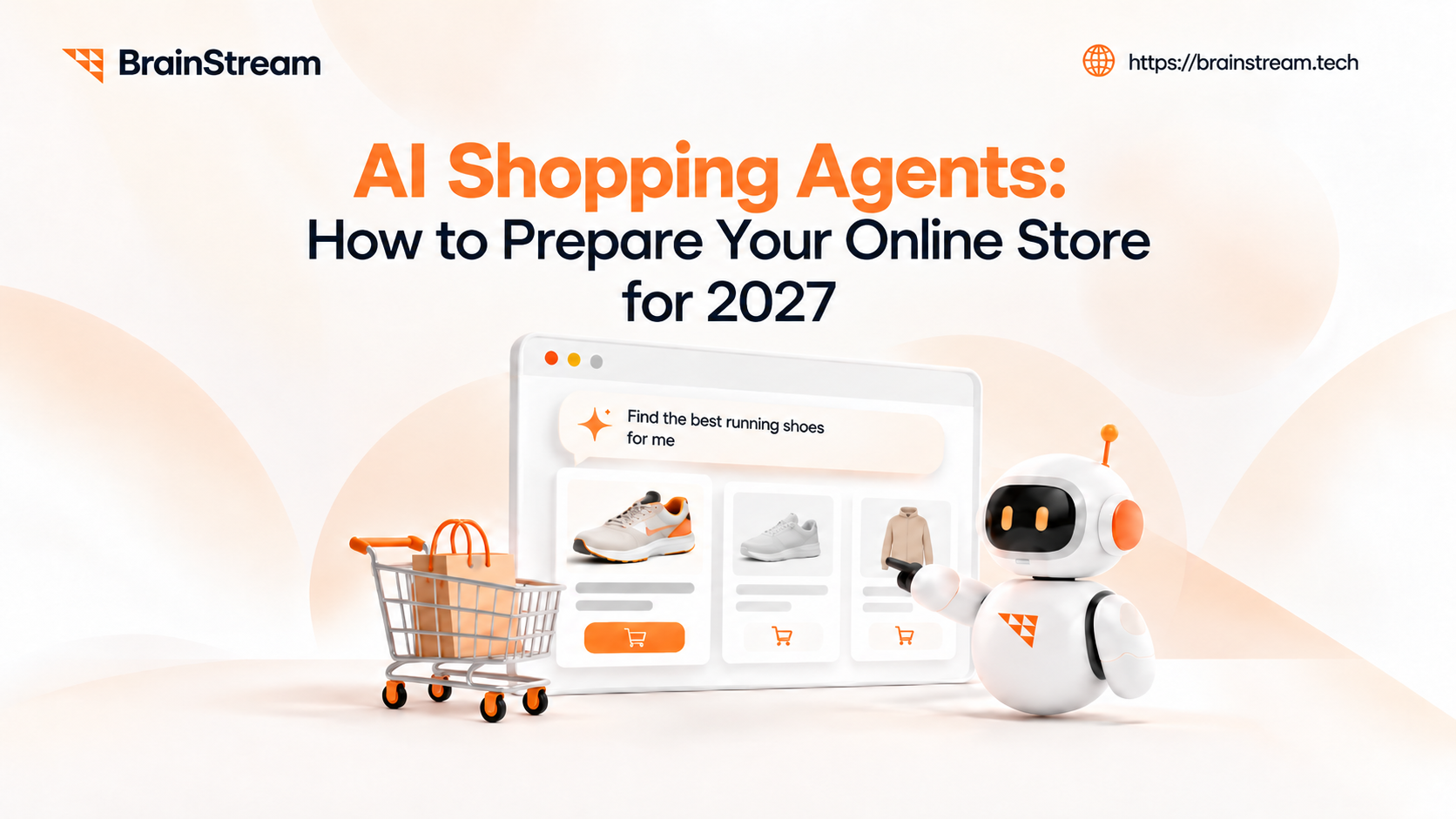
AI Shopping Agents: How to Prepare Your Online Store for 2027
Online shopping is changing quickly. Today, AI shopping agents help customers discover products without visiting several websites.
Instead, they can ask an AI assistant to compare products, check prices, and suggest suitable options.
For example, imagine asking an AI assistant:
“Find me a lightweight laptop under $800 with good battery life.”
The assistant can search products, compare features, and recommend suitable models. In supported shopping experiences, it may also help with checkout.
This is where AI shopping agents become important.
As 2027 approaches, businesses need to prepare for AI-powered product discovery. Customers may increasingly discover products through AI conversations rather than traditional search results.
However, preparing your store does not mean rebuilding your entire website.
In this guide, we explain how AI shopping agents work, their benefits, and how to prepare your eCommerce store for 2027.
What Are AI Shopping Agents?
AI shopping agents are intelligent software assistants that help customers discover, compare, and sometimes purchase products using artificial intelligence.
Unlike traditional search tools, they can understand detailed customer requests and guide shoppers through different buying steps.
For example, a customer might ask:
“I need running shoes for daily workouts under $120 with good arch support.”
An AI shopping agent could:
- Understand the customer’s requirements.
- Find products within their budget.
- Compare prices and product features.
- Check available stock information.
- Recommend suitable options.
- Help customers move toward checkout.
Additionally, some shopping agents can connect with eCommerce platforms to support more advanced shopping tasks.
As a result, customers may spend less time searching and comparing products.
How Do AI Shopping Agents Work?
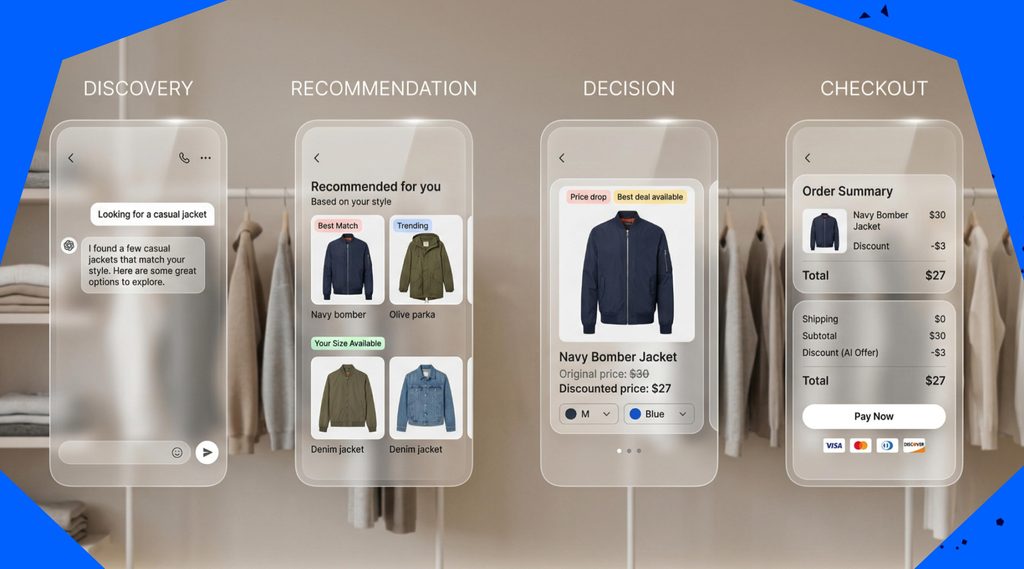
AI shopping agents combine artificial intelligence, product information, and eCommerce integrations.
They use customer questions to identify relevant products and guide shopping decisions.
Step 1: Understand Customer Requirements
First, the AI shopping agent analyzes the customer’s question.
For example, someone might ask:
“Show me a waterproof backpack for office travel under $100.”
The AI identifies important details such as product type, budget, purpose, and features.
Therefore, customers can explain their needs without using complicated search filters.
Step 2: Find Relevant Products
Next, the agent searches available product catalogs or connected shopping services.
It reviews information such as product titles, descriptions, specifications, and prices.
Additionally, it may check product availability when reliable inventory data is accessible.
As a result, the agent can identify products that match the customer’s requirements.
Step 3: Compare Product Options
After finding suitable products, the AI compares their features.
For example, it may consider:
- Product price
- Features and specifications
- Customer reviews
- Available sizes and colors
- Shipping information
- Return policies
Then, it can explain the differences in simple language.
Step 4: Provide Personalized Recommendations
Not every customer has the same requirements.
For instance, one shopper may prefer affordable products. Another may prioritize quality or advanced features.
Therefore, the agent can refine its suggestions based on customer preferences.
Customers can also ask follow-up questions without starting a new search.
Step 5: Support the Checkout Process
Finally, some AI shopping experiences can help customers proceed toward checkout.
Depending on the integration, the agent may support cart creation or other shopping actions.
However, checkout capabilities vary by platform, merchant eligibility, and country.
Customers may still need to complete payment through a supported checkout system.
Why AI Shopping Agents Matter for eCommerce in 2027
For years, online stores have focused on Google rankings, paid advertising, and social media traffic.
These channels remain important. However, AI-powered shopping introduces another way for customers to discover products.
Customers Can Search Through Conversations
Traditionally, shoppers enter short keywords into search engines.
For example, someone might search for “best office chair.”
In contrast, an AI shopping agent can understand more detailed requests.
A customer might ask:
“I need an ergonomic office chair for long working hours, under $250, suitable for a small room.”
The AI can then compare suitable products based on these preferences.
Therefore, detailed product information becomes increasingly valuable.
Product Information Becomes More Important
AI shopping agents depend on accurate product information.
For instance, they may use product specifications, pricing, and availability to compare options.
However, missing or outdated details can reduce the quality of recommendations.
Therefore, businesses should regularly review their product catalogs.
Additionally, clear descriptions help customers understand product differences.
Shopping Experiences Can Become Faster
Traditional online shopping often requires customers to open several product pages.
In contrast, AI shopping agents can summarize relevant options.
For example, an agent may compare different products based on price, features, and customer needs.
As a result, customers may spend less time searching for suitable products.
Personalized Recommendations May Improve
Every customer has different shopping requirements.
For example, one customer may prioritize price, while another prefers product quality.
AI shopping agents can consider these preferences during conversations.
Consequently, recommendations may become more relevant.
However, businesses still need reliable product data to support these experiences.
New AI Commerce Opportunities Are Emerging
AI-powered shopping is creating new opportunities for eCommerce businesses.
For example, supported integrations may allow shopping agents to access product catalogs and assist with checkout.
Meanwhile, commerce platforms continue developing tools for AI-powered shopping.
Therefore, merchants should stay informed about new integration options.
More importantly, they should improve their existing stores before investing in advanced AI features.
AI Shopping Agents vs Traditional eCommerce Search
Traditional eCommerce search and AI shopping agents both help customers find products.
However, their approaches are different.
| Feature | Traditional Search | AI Shopping Agents |
|---|---|---|
| Search method | Keywords and filters | Natural conversations |
| Product discovery | Matching product lists | Context-based recommendations |
| Personalization | Filters and browsing history | Customer requirements |
| Product comparison | Often manual | AI-assisted comparisons |
| Follow-up questions | Limited | Conversational |
| Checkout | Standard website checkout | Website or supported AI-assisted checkout |
| Buying experience | Customer-led browsing | AI-guided shopping |
Traditional search will remain useful for online stores.
However, AI shopping agents can make product discovery more conversational.
Therefore, businesses should prepare for both shopping experiences.
How to Prepare Your Online Store for AI Shopping Agents in 2027
Preparing your online store for AI shopping agents does not require a complete website redesign.
Instead, you can start with small improvements that support AI-powered shopping.
1. Improve Product Titles and Descriptions
First, review your product titles and descriptions. Make sure they explain the product’s features, benefits, and uses.
For example, replace “Premium Backpack” with “Waterproof Laptop Backpack for Office and Travel.”
Additionally, include important information such as material, size, color, and product specifications.
As a result, customers and AI shopping systems can better understand your products.
2. Add Structured Data to Product Pages
Next, add relevant Product structured data to your website.
Structured data helps search engines identify important product information.
For example, it can describe:
- Product names and descriptions
- Prices and availability
- Brand information
- Product images
- SKU and product identifiers
- Eligible customer ratings
- Shipping and return details
Moreover, accurate structured data makes product information easier for supported systems to process.
However, structured data alone does not guarantee visibility in AI shopping recommendations.
3. Keep Product Prices and Inventory Updated
Accurate pricing and product availability are essential for AI shopping experiences.
For example, customers may receive recommendations for products that are no longer available.
Therefore, update your inventory regularly and remove outdated product information.
Additionally, connect your inventory system with your eCommerce platform whenever possible.
This helps reduce errors and improves the shopping experience.
4. Optimize Product Feeds for AI Shopping
Product feeds allow shopping platforms to access structured catalog information.
First, check whether your feeds include accurate titles, descriptions, prices, and product images.
Next, review product links, identifiers, and availability information.
Moreover, make sure your feeds follow the requirements of each shopping platform.
As a result, supported shopping services can access more reliable product details.
5. Prepare for AI Commerce Integrations
AI shopping agents may connect with online stores through supported commerce systems.
For example, some integrations can support product discovery, shopping carts, and checkout.
Additionally, emerging commerce protocols aim to make these interactions easier.
The Agentic Commerce Protocol and Universal Commerce Protocol are examples of efforts to support agent-driven shopping.
However, merchant eligibility and platform support may vary.
Therefore, review the latest integration requirements before planning development work.
6. Improve Website Speed and Mobile Experience
Website performance remains important, even when customers discover products through AI.
First, optimize your product images and reduce unnecessary scripts.
Next, make sure your website works smoothly on mobile devices.
Furthermore, provide clear navigation and a simple checkout process.
Consequently, customers can complete their purchases with fewer difficulties.
7. Create Helpful Product FAQs
Customers often ask questions before buying a product.
For example, they may want to know about product compatibility, materials, or warranties.
Therefore, add useful FAQs to your product pages.
Additionally, include comparison tables when customers need help choosing between products.
This information can improve the customer experience and support AI-powered product discovery.
8. Build Customer Trust
Trust is important in every shopping experience.
First, display genuine customer reviews and accurate product information.
Next, provide clear shipping, return, and refund policies.
Moreover, make your business contact information easy to find.
As a result, customers can make purchasing decisions with greater confidence.
9. Track AI Shopping Traffic and Conversions
Finally, review how customers discover and interact with your products.
For example, GA4 can help identify some referral traffic from AI platforms.
Additionally, track product visits, add-to-cart events, and completed purchases.
However, not every AI-assisted interaction will appear as a separate traffic source.
Therefore, combine analytics data with available sales and referral information.
How Can Shopify Stores Prepare for AI Shopping Agents?
Shopify continues developing tools that support AI-powered commerce.
As a result, Shopify merchants should understand how their product information connects with new shopping experiences.
Improve Shopify Product Data
First, review product titles, descriptions, images, and variations.
Make sure all important details are accurate and easy to understand.
Additionally, keep your product inventory synchronized.
This helps maintain consistent information across supported shopping channels.
Explore Supported AI Commerce Integrations
Next, review Shopify’s available AI commerce features and supported channels.
Some integrations may support AI-powered product discovery or purchasing experiences.
However, availability can depend on merchant eligibility and other requirements.
Therefore, check current documentation before enabling a new integration.
Consider Custom Shopify Development
Some businesses need features beyond standard eCommerce functionality.
For example, a store may want AI-powered recommendations connected to its inventory or customer support system.
In such cases, custom Shopify development can help meet specific business requirements.
Additionally, businesses can introduce new features gradually to control development costs.
How Can Shopware Stores Prepare for AI Shopping Agents?
Shopware businesses can also benefit from preparing their platforms for AI-powered product discovery.
This is particularly useful for B2B stores with complex catalogs and customer-specific requirements.
Improve Product Catalog Management
First, make sure your Shopware store contains accurate product information.
Include detailed specifications, categories, variations, and relevant product attributes.
Additionally, maintain clear product relationships.
This helps customers and connected systems find suitable products.
Connect Inventory and Business Systems
Many B2B businesses manage inventory through ERP or other business systems.
Therefore, accurate data synchronization is important.
For example, customers may need updated information about bulk pricing or product availability.
Reliable integrations help reduce manual work and inconsistent information.
Explore Custom AI Integrations
Some Shopware businesses may require custom AI-powered workflows.
For example, a B2B customer might ask:
“Find 500 industrial safety gloves that meet our requirements and fit our budget.”
A connected AI shopping system could help identify suitable products.
However, actual capabilities depend on the store’s architecture and available integrations.
Therefore, a technical assessment is useful before development begins.
What Challenges Should Businesses Consider Before Using AI Shopping Agents?
AI shopping agents offer new opportunities. However, businesses should understand the potential challenges.
Maintaining Accurate Product Data
AI recommendations can become unreliable when product information is incorrect.
For example, outdated pricing may cause confusion during checkout.
Therefore, businesses should maintain accurate product catalogs and inventory information.
Protecting Customer Information
AI shopping systems may process customer preferences and shopping details.
As a result, privacy and security become important considerations.
Businesses should protect sensitive information and follow applicable data protection rules.
Managing Integration Complexity
Not every online store has the same technical structure.
For example, older eCommerce platforms may require additional API development.
Therefore, businesses should review existing systems before starting an integration.
Understanding Platform Limitations
AI shopping capabilities differ across providers and regions.
Some features may only be available to approved merchants.
Additionally, payment and checkout support can vary.
Therefore, businesses should avoid assuming that every AI agent can complete purchases automatically.
How Much Does AI Shopping Agent Integration Cost?
There is no fixed price for AI shopping agent integration.
Instead, development costs depend on your eCommerce platform, product catalog, and required features.
Basic AI Shopping Preparation
Some businesses may only need improvements to existing product information.
For example, the work may involve:
- Updating product descriptions
- Improving structured data
- Fixing product feeds
- Correcting inventory information
These tasks usually require less custom development than building a complete AI shopping system.
Custom AI Shopping Integration
Other businesses may need AI features connected to their existing stores.
For example, an online store might want custom product recommendations or conversational shopping assistance.
Such projects may require API development, testing, and additional business logic.
Therefore, the development cost depends on technical requirements.
Advanced AI Commerce Development
Large eCommerce businesses may need more complex integrations.
For example, an AI shopping system might connect with CRM, ERP, inventory, and order management platforms.
Additionally, it may require advanced security, customer permissions, and monitoring.
As a result, development and maintenance costs can increase.
AI Shopping Agent Readiness Checklist for 2027
Preparing for AI shopping does not need to happen all at once.
Instead, focus on the most important technical improvements first.
| Task | Priority |
|---|---|
| Improve product titles and descriptions | High |
| Add accurate Product structured data | High |
| Optimize product feeds | High |
| Synchronize pricing and inventory | High |
| Improve mobile performance | High |
| Add helpful product FAQs | Medium |
| Review AI commerce integrations | High |
| Check API and checkout security | High |
| Improve customer reviews and policies | Medium |
| Configure conversion tracking | High |
| Review performance regularly | Medium |
Where Should You Start?
First, review your existing product catalog.
Next, fix outdated information and improve product descriptions.
Then, check your website’s technical performance and data feeds.
Finally, explore AI integrations that match your business requirements.
This approach helps businesses prepare without making unnecessary investments.
How Brainstream Technolabs Can Help Prepare Your Store for AI Shopping
Preparing for AI shopping agents requires more than adding a chatbot.
Your store needs reliable product information, strong technical performance, and suitable integrations.
Brainstream Technolabs provides eCommerce development and integration services for businesses using platforms such as Shopify and Shopware.
Shopify and Shopware Development
Our development team can help businesses improve their existing eCommerce platforms.
For example, projects may involve performance improvements, custom features, or third-party integrations.
Additionally, reliable technical foundations make future upgrades easier.
Custom AI Integration
Businesses may need AI-powered features that support specific customer requirements.
For example, these could include conversational product discovery or automated customer support.
Therefore, choosing the right integration approach is important.
ERP and CRM Connectivity
Many eCommerce businesses depend on ERP and CRM platforms for daily operations.
Connecting these systems can improve data consistency and reduce manual work.
Moreover, accurate product and customer information can support more reliable AI-powered workflows.
Prepare Your Online Store for 2027
Whether you operate a growing Shopify store or a complex Shopware platform, preparation starts with understanding your existing systems.
Want to make your online store ready for AI-powered shopping?
Contact Brainstream Technolabs to discuss your eCommerce platform, integration requirements, and development goals.
Frequently Asked Questions
1. What are AI shopping agents?
AI shopping agents are intelligent software assistants that help customers discover, compare, and sometimes purchase products. They use artificial intelligence to understand shopping requirements and suggest suitable options.
2. How do AI shopping agents work?
First, they analyze customer questions. Next, they search available product information and compare suitable options. Finally, they may help customers move toward checkout through supported integrations.
3. Will AI shopping agents replace traditional eCommerce websites?
Not necessarily. Online stores will continue managing products, orders, payments, and customer information. However, AI shopping agents may become another channel for product discovery.
4. How can I make my online store ready for AI shopping agents?
Start by improving product descriptions, structured data, and product feeds. Additionally, maintain accurate pricing and inventory. Then, explore supported AI commerce integrations.
5. Can Shopify stores support AI shopping agents?
Yes. Shopify offers tools and integrations related to AI-powered commerce. However, availability depends on the shopping channel, merchant eligibility, and technical requirements.
6. Can Shopware stores integrate AI shopping agents?
Yes, Shopware stores can support custom AI features through suitable APIs and integrations. However, development requirements depend on the existing platform and business processes.
7. Can AI shopping agents increase eCommerce sales?
AI shopping agents may improve product discovery and help customers compare options. As a result, they may support better shopping experiences. However, sales improvements are not guaranteed.
8. What is the difference between AI shopping agents and AI chatbots?
AI chatbots mainly provide conversational assistance. In contrast, AI shopping agents may also search products, compare options, and perform supported shopping actions.
9. Is Product schema enough for AI shopping visibility?
No. Product schema is only one part of preparation. Additionally, businesses need accurate product feeds, useful content, updated inventory, and suitable commerce integrations.
10. Should small eCommerce businesses prepare for AI shopping in 2027?
Yes. Small businesses can begin with simple improvements. For example, they can update product descriptions, correct inventory information, and optimize their product feeds.
Conclusion
AI shopping agents are introducing new ways for customers to discover and compare products.
Instead of relying only on traditional search results, shoppers can describe their requirements through AI conversations.
As a result, online stores need accurate product information and reliable technical systems.
However, preparing for AI shopping does not require a complete website redesign.
Businesses can start by improving product descriptions, structured data, product feeds, and inventory management.
Additionally, Shopify and Shopware merchants can explore suitable AI integrations as new capabilities become available.
The goal is not to add AI everywhere. Instead, it is to make online shopping easier, faster, and more useful for customers.
Prepare your eCommerce business for the next generation of online shopping with Brainstream Technolabs.

Manish Khilwani
Author
Co-Founder at BrainStream Technolabs, he focuses on building people-first, scalable eCommerce and digital products that help brands grow with clarity and innovation.
Table of contents
BLOGS
Learn & Grow with Us
Get the latest updates on trends and strategies that shape the business world. Our insights are here to keep you informed and inspired.
AI Shopping Agents: How to Prepare Your Online Store for 2027
Online shopping is changing quickly. Today, AI shopping agents help…
Top 10 AI Automation Companies in India
Businesses today want to work faster, reduce manual tasks, and…
Custom AI Chatbot vs Ready-Made Chatbot: Which Is Better for Your Business?
AI chatbots are changing how businesses communicate with customers, manage…
Top 5 Symfony Development Companies in India 2026
Choosing the right development company can make a big difference…