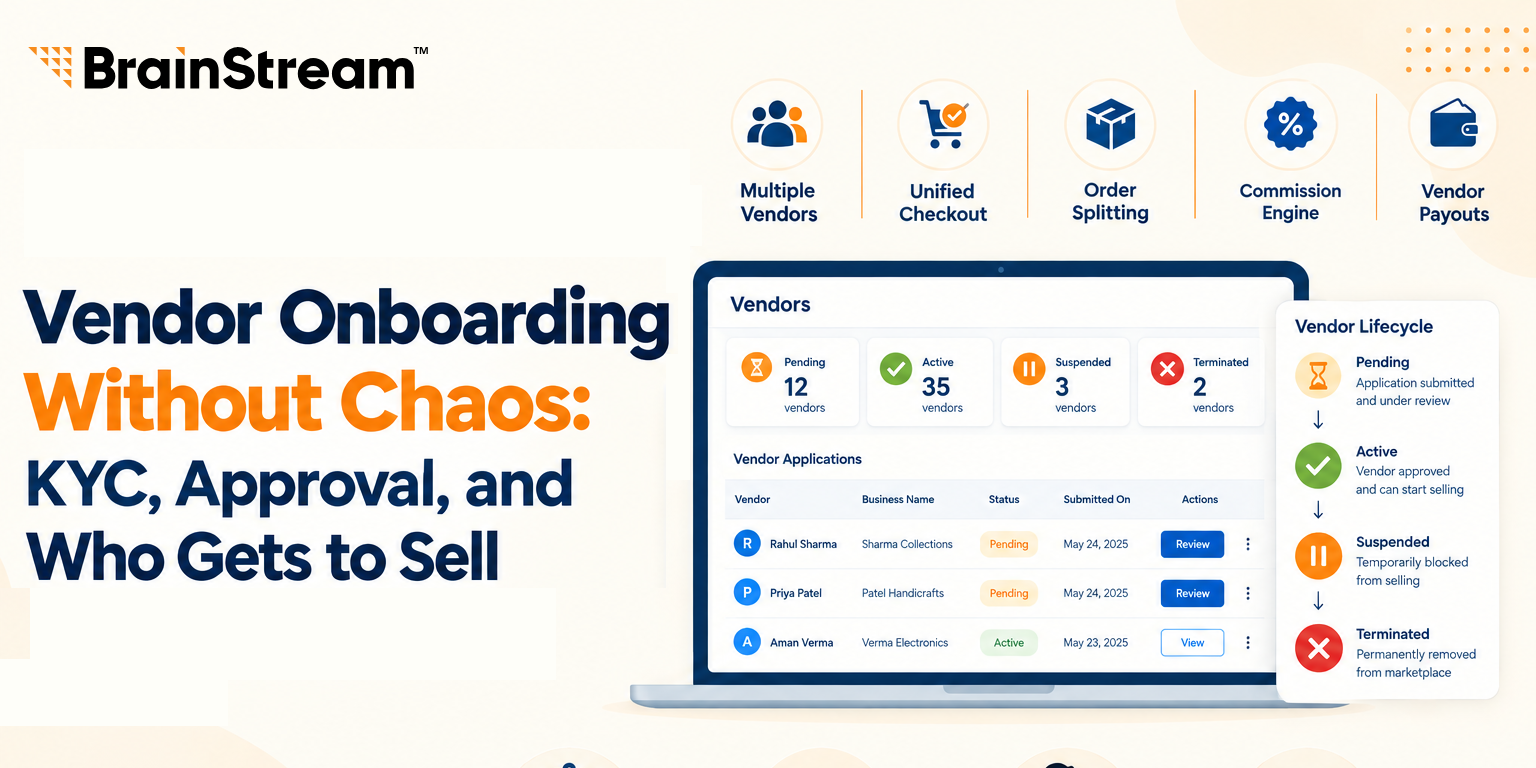
Vendor Onboarding Without Chaos: KYC, Approval, and Who Gets to Sell
Anyone can fill out a vendor signup form.
That’s the easy part.
The real question is what happens after they submit it.
Do they immediately get access to the marketplace and start selling? Or does someone first check who they are, what they’re selling, and whether they’re actually a legitimate business?
Getting this wrong can cause problems in both directions.
If you approve everyone automatically, you may end up with fake businesses, copied products, poor-quality listings, or sellers who never fulfill their orders.
But if every application has to go through a completely manual process, your team can quickly become the bottleneck. Legitimate vendors may end up waiting days just to get started.
Neither approach is necessarily wrong.
The important thing is having a clear process for how a vendor moves through the marketplace.
At any point, you should be able to answer a simple question:
What is this vendor’s current status, and what are they allowed to do because of it?
That’s the foundation of vendor onboarding in MarketFox.
What Does a Good Vendor Approval Process Look Like?
Every marketplace will have slightly different requirements, but the basic questions are usually the same.
You need to know what states a vendor can be in and what each state actually means.
For example, someone who has just applied shouldn’t have the same access as an approved vendor. A suspended vendor is different from someone who has been permanently removed.
You also need to decide which status changes are allowed.
A suspended vendor may be able to come back after an admin reviews the issue. A terminated vendor, on the other hand, shouldn’t simply be able to log in and reactivate their account.
Then there’s the question of approval itself.
Some marketplaces want to review every vendor before they can start selling. Others are comfortable with automatic approval.
Neither is universally better. It depends on the marketplace type, the vendors you’re onboarding, and the level of control you need.
The information you collect during registration matters too.
Depending on the marketplace, you might need identity details, business registration, tax information, payout details, supporting documents, or some combination of these.
And once someone submits an application, the process shouldn’t disappear into a black hole.
The vendor should know what’s happening with their application, and the marketplace administrator should know when a new application is waiting for review.
It’s also worth keeping a record of important decisions.
If a vendor is suspended or rejected and later asks why, you should be able to see what happened, when it happened, and who made the decision.
These things may seem like small details when you’re starting out.
They become much more important once you have hundreds or thousands of vendors.
The Vendor Lifecycle
One of the simplest ways to keep this manageable is to give vendors a clear lifecycle.
In MarketFox, a vendor can move through four main states:
Pending → Active → Suspended → Terminated
A new vendor starts as pending when manual approval is enabled.
From there, an administrator can approve the vendor and make them active, or terminate the application.
An active vendor can later be suspended or terminated.
A suspended vendor can be reviewed and moved back to active, or permanently terminated.
Once a vendor has been terminated, they cannot simply be moved back to active.
The important part isn’t just having these four statuses.
The application also controls which transitions are allowed.
That prevents different parts of the system from treating vendor status differently and creating unexpected edge cases later.
How MarketFox Handles Vendor Approval?
MarketFox gives each marketplace control over how vendor onboarding works.
A new vendor can register through a public signup form without an administrator having to create the account manually.
After that, the marketplace decides what happens.
If the marketplace wants to review every vendor, new registrations can remain in pending status until an administrator approves them.
If the marketplace is comfortable with automatic approval, it can allow vendors to become active immediately after registration.
This is a marketplace-level setting, so you don’t need a different version of MarketFox for different onboarding strategies.
One marketplace can require manual approval while another can allow vendors to join automatically.
That flexibility is important because marketplaces don’t all operate in the same way.
KYC and Vendor Verification
Creating an account doesn’t necessarily tell you much about the person or business behind it.
A name, email address, and phone number are easy to provide.
Depending on what the marketplace sells and where it operates, you may need more information before allowing a vendor to sell or receive payouts.
That could include identity information, business registration documents, tax identification, bank or payout details, a business address, or other supporting documents.
The exact requirements will vary depending on the marketplace, country, payout provider, and compliance requirements.
That’s why MarketFox doesn’t force every marketplace to use one fixed verification form.
Marketplaces can add their own application fields, including file uploads, so they can collect the information they actually need.
A marketplace selling handmade products may have very different requirements from one onboarding registered businesses at a much larger scale.
The onboarding process needs to fit the business rather than forcing every business into exactly the same process.
Approval Should Trigger More Than a Status Change
Approving a vendor shouldn’t just mean changing one value from pending to active.
There are usually a few things that need to happen around that decision.
When an administrator approves a vendor, MarketFox can notify the vendor by email and provide the information they need to access their account.
When a new vendor submits an application and enters the pending state, administrators can also be notified so applications don’t sit unnoticed.
If a vendor is suspended, the administrator needs to provide a reason.
That reason stays with the vendor’s record so there’s some history around the decision.
This creates a basic audit trail for one of the most important decisions a marketplace makes: deciding who is allowed to sell.
It’s especially useful later when someone needs to understand why a particular action was taken.
Suspension Isn’t the Same as Termination
These two statuses can sound similar, but they serve very different purposes.
Suspension is usually temporary.
Maybe a vendor failed a verification check. Maybe they’ve violated a marketplace rule. Maybe there’s an issue with their account that needs to be resolved before they can continue selling.
In those situations, you may want to stop their activity for now but leave the option to bring them back.
Termination is different.
It means the vendor is no longer allowed to participate in the marketplace.
That’s why MarketFox treats the two differently.
A suspended vendor can be reviewed and returned to active status.
A terminated vendor cannot simply be reactivated.
Having these rules defined in the lifecycle may seem like a small implementation detail, but it prevents a lot of confusion later.
Without clear rules, different parts of the application can start making their own assumptions about what a vendor is allowed to do.
Vendor Status and Product Visibility Are Different Things
There’s another distinction that’s easy to overlook.
A vendor’s account status isn’t necessarily the same thing as the status of their products.
Suppose a vendor is suspended.
One marketplace might want all of their products to be unpublished immediately.
Another marketplace might want to keep existing products visible but prevent the vendor from adding new products or receiving new orders.
Both approaches can make sense depending on the business.
The important thing is deciding what should happen instead of letting it happen accidentally.
If a vendor has been suspended because of a serious compliance issue, you probably don’t want their products to remain available simply because changing the vendor’s status doesn’t affect product visibility.
The two concepts answer different questions.
Vendor status is about the seller and what they are allowed to do.
Product status is about what customers can see and purchase.
Keeping those decisions separate gives the marketplace more control.
Manual Approval or Auto-Approval?
There’s no single answer that works for every marketplace.
Manual approval gives the marketplace more control before a vendor goes live, but it also means someone has to review applications.
As the marketplace grows, that can become a bottleneck.
Automatic approval gives vendors a much faster onboarding experience, but it means the marketplace needs to rely more heavily on verification, monitoring, and other controls after registration.
For many marketplaces, starting with manual approval makes sense.
It gives the team time to understand what good and bad applications look like and build a reliable process.
Once that process becomes more mature, more of the onboarding can be automated.
That’s why MarketFox treats approval behavior as a configurable marketplace setting rather than something permanently built into the application.
Why Vendor Onboarding Matters More as You Grow
When you have five vendors, you can probably manage most things manually.
When you have 50, the process starts to matter.
At 500 or 5,000 vendors, you really don’t want important decisions living in someone’s memory or being handled differently every time.
A clear vendor lifecycle gives the marketplace a consistent way to handle applications, approvals, suspensions, and terminations.
It also makes it easier for the team to understand what should happen when something goes wrong.
That’s really what good onboarding is about.
It’s not just collecting information from a new vendor.
It’s making sure the marketplace knows who is allowed to sell, what they are allowed to do, and what should happen when that changes.
Want to see how MarketFox handles vendor registration, approval, verification, and lifecycle management on a real Shopify-connected marketplace?
FAQs
1. What is KYC verification for marketplace sellers?
KYC, or “know your customer,” is the process of verifying that a seller is a legitimate person or business.
Depending on the marketplace and region, this can include identity information, business registration, tax details, payout information, and supporting documents.
The exact requirements depend on the marketplace and its business model.
2. Should vendors be auto-approved or manually reviewed?
It depends on the marketplace.
Auto-approval gives vendors a faster onboarding experience, while manual approval gives the marketplace more control over who can start selling.
Many marketplaces begin with manual approval and introduce more automation as their verification process becomes more mature.
Integrating CRM with ERP provides real-time access to customer, inventory, financial, and operational data. This improves collaboration, reduces manual work, and supports better decision-making.
3. What happens to a vendor’s products if they’re suspended?
There isn’t one answer that works for every marketplace.
A marketplace might unpublish the vendor’s products, prevent new orders, or keep existing listings visible while restricting other vendor actions.
The important thing is to define this behavior clearly.
4. Can a suspended vendor be reactivated?
Usually, yes.
Suspension is generally temporary and can be reversed after the issue has been reviewed.
In MarketFox, a suspended vendor can be moved back to active status, while a terminated vendor cannot be reactivated.
5. What documents are typically required to onboard a marketplace vendor?
Requirements vary by marketplace and region.
Common examples include government-issued identification, business registration, tax information, proof of address, and bank or payout details.
The right requirements depend on the type of marketplace, the country, the payout provider, and the applicable compliance requirements.
6. Does every vendor need a separate database?
Not necessarily.
In MarketFox, the isolation boundary is the marketplace rather than the individual vendor.
Vendors within the same marketplace operate inside that marketplace’s database, while separate marketplaces have their own databases.
What’s Next in This Series
Getting vendors onto the marketplace is only the beginning.
Once customers start buying from those vendors, another problem appears:
What happens when one customer buys from multiple sellers in the same checkout?
The customer sees one order.
Behind the scenes, the marketplace may need to split that order into separate vendor-specific records for fulfillment, inventory, commissions, and payouts.
That’s where the next architectural challenge begins.
Next: One customer, one checkout, five sellers — how order splitting actually works.
Part of the MarketFox series on what it actually takes to run a multivendor marketplace on Shopify.

Manish Khilwani
Author
Co-Founder at BrainStream Technolabs, he focuses on building people-first, scalable eCommerce and digital products that help brands grow with clarity and innovation.
Table of contents
BLOGS
Learn & Grow with Us
Get the latest updates on trends and strategies that shape the business world. Our insights are here to keep you informed and inspired.
Vendor Onboarding Without Chaos: KYC, Approval, and Who Gets to Sell
Anyone can fill out a vendor signup form. That’s the…

How to Sync Shopify and Odoo Exactly When You Want Using Manual and Scheduled Sync?
A step-by-step look at the OdooStream features that put you…

Shopware 6 Migration: 10 Technical Issues That Can Break Your Store
Migrating an ecommerce store to Shopware 6 can improve performance,…

Top 10 WordPress Development Companies in India in 2026 – What Sets Them Apart
Finding the right WordPress partner can feel overwhelming. There are…