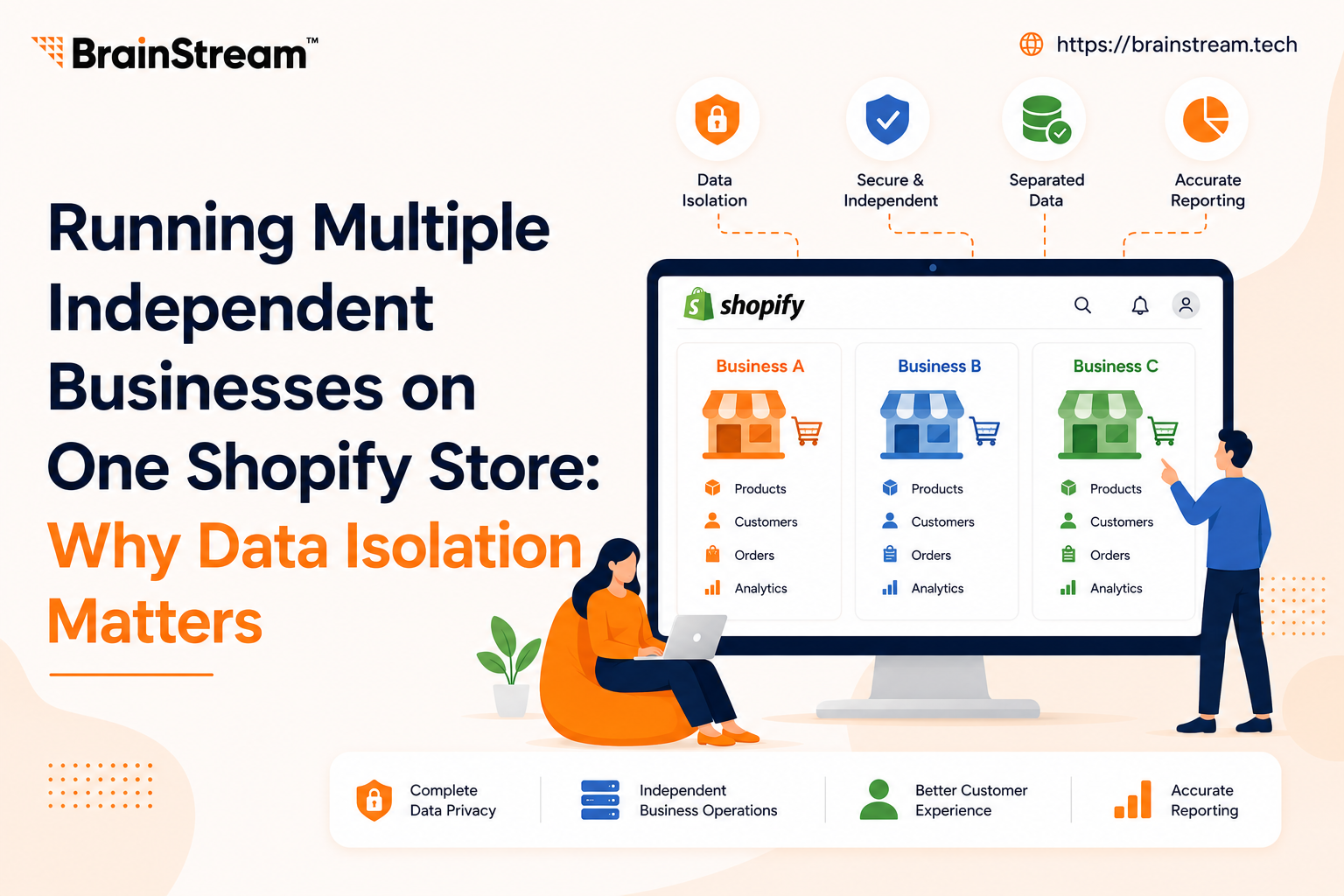
Running Multiple Independent Businesses on One Shopify Store: Why Data Isolation Matters
When you build a marketplace, one of the first things you think about is how vendors will sell their products, manage orders, and receive payouts.
What usually gets less attention is what happens behind the scenes as the marketplace starts to grow.
Imagine you have 20 vendors using your marketplace. Everything is running normally, and then one vendor launches a flash sale. Their traffic suddenly jumps, orders start coming in quickly, and they’re processing a large number of inventory updates at the same time.
A few minutes later, another vendor notices that their dashboard is slower than usual.
Nothing is wrong with Shopify. The problem is inside the marketplace application. Multiple independent businesses share the same application infrastructure, and activity from one can start affecting the others.
There is another situation that’s even more concerning.
A vendor might run a large import and something goes wrong. Their inventory gets updated incorrectly, or some data becomes corrupted. Now you need to investigate and fix the problem without accidentally affecting data belonging to other vendors.
This is why data isolation matters in a marketplace.
It isn’t something customers see in the UI, but it becomes one of the most important architectural decisions as the platform grows.
For MarketFox, we decided that the marketplace itself should be the isolation boundary.
Each marketplace gets its own database.
Why not simply separate everything with a vendor ID?
The common approach to multi-tenant applications is to keep everything in the same database and add a vendor or tenant identifier to the records.
Every time the application reads or writes data, it applies the appropriate filter.
There is nothing inherently wrong with this approach. For many applications, it works well.
The problem starts when the application becomes large, and there are many different places where tenant data is being accessed.
You have dashboards, reports, APIs, background jobs, imports, exports, webhooks, scheduled tasks and integrations. Every one of them needs to understand which tenant it is working with.
Most of the time, the correct filter will be applied.
But all it takes is one missed filter.
A new report might accidentally return data belonging to another vendor. A background job might process records that it shouldn’t. An export might include information from the wrong account.
When you’re dealing with marketplace orders, payouts and customer information, that’s a risk we don’t want to depend on application code alone to prevent.
There is also the performance side of the problem.
When everything is stored together, all marketplaces are using the same database resources. A particularly busy marketplace can generate a lot more queries, imports, reports and background processing than another one.
As the platform grows, that shared environment becomes harder to manage.
MarketFox uses the marketplace as the tenant
In MarketFox, vendors belong to a marketplace, and the marketplace is the actual tenant.
This distinction is important.
If Marketplace A has 50 vendors, those vendors operate within Marketplace A’s database.
If Marketplace B has 20 vendors, its data lives in a completely separate database.
The vendors within a marketplace still work together as part of that marketplace. But two independent marketplaces don’t share the same application data.
This gives us a much clearer boundary between them.
If something happens inside one marketplace, we can deal with that marketplace without having to work through a large shared collection of records belonging to everyone else.
The database is only one part of the problem
Having a separate database for every marketplace sounds straightforward.
In practice, there are several things that need to work together for it to be reliable.
The application first needs to know which marketplace a request belongs to.
Once that is known, MarketFox connects the request to the correct marketplace database. From that point on, marketplace-specific operations use that database.
This means developers don’t have to remember to add a marketplace filter to every single query.
The connection itself is already pointing to the correct tenant.
That doesn’t remove the need for good application-level security, of course. Authentication and authorization are still important. But it gives us another layer of separation underneath the application logic.
Not everything belongs in a marketplace database
There is also information that shouldn’t belong to any individual marketplace.
For example, MarketFox needs to know which marketplaces exist on the platform. Platform administrators also need information that sits above individual marketplaces.
That information lives separately from the marketplace databases.
So there is a clear distinction between platform-level data and marketplace-level data.
A marketplace administrator manages their own marketplace.
A platform administrator can manage the wider MarketFox installation.
These aren’t simply two roles on the same account with different permissions. They operate at different levels of the system.
That separation becomes especially useful as the platform grows.
Creating a marketplace shouldn’t be a manual process
If every new marketplace required someone to manually create a database, configure it, run migrations and check that everything was set up correctly, operating the platform would quickly become painful.
MarketFox handles this as part of the marketplace setup process.
When a new marketplace is created, its database is provisioned and prepared automatically.
This means every marketplace starts with the same expected structure without someone having to repeat the same setup steps manually.
It also makes it much easier to scale the number of marketplaces over time.
Background jobs need tenant awareness too
This is one of the areas that can easily be overlooked.
A normal web request is relatively simple. The application receives the request, identifies the marketplace and connects to the appropriate database.
A background job is different.
A job might be created today but processed several minutes later. By the time it runs, the application may have already processed jobs belonging to several other marketplaces.
The job cannot rely on whatever marketplace happens to be active at that moment.
It needs to know where it came from.
MarketFox carries the marketplace context with queued work so that when the job eventually runs, it can connect to the correct marketplace database.
This is important for things like Shopify webhooks, product synchronization, inventory imports, order processing and scheduled tasks.
Without this, a database-per-marketplace architecture would only work for part of the application.
What happens when something goes wrong?
This is probably one of the biggest reasons we chose this architecture.
Let’s say a marketplace has a bad import and a large amount of inventory data needs to be investigated.
Because that marketplace has its own database, we have a much cleaner operational boundary.
We can back it up, restore it, investigate it or migrate it without directly modifying another marketplace’s data.
The same applies when marketplaces grow at very different rates.
One marketplace might have a relatively small amount of activity while another becomes significantly larger.
Keeping them separate gives us more flexibility in how we operate the platform.
It doesn’t mean that a bug can never affect multiple marketplaces. Shared application code can still have bugs, and infrastructure can still fail.
What it does mean is that the data itself has a much stronger boundary.
Why this matters as MarketFox grows
We didn’t choose separate databases because database-per-tenant sounds impressive.
We chose it because marketplaces are made up of independent businesses.
Those businesses expect their products, orders, customers, inventory and payouts to remain separate from someone else’s.
With a shared database, a lot of that separation depends on application code always doing the right thing.
With separate databases, the architecture gives us another level of protection.
It also gives us more options operationally.
If one marketplace becomes much larger than the others, we have the flexibility to treat its infrastructure differently. If we need to restore or migrate one marketplace, we don’t have to treat the entire platform as one giant dataset.
That flexibility becomes increasingly valuable as the number of marketplaces grows.
Is database-per-marketplace overkill?
For a small application with one business, probably.
If you’re building a simple Shopify app for a single store, there isn’t much reason to introduce this level of separation.
A marketplace is different.
You’re not just managing multiple users. You’re hosting multiple businesses that may have their own vendors, orders, customers, inventory and financial activity.
At that point, isolation becomes an architectural concern rather than just a permissions feature.
The question isn’t whether shared tables can work.
They can.
The question is where you want your isolation to live.
With shared tables, a lot of that responsibility sits in application code.
With MarketFox, we decided that the database should be part of that boundary as well.
Can one MarketFox installation run multiple Shopify-connected marketplaces?
Yes.
That’s exactly what this architecture is designed to support.
One MarketFox installation can manage multiple independent Shopify-connected marketplaces, with each marketplace having its own database and its own data.
When a request comes in, MarketFox identifies the marketplace and connects to the appropriate database.
The same marketplace context is carried through background processing, so queued jobs continue working with the correct marketplace even when many other marketplaces are active at the same time.
The result is one platform that can operate multiple marketplaces without putting all of their data into one shared tenant environment.
Frequently Asked Questions
1. What is multi-tenant architecture?
Multi-tenant architecture is a way of building software so that one application can serve multiple independent customers or organizations while keeping their data separated.
There are several ways to do this. Some applications keep everyone in the same database and separate records using tenant identifiers. Others use separate databases for each tenant.
MarketFox uses a separate database for each marketplace.
2. Should each marketplace have its own database?
It depends on the product and its requirements.
For a platform handling independent marketplaces, vendor payouts, customer information and large amounts of business data, having a separate database for each marketplace can provide a much stronger isolation boundary.
It also makes marketplace-specific backups, restores and migrations easier to manage.
3. Can one app run multiple Shopify-connected marketplaces?
Yes. MarketFox is designed to do exactly that.
Each marketplace has its own database, while the platform manages the marketplaces from a central level.
4. What’s wrong with putting all vendors in shared tables?
Shared tables can work, but they require every part of the application to correctly identify which records belong to which tenant.
As the application grows, there are more queries, jobs, reports and integrations that need to get that separation right.
A missed filter can become a data-access problem, while heavy activity from one tenant can also affect the shared database.
5. Is Laravel suitable for multi-tenant applications?
Yes. Laravel provides the database connection and application structure needed to build this type of system.
The important part isn’t just the framework, though. A reliable multi-tenant architecture needs to handle tenant identification, database switching, provisioning, authentication and background jobs correctly.
What’s next?
Database isolation is only one part of building a marketplace.
The next challenge is deciding who should actually be allowed to become a vendor and how that vendor should move through the platform.
KYC, approval, onboarding, suspension and vendor status all need a clear lifecycle if you want to keep the marketplace healthy as it grows.
Next in the series: Vendor onboarding without chaos — KYC, approval, and the lifecycle that keeps bad actors out.
Want to see how MarketFox handles multiple Shopify-connected marketplaces? Explore the MarketFox demo and see the platform in action.

Manish Khilwani
Author
Co-Founder at BrainStream Technolabs, he focuses on building people-first, scalable eCommerce and digital products that help brands grow with clarity and innovation.
Table of contents
BLOGS
Learn & Grow with Us
Get the latest updates on trends and strategies that shape the business world. Our insights are here to keep you informed and inspired.
Running Multiple Independent Businesses on One Shopify Store: Why Data Isolation Matters
When you build a marketplace, one of the first things…
Laravel vs Node.js in 2026: Which Backend Should Businesses Choose?
Choosing the right backend technology is an important decision when…

How to Choose the Right Shopify Development Company in the USA?
If you’ve searched “Shopify development company USA,” you’ve probably noticed…
What Is a Multivendor Marketplace on Shopify (and Why Shopify Alone Can’t Do It)
If you’ve thought about building the next Etsy, Amazon Marketplace,…