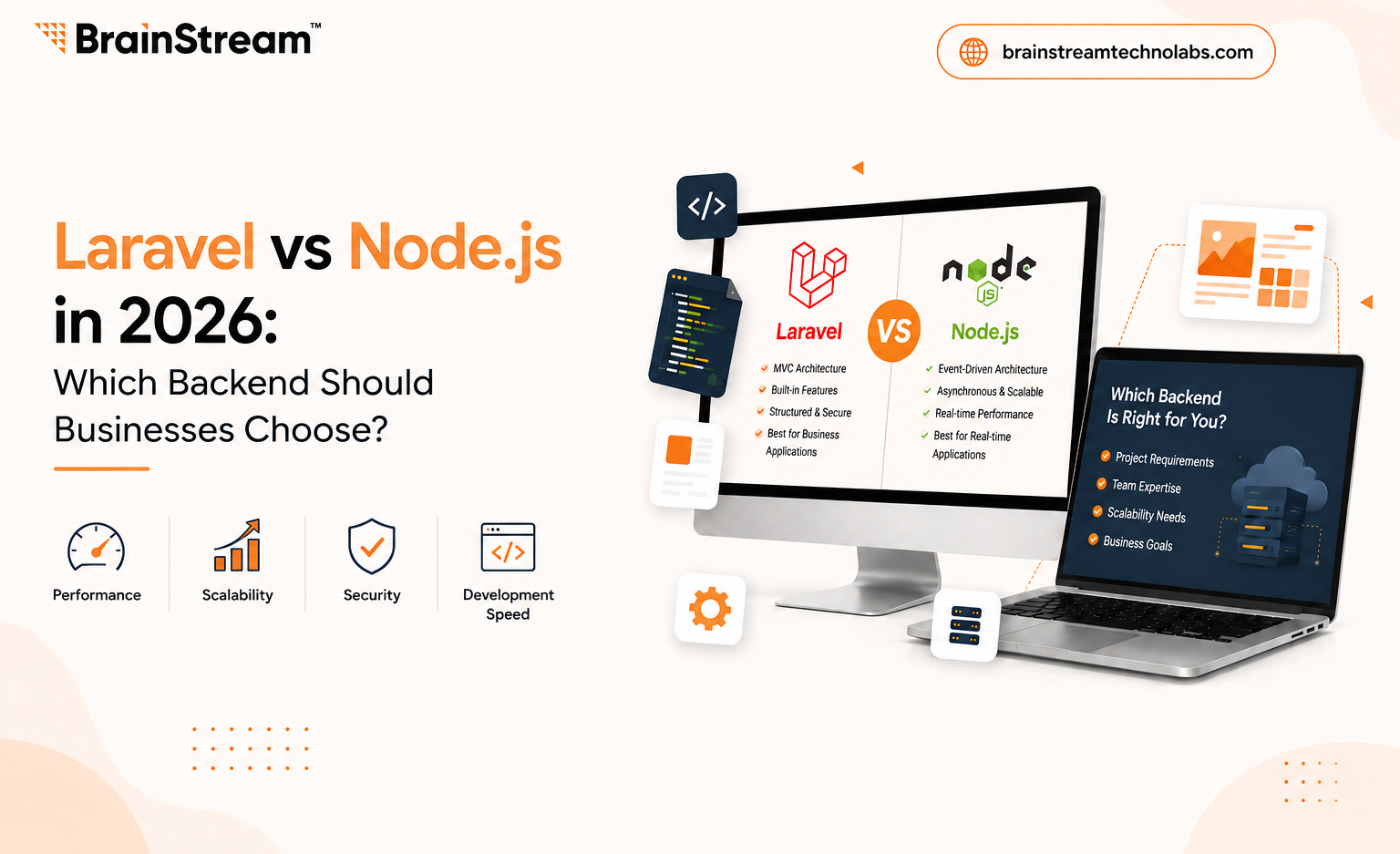
Laravel vs Node.js in 2026: Which Backend Should Businesses Choose?
Choosing the right backend technology is an important decision when building a modern web application. The backend affects development speed, application performance, scalability, security, maintenance, and long-term costs.
Laravel and Node.js are two popular choices for modern application development, but they serve different needs. Laravel is a PHP framework designed for structured and efficient web application development, while Node.js is a JavaScript runtime well suited to event-driven and real-time applications.
So, Laravel vs Node.js — which one should your business choose in 2026?
The answer depends on your project requirements, development goals, scalability needs, and the type of application you want to build.
Laravel vs Node.js: At a Glance
| Factor | Laravel | Node.js |
|---|---|---|
| Technology | PHP Framework | JavaScript Runtime |
| Architecture | MVC | Event-driven |
| Best For | SaaS, business applications, eCommerce, APIs | Real-time apps, APIs, streaming |
| Development Speed | Fast | Fast |
| Scalability | Excellent | Excellent |
| Real-Time Applications | Good | Excellent |
| Ecosystem | Laravel & PHP ecosystem | Large JavaScript/NPM ecosystem |
| Learning Curve | Moderate | Moderate |
| Enterprise Applications | Excellent | Excellent |
Both technologies are capable of powering production-grade applications. The right choice depends on what your business actually needs.
What Is Laravel?
Laravel is a modern PHP framework designed to simplify web application development. It follows the Model-View-Controller (MVC) architecture and provides developers with many built-in features for common application requirements.
Laravel includes functionality for routing, authentication, database management, queues, caching, testing, API development, and more.
Businesses commonly use Laravel for:
- Custom web applications
- SaaS platforms
- eCommerce websites
- CRM and ERP systems
- Business portals
- Booking platforms
- REST APIs
- Enterprise applications
- Custom dashboards
One of Laravel’s biggest advantages is its structured development environment. Developers can build complex applications without having to assemble every backend component from scratch.
What Is Node.js?
Node.js is a JavaScript runtime that allows developers to execute JavaScript on the server side. It uses an event-driven, non-blocking architecture, making it particularly useful for applications that handle many simultaneous connections.
Node.js is commonly used for:
- REST APIs
- Real-time applications
- Chat applications
- Collaboration platforms
- Streaming applications
- Microservices
- Web applications
- High-concurrency applications
Another major advantage is that businesses can use JavaScript across both frontend and backend development, depending on the chosen technology stack.
Laravel vs Node.js: Key Differences
1. Development Speed
Laravel provides many features out of the box, including routing, authentication, database tools, queues, validation, and other components required for web application development.
This can help development teams build business applications quickly and maintain a consistent architecture.
Node.js provides considerable flexibility, but developers often select and combine packages from the NPM ecosystem according to project requirements.
Winner for structured business application development: Laravel
2. Performance
Performance depends heavily on application architecture, database queries, caching, infrastructure, and coding practices—not simply the choice of backend technology.
Node.js can perform particularly well for I/O-intensive and real-time workloads because of its asynchronous, event-driven architecture.
Laravel applications can also deliver excellent performance when properly optimized using caching, queues, database optimization, load balancing, and suitable infrastructure.
Winner: Depends on the application
3. Scalability
Both Laravel and Node.js can support scalable applications.
Laravel applications can scale using techniques such as:
- Database optimization
- Redis caching
- Queues
- Load balancing
- Horizontal scaling
- Cloud infrastructure
- CDN integration
Node.js applications can also scale effectively through horizontal scaling, clustering, load balancing, caching, and distributed architectures.
Winner: Both
The architecture matters more than simply choosing one technology.
4. Real-Time Applications
This is an area where Node.js is particularly strong.
Applications such as:
- Live chat
- Real-time notifications
- Collaboration tools
- Online gaming
- Live dashboards
- Streaming applications
can benefit from Node.js’s event-driven architecture.
Laravel can support real-time functionality as well, but Node.js is often a natural choice when real-time communication is a core requirement.
Winner: Node.js
5. API Development
Both technologies are excellent choices for API development.
Laravel provides tools and conventions that make it straightforward to build REST APIs and integrate authentication, databases, third-party services, and business logic.
Node.js is also widely used for API development and can be particularly useful when building event-driven or JavaScript-centric architectures.
Winner: Both
Your existing infrastructure and development team’s expertise should be considered when choosing between them.
6. Security
Security should be considered throughout the development lifecycle regardless of the backend technology.
Laravel provides several built-in features and conventions that help developers implement common security requirements, including authentication, validation, password hashing, CSRF protection, and secure application practices.
Node.js applications can also be secure, but security depends significantly on dependency management, configuration, coding practices, and regular updates.
Winner: Both, when properly implemented
Laravel vs Node.js for SaaS Development
SaaS applications often require:
- User authentication
- Subscription management
- Payment integration
- Admin dashboards
- Role-based permissions
- APIs
- Database management
- Background jobs
- Notifications
- Reporting
Laravel is a strong choice for these types of applications because its ecosystem provides many of the building blocks required for business software.
Node.js can also be an excellent option, particularly when the application requires extensive real-time functionality or an event-driven architecture.
For a traditional business-focused SaaS platform, Laravel can be a highly practical choice.
Laravel vs Node.js for AI-Powered Applications
AI is becoming an important part of modern business applications in 2026.
Businesses are integrating AI into:
- Customer support platforms
- SaaS products
- CRM systems
- Internal business tools
- Document processing applications
- Recommendation systems
- AI assistants
- Search experiences
- Automation platforms
Both Laravel and Node.js can integrate with AI APIs and external machine-learning services.
For example, a Laravel application can act as the core business backend while connecting to AI services through APIs. Background jobs and queues can also be used to process resource-intensive tasks efficiently.
Therefore, choosing Node.js is not a requirement simply because an application uses AI.
The better choice depends on the overall architecture and business requirements.
Laravel vs Node.js: Which Is Better for Your Business?
There is no universal winner.
Choose Laravel if your business needs:
- Custom business applications
- SaaS platforms
- CRM or ERP systems
- eCommerce applications
- Booking platforms
- Enterprise portals
- API-driven applications
- Rapid and structured development
- Long-term maintainability
Choose Node.js if your project requires:
- Real-time communication
- Chat applications
- Streaming
- Highly event-driven workloads
- Real-time collaboration
- JavaScript-based backend development
- Microservices-oriented architectures
When Should You Consider Both?
Some complex applications can benefit from using Laravel and Node.js together.
For example, Laravel could manage the primary business logic, authentication, database operations, and administration, while Node.js handles specific real-time services.
The best architecture depends on the application’s requirements rather than following a one-technology-fits-all approach.
Laravel vs Node.js: Which Backend Should Businesses Choose in 2026?
For many business applications, Laravel remains a strong backend choice in 2026 because of its mature ecosystem, structured architecture, development productivity, and suitability for SaaS, eCommerce, CRM, ERP, and custom business applications.
Node.js can be the better option when real-time performance, event-driven workloads, streaming, or a JavaScript-centric architecture are key priorities.
The right question isn’t simply “Which technology is better?”
It is:
“Which technology is better for our specific business requirements?”
Before selecting a backend, businesses should evaluate application complexity, expected traffic, integrations, development expertise, scalability requirements, security, maintenance, and long-term business goals.
Build Your Next Application with the Right Technology
Choosing the right technology stack at the beginning can help reduce development risks and create a stronger foundation for future growth.
BrainStream Technolabs provides custom software and web application development services for businesses looking to build scalable digital solutions.
If Laravel is the right fit for your project, our team can help with custom Laravel development, SaaS applications, API development, eCommerce solutions, third-party integrations, migration, and ongoing support.
Ready to discuss your Laravel project?
👉 Explore our Laravel Development Services and discuss your requirements with our development team.

Manish Khilwani
Author
Co-Founder at BrainStream Technolabs, he focuses on building people-first, scalable eCommerce and digital products that help brands grow with clarity and innovation.
Table of contents
BLOGS
Learn & Grow with Us
Get the latest updates on trends and strategies that shape the business world. Our insights are here to keep you informed and inspired.
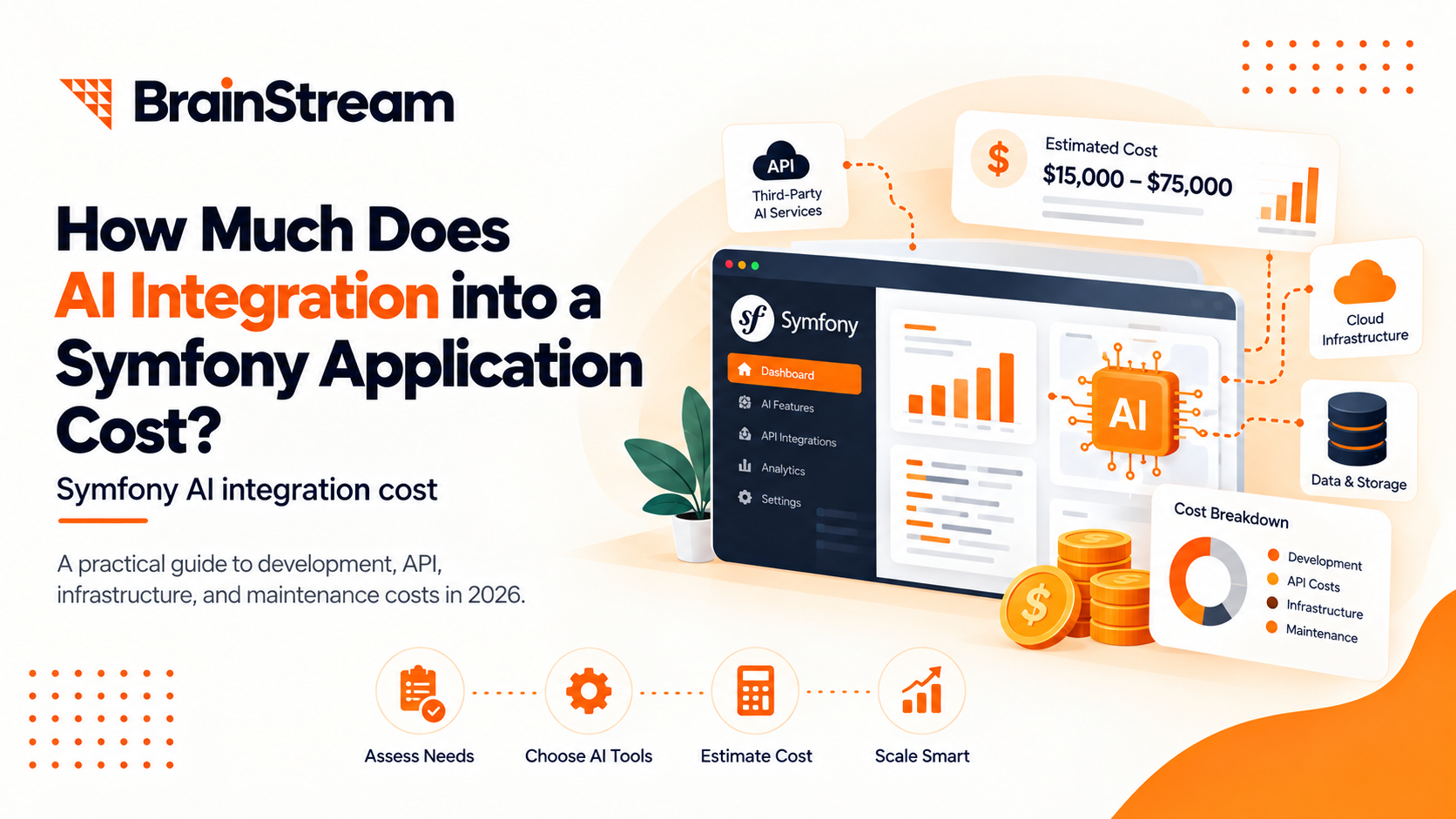
How Much Does AI Integration into a Symfony Application Cost in 2026?
Adding artificial intelligence to your Symfony application can improve customer…
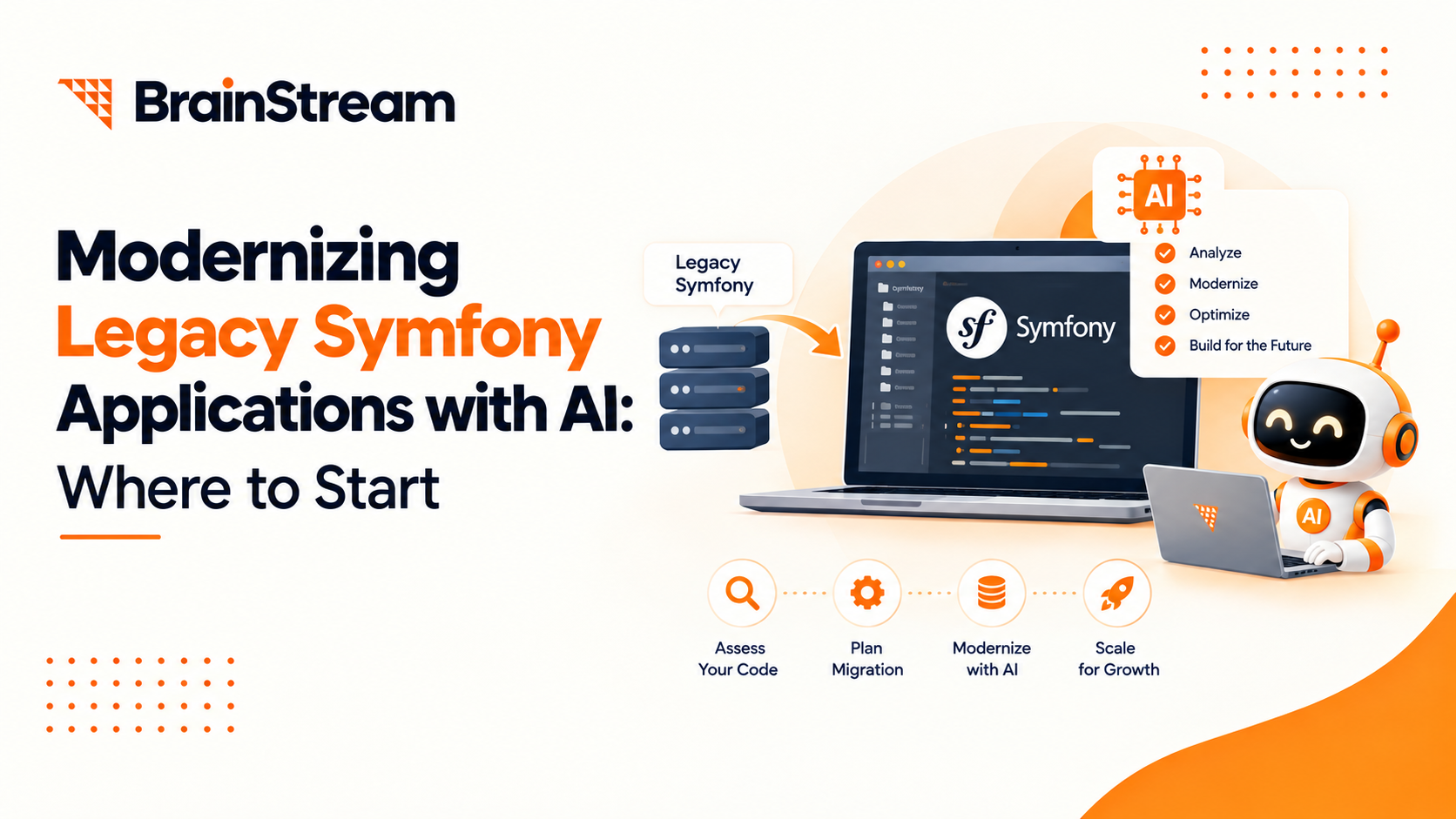
Modernizing Legacy Symfony Applications with AI: Where to Start
Your Symfony application still runs your business. However, adding features…

Agentic Commerce in 2026: How AI Agents Are Changing Online Shopping
Online shopping is entering a new phase. For years, shoppers…

Top 7 Must-Have Bagisto Extensions to Improve Your eCommerce Store in 2026
Running an online store takes more than adding products and…