What Is a Multivendor Marketplace on Shopify (and Why Shopify Alone Can’t Do It)
If you’ve thought about building the next Etsy, Amazon Marketplace, or Flipkart, Shopify is one of the first platforms that comes to mind. It’s fast, reliable, and provides everything needed to launch a modern ecommerce store.
But there’s one important catch.
Shopify is built around a single merchant selling to customers. When you want multiple independent sellers managing their own products, inventory, orders, and payouts under one storefront, you quickly discover Shopify wasn’t designed for that.
That doesn’t mean Shopify can’t power a marketplace; it absolutely can. It just needs another layer to handle marketplace operations, while Shopify keeps doing what it does best: storefront, checkout, payments, and order management.
This article covers what a multivendor marketplace actually requires, and exactly where Shopify’s native capabilities stop.
What a Multivendor Marketplace Actually Needs
A multivendor marketplace is much more than a store with thousands of products.
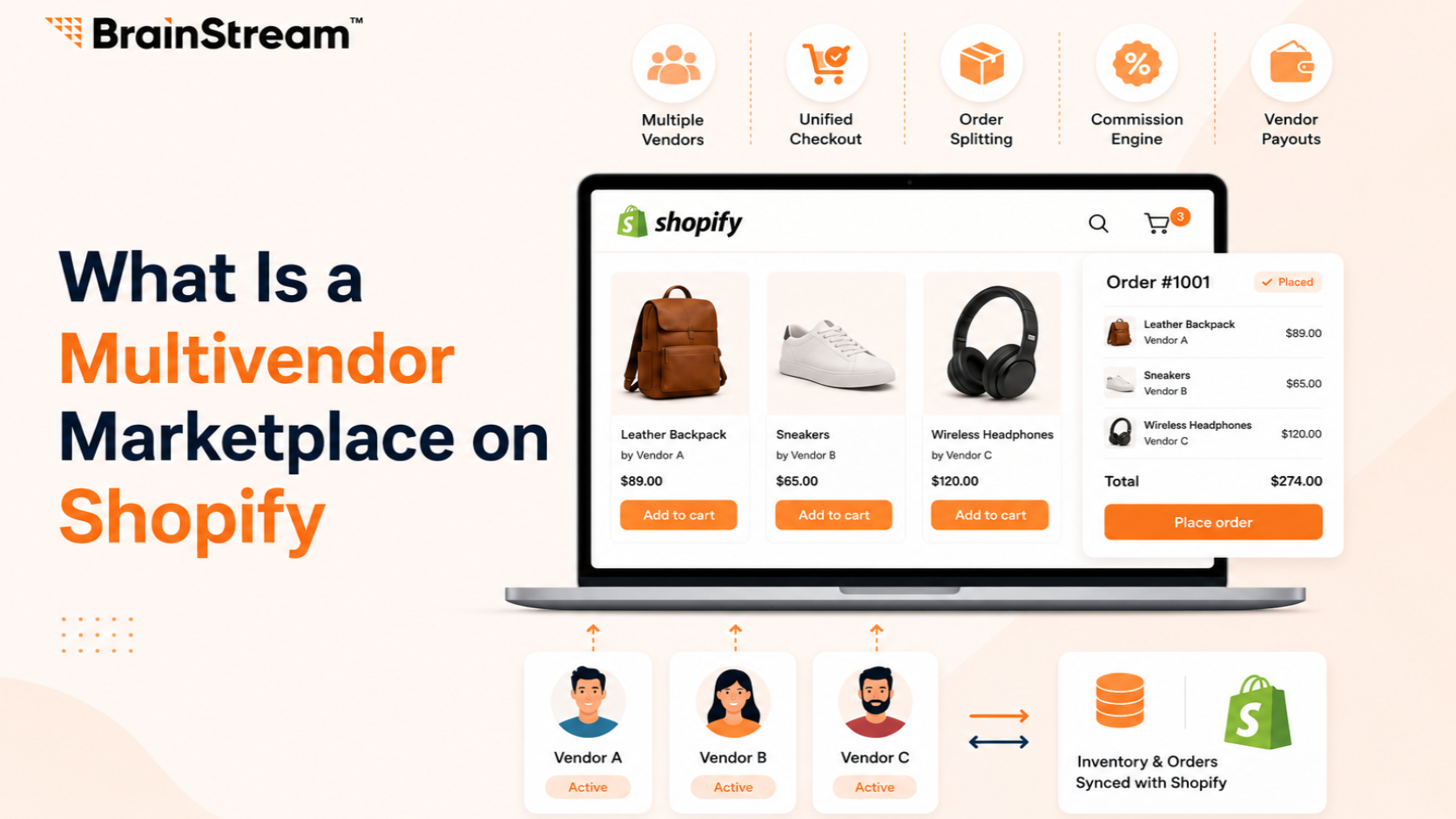
Instead of a single business selling everything, multiple independent businesses sell through the same site, while customers get a single shopping experience.
Think Etsy or Amazon Marketplace. Customers browse a single storefront, but behind the scenes, each seller manages their own business independently.
A complete marketplace typically requires:
- Multiple vendors managing their own products independently
- Vendors controlling their own inventory and warehouse locations
- Orders automatically split by vendor for fulfillment.
- Individual commission rules for each seller, category, or product
- Vendor onboarding, approvals, and KYC verification
- Separate dashboards and permissions for marketplace admins and vendors
- Financial reconciliation, payout tracking, and audit logs
These aren’t optional features — they’re the core building blocks of any serious marketplace.
Where Shopify’s Native Model Stops
Shopify provides an excellent ecommerce foundation, but its architecture is intentionally designed around a single store owner.
Out of the box, Shopify offers:
- A single product catalog owned by the store
- Centralized inventory management
- One checkout experience
- One order record
- Staff accounts with permissions.
- Payments settled to one merchant bank account.
What Shopify doesn’t include is just as important:
- No vendor entity
- No vendor dashboards
- No per-vendor inventory ownership
- No automatic order splitting
- No commission management
- No payout system for multiple sellers
Say a customer buys one laptop from Vendor A and one keyboard from Vendor B in the same order. From Shopify’s perspective, it’s still just one order belonging to one merchant. It has no idea that two independent businesses now need to fulfill their own products and get paid separately.
This isn’t a flaw in Shopify: it’s simply outside what the platform was built for. Marketplace management is an orchestration layer that sits on top of Shopify, not inside it.
What It Takes To Close the Gap
Every one of the missing pieces above has to be built by whoever’s adding marketplace functionality: a vendor entity with its own lifecycle, order-splitting logic, a commission engine, a payout ledger, inventory ownership mapped to Shopify locations, and role-scoped permissions for admins and vendors.
That’s exactly what we built with MarketFox — a Laravel app that sits on top of Shopify’s Admin GraphQL API and adds each of those pieces, while leaving checkout, payments, and the storefront to Shopify itself. Customers still buy through Shopify Checkout; vendors, commissions, payouts, and inventory ownership are handled in a purpose-built admin and vendor panel.
Each piece is its own deep dive later in this series: order splitting, the commission engine, payouts, inventory, and permissions all get a dedicated post.
See how MarketFox handles all of this on a real Shopify store.
Is Shopify Enough for a Marketplace?
For a traditional online store, Shopify is one of the best ecommerce platforms available. For a true multivendor marketplace, additional infrastructure is essential.
The challenge isn’t selling products; Shopify already excels at that. The challenge is managing independent businesses that all sell through the same storefront, while orders, inventory, commissions, payouts, and permissions stay accurate.
Frequently Asked Questions
1. Does Shopify support multiple vendors natively?
No. Shopify’s Admin API has a vendor field on products, but it’s a plain text label used for filtering and collections — not an account, a login, or an entity with permissions. Running multiple independent sellers requires a separate app layer on top of Shopify.
2. Can I add a marketplace feature to my existing Shopify store?
Yes. Since Shopify’s storefront, checkout, and payments stay in place, marketplace apps like MarketFox connect through the Admin API without requiring you to rebuild or migrate your store.
3. What’s the difference between a Shopify store and a Shopify marketplace?
A Shopify store has one seller and one catalog. A marketplace built on Shopify has multiple independent sellers, each with their own inventory and payouts, unified under one storefront — a layer Shopify itself doesn’t provide.
4. Do I need a separate platform, or can I extend Shopify?
You can extend Shopify. Replacing it means losing Shopify Checkout, Shopify Payments, Shop Pay, and your existing themes/apps; extending it via the Admin API keeps all of that intact while adding marketplace operations on top.
5. What does the product “vendor” field on Shopify actually do?
It’s a text attribute (the same kind of field as a tag) used to group and filter products by brand or supplier name in the admin and storefront. It carries no ownership, permission, or payout logic; that has to be built separately.
What’s Next in This Series
- The architecture problem: why multiple independent businesses on one store need database isolation, and how multi-tenant Laravel handles it.
- Vendor onboarding without chaos: KYC, approval, and the lifecycle that keeps bad actors out.

Manish Khilwani
Author
Co-Founder at BrainStream Technolabs, he focuses on building people-first, scalable eCommerce and digital products that help brands grow with clarity and innovation.
Table of contents
BLOGS
Learn & Grow with Us
Get the latest updates on trends and strategies that shape the business world. Our insights are here to keep you informed and inspired.

How Much Does AI Integration into a Symfony Application Cost in 2026?
Adding artificial intelligence to your Symfony application can improve customer…

Modernizing Legacy Symfony Applications with AI: Where to Start
Your Symfony application still runs your business. However, adding features…

Agentic Commerce in 2026: How AI Agents Are Changing Online Shopping
Online shopping is entering a new phase. For years, shoppers…

Top 7 Must-Have Bagisto Extensions to Improve Your eCommerce Store in 2026
Running an online store takes more than adding products and…