Why Most AI Development Projects Fail and How to Avoid Common Mistakes?
Artificial intelligence (AI Development) is changing the way businesses operate. From customer support chatbots to predictive analytics and workflow automation, AI is helping companies improve efficiency and make smarter decisions. As a result, organizations across industries are investing heavily in AI-powered solutions.
However, there is one important fact that many businesses overlook. Not every AI project becomes a success. In fact, many organizations spend significant time and money on AI initiatives that never deliver the expected results.
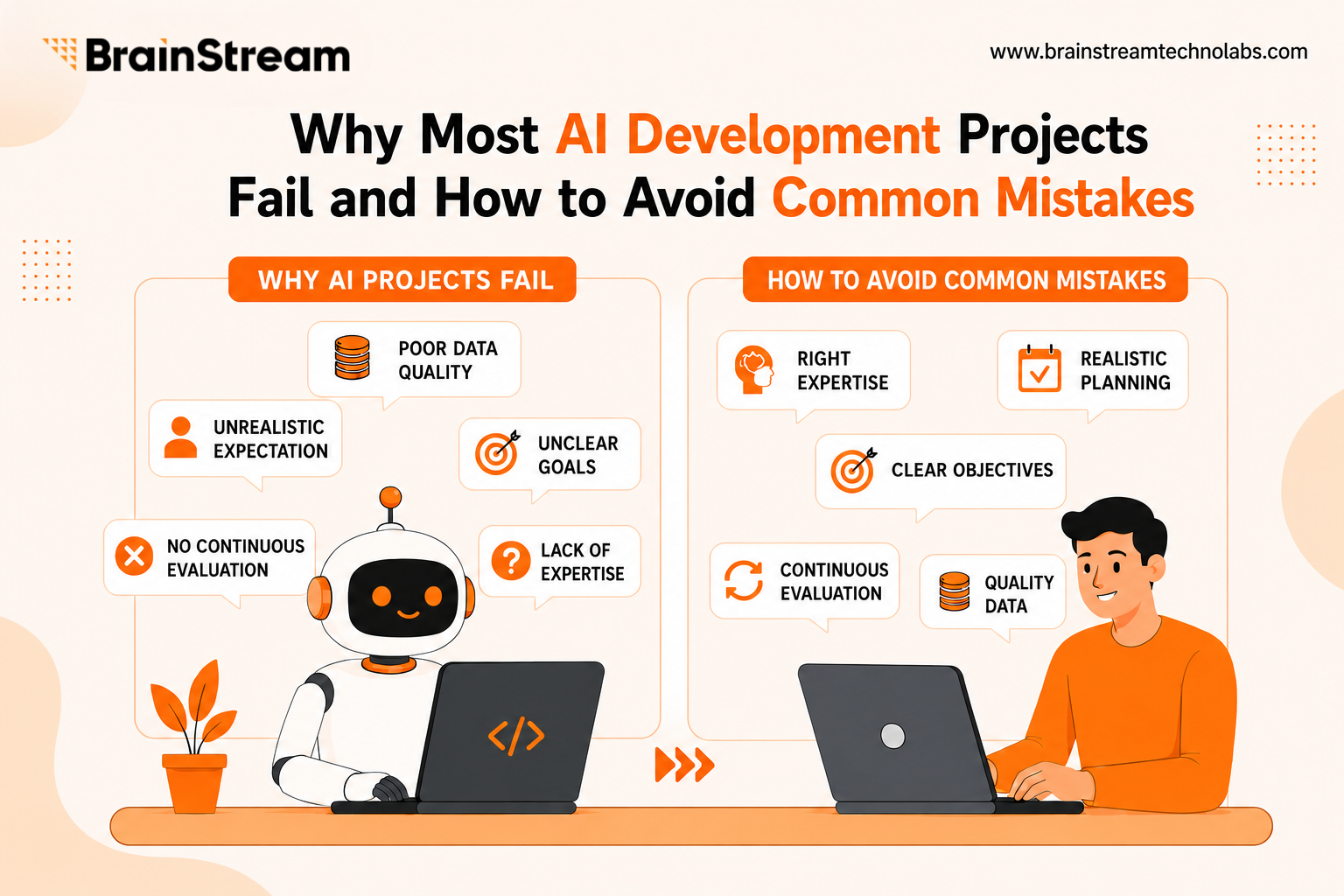
The problem is rarely the technology itself. Instead, AI projects often fail because of poor planning, unclear goals, weak data, or unrealistic expectations. Many businesses jump into AI because it is popular, not because they have identified a real business problem.
The good news is that these mistakes are avoidable. With the right strategy, experienced technical guidance, and a clear implementation plan, businesses can build AI solutions that create measurable value.
In this guide, you will learn why AI development projects fail, the most common mistakes businesses make, and practical steps to improve your chances of success.
Why Businesses Are Investing in AI Development?
AI is no longer limited to large technology companies. Today, startups, mid-sized businesses, and enterprises are using AI to improve operations and stay competitive.
Let’s look at some of the main reasons behind this growing adoption.
Improve Business Efficiency
Every business has repetitive tasks that consume valuable time.
AI can automate many of these activities, including:
- Customer support
- Data entry
- Invoice processing
- Document analysis
- Email categorization
As a result, employees can focus on work that requires creativity and decision-making.
Deliver Better Customer Experiences
Customers expect quick responses and personalized experiences.
AI helps businesses meet these expectations by offering:
- Intelligent chatbots
- Personalized recommendations
- Faster customer support
- Predictive search
- Smart virtual assistants
Consequently, businesses improve customer satisfaction while reducing support costs.
Make Better Business Decisions
Modern businesses collect huge amounts of data every day.
Unfortunately, raw data alone provides little value.
AI analyzes this information quickly and identifies useful patterns.
For example, AI can help businesses:
- Forecast sales
- Predict customer behavior
- Detect fraud
- Optimize inventory
- Identify operational bottlenecks
Better insights often lead to better business decisions.
Increase Productivity
AI reduces manual work across multiple departments.
Marketing teams can automate campaigns.
HR departments can screen resumes.
Finance teams can process invoices automatically.
Similarly, sales teams can identify high-value leads more efficiently.
Therefore, AI improves productivity across the organization.
Why Most AI Development Projects Fail?
Although AI offers enormous potential, many projects struggle before they generate real business value.
Here are the most common reasons.
Lack of Clear Business Objectives
Many companies begin AI projects because competitors are adopting AI.
Unfortunately, this approach rarely succeeds.
Instead of asking, “How can we use AI?” businesses should ask, “Which business problem are we trying to solve?”
For example:
✅ Reduce customer support costs
✅ Improve demand forecasting
✅ Increase sales conversions
✅ Detect fraudulent transactions
These are measurable business goals.
Without clear objectives, AI projects often lose direction.
Poor Data Quality
AI depends on data.
If the data is incomplete, outdated, or inaccurate, the AI model will also produce poor results.
This is often summarized by the phrase:
Garbage in, garbage out.
Before building an AI solution, businesses should evaluate:
- Data accuracy
- Data consistency
- Missing information
- Duplicate records
- Data security
Clean data creates better AI models.
Choosing the Wrong AI Use Case
Not every problem requires artificial intelligence.
Sometimes a simple software solution works better.
Businesses often waste resources by forcing AI into situations where traditional automation is sufficient.
Good AI use cases include:
- Image recognition
- Fraud detection
- Recommendation systems
- Predictive maintenance
- Natural language processing
Poor AI use cases include simple rule-based tasks that standard software can handle efficiently.
Unrealistic Expectations
AI is powerful, but it is not magic.
Some businesses expect AI to deliver immediate results after implementation.
Others believe AI will eliminate all manual work.
In reality, AI requires:
- Continuous improvement
- Model training
- Performance monitoring
- Data updates
- Human oversight
Successful AI projects evolve.
Lack of AI Expertise
Building AI applications requires more than software development skills.
Successful projects often involve:
- Data scientists
- AI engineers
- Cloud architects
- Software developers
- Business analysts
- Security specialists
Without experienced professionals, businesses may struggle to build reliable AI solutions.
Working with an experienced AI development partner helps reduce these risks.
Ignoring Cloud Infrastructure
Many AI applications process large amounts of data.
They also require scalable computing resources.
Without proper cloud infrastructure, AI systems may experience:
- Slow performance
- High operational costs
- Limited scalability
- Security challenges
Cloud platforms such as AWS, Microsoft Azure, and Google Cloud provide the flexibility needed for modern AI applications.
Poor Integration with Existing Systems
AI should not operate in isolation.
It should connect with existing business applications, including:
- CRM systems
- ERP platforms
- Customer support software
- eCommerce platforms
- Analytics tools
Without proper integration, businesses cannot maximize AI’s value.
Lack of Employee Adoption
Technology succeeds only when people use it.
Employees may resist AI because they fear change or lack training.
Businesses should involve users early in the project and provide proper education.
This improves adoption and increases the return on investment.
Common AI Development Mistakes Businesses Make
Even companies with large budgets can struggle with AI implementation. In many cases, the problem is not the technology. Instead, it is the planning process.
Let’s look at the most common mistakes businesses make.
Starting Without an AI Strategy
Many businesses invest in AI before defining a clear strategy.
They purchase AI tools or hire developers without identifying the business problem they want to solve.
As a result, the project lacks direction and measurable outcomes.
Instead, start by answering these questions:
- What business challenge are we solving?
- Which processes need improvement?
- What results do we expect?
- How will we measure success?
A well-defined AI strategy keeps the entire project focused.
Ignoring Data Preparation
Data is the foundation of every AI solution.
However, many businesses underestimate the effort required to prepare it.
Before development begins, make sure your data is:
- Accurate
- Complete
- Consistent
- Up to date
- Secure
Clean data helps AI models produce reliable and meaningful results.
Trying to Build Everything at Once
Some organizations attempt to automate every process with AI.
This often leads to delays, higher costs, and unnecessary complexity.
Instead, begin with one high-impact use case.
For example:
- Customer support automation
- Invoice processing
- Sales forecasting
- Product recommendations
After achieving success, expand AI into other business areas.
Choosing Technology Before Defining Requirements
Businesses sometimes choose AI tools because they are popular.
However, the right technology depends on your business goals.
Start with the problem first.
Then select the technology that solves it efficiently.
This approach reduces unnecessary costs and simplifies development.
Ignoring Security and Compliance
AI applications often process sensitive customer and business data.
Without proper security, organizations increase the risk of cyberattacks and compliance violations.
Best practices include:
- Data encryption
- Multi-factor authentication
- Role-based access control
- Secure APIs
- Regular security testing
Security should be part of the project from day one.
How to Build a Successful AI Development Project?
Successful AI implementation requires careful planning.
The following steps can significantly improve project outcomes.
Step 1: Identify a Real Business Problem
Avoid implementing AI simply because it is trending.
Instead, focus on challenges that directly affect your business.
Examples include:
- Reducing operational costs
- Improving customer service
- Increasing sales
- Detecting fraud
- Optimizing inventory
When AI solves a real problem, the investment becomes much more valuable.
Step 2: Define Clear Success Metrics
Every AI project should have measurable goals.
Examples include:
- Reduce customer support costs by 30%
- Improve forecast accuracy by 20%
- Increase customer satisfaction scores
- Reduce processing time
- Improve employee productivity
Clear KPIs help businesses evaluate project success.
Step 3: Build a Strong Data Foundation
Your AI model is only as good as the data it receives.
Therefore:
- Remove duplicate records.
- Correct inaccurate information.
- Standardize data formats.
- Protect sensitive information.
Good data improves prediction accuracy and model performance.
Step 4: Start with a Minimum Viable Product (MVP)
Many successful AI companies begin with a small pilot project.
An MVP allows businesses to:
- Test assumptions
- Collect user feedback
- Measure ROI
- Reduce development risks
If the pilot succeeds, additional features can be added gradually.
Step 5: Choose Scalable Cloud Infrastructure
AI applications often require significant computing power.
Cloud platforms provide flexibility as business needs grow.
Benefits include:
- Faster deployment
- Better scalability
- Lower infrastructure costs
- Improved security
- Easy integration with AI services
Cloud infrastructure also supports future AI expansion.
Step 6: Work with Experienced AI Professionals
AI projects involve multiple technical disciplines.
A strong development team may include:
- AI Engineers
- Data Scientists
- Cloud Architects
- Software Developers
- DevOps Engineers
- UI/UX Designers
- Quality Assurance Specialists
Experienced professionals reduce project risks and improve overall quality.
AI Development Best Practices
Businesses that follow proven practices achieve better results.
Here are several recommendations.
Focus on Business Value
Technology should always support business goals.
Every AI feature should solve a measurable problem.
Keep Humans in the Process
AI supports decision-making.
However, humans should continue reviewing critical business decisions.
This improves accuracy and accountability.
Monitor AI Performance Regularly
AI models require continuous improvement.
Monitor:
- Accuracy
- User adoption
- Response times
- Business impact
Regular reviews help maintain long-term performance.
Improve Models Continuously
Customer behavior changes over time.
Business data also evolves.
Therefore, retrain AI models using updated information whenever necessary.
Continuous improvement keeps AI relevant.
Build for Future Growth
Business requirements rarely stay the same.
Design AI applications with scalability in mind.
Future-ready architecture makes expansion easier and reduces redevelopment costs.
Benefits of Successful AI Development
Organizations that implement AI successfully gain several competitive advantages.
Increased Productivity
AI automates repetitive tasks.
Employees spend more time on strategic work.
Better Customer Experiences
Personalized recommendations and intelligent support improve customer satisfaction.
Happy customers are more likely to remain loyal.
Faster Decision-Making
AI analyzes large volumes of data in seconds.
Business leaders receive insights much faster.
Lower Operational Costs
Automation reduces manual effort.
Consequently, businesses lower operating expenses while improving efficiency.
Improved Scalability
Cloud-based AI applications grow alongside the business.
Organizations can serve more customers without major infrastructure changes.
Competitive Advantage
Companies that adopt AI effectively often outperform competitors.
They innovate faster, improve customer experiences, and respond quickly to market changes.
Real-World Example
Imagine an online retail company receiving thousands of customer inquiries every week.
Instead of hiring additional support agents, the company introduces an AI-powered chatbot.
The chatbot answers common questions instantly, handles order tracking, and directs complex issues to human agents.
As a result:
- Customer response times improve.
- Support costs decrease.
- Employees focus on high-value conversations.
- Customer satisfaction increases.
This simple AI implementation delivers measurable business value without replacing the human support team.
Final Thoughts
Artificial intelligence has the potential to transform how businesses operate. However, technology alone does not guarantee success. The most successful AI initiatives start with a clear business problem, realistic expectations, and a well-defined implementation strategy.
Instead of trying to automate everything at once, focus on one valuable use case. Build a strong data foundation, involve key stakeholders, and measure results throughout the project. This approach helps reduce risk and increases the chances of long-term success.
It is also important to remember that AI is not a one-time investment. As your business grows, your AI models should continue to learn, improve, and adapt to changing customer needs and market conditions.
Finally, choose a technology partner who understands both business and technology. An experienced AI development team can help you identify the right opportunities, avoid common mistakes, and build scalable solutions that deliver measurable business value.
Whether you are planning your first AI initiative or expanding existing capabilities, a strategic approach will help you maximize your investment and stay competitive in an increasingly AI-driven world.
FAQs
What is the biggest reason AI development projects fail?
The biggest reason is the lack of a clear business objective. Many companies invest in AI because it is a popular trend rather than because it solves a specific problem. Successful AI projects always begin with measurable business goals.
How can businesses improve the success rate of AI projects?
Businesses can improve success by creating an AI strategy, preparing high-quality data, starting with a small pilot project, using scalable cloud infrastructure, and working with experienced AI professionals.
Do small businesses benefit from AI development?
Yes. AI is no longer limited to large enterprises. Small and medium-sized businesses can use AI for customer support, sales forecasting, workflow automation, document processing, and marketing personalization.
How long does an AI development project take?
The timeline depends on the project’s complexity. A small AI solution may take a few months, while enterprise AI applications with multiple integrations can take six months or longer.
Why is data important in AI development?
AI models learn from data. Poor-quality data leads to inaccurate predictions and unreliable results. Clean, organized, and secure data improves the performance of AI applications.
Should businesses build AI solutions in-house or hire an AI development company?
It depends on internal expertise and available resources. Many businesses partner with an experienced AI development company to reduce risk, accelerate development, and gain access to specialized skills without hiring a large internal team.

Manish Khilwani
Author
Co-Founder at BrainStream Technolabs, he focuses on building people-first, scalable eCommerce and digital products that help brands grow with clarity and innovation.
Table of contents
BLOGS
Learn & Grow with Us
Get the latest updates on trends and strategies that shape the business world. Our insights are here to keep you informed and inspired.
How Much Does an AI Agent Cost to Build in 2026? USA vs. India Development Rates
Hiring an AI agent development company starts with one practical…
Zero-Downtime Database Migration: Strategies for Growing Applications
Zero-Downtime Database Migration – Your application is growing. More customers…

AI Shopping Agents: How to Prepare Your Online Store for 2027
Online shopping is changing quickly. Today, AI shopping agents help…
Top 10 AI Automation Companies in India
Businesses today want to work faster, reduce manual tasks, and…