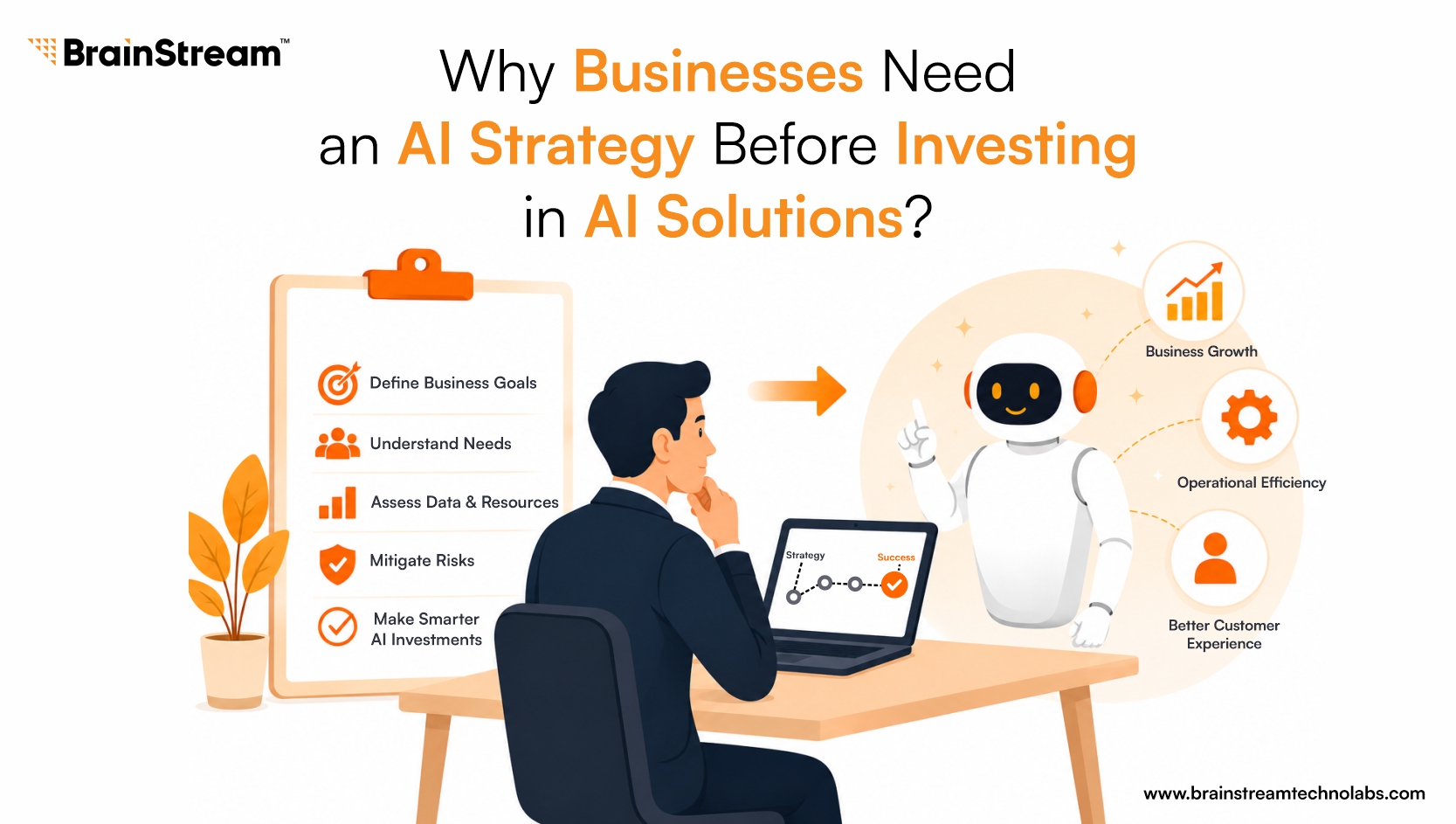
Why Businesses Need an AI Strategy Before Investing in AI Solutions?
Artificial intelligence (AI) is everywhere.
Every day, businesses hear about AI-powered automation, predictive analytics, AI agents, and generative AI. As a result, many organizations feel pressure to invest in AI quickly.
However, rushing into AI often leads to disappointing results.
Many companies spend thousands of dollars on AI tools without solving real business problems. Some invest in complex technologies before understanding how AI fits into their operations. Others launch AI projects that never deliver measurable value.
The problem is not AI itself.
The real problem is the lack of a clear AI strategy.
Before investing in any AI solution, businesses need a roadmap that connects technology decisions with business goals. A well-defined AI strategy helps organizations identify opportunities, reduce risks, and maximize return on investment.
In this guide, we will explore why an AI strategy matters and how businesses can build one successfully.
What Is an AI Strategy?
An AI strategy is a structured plan that defines how a business will use artificial intelligence to achieve specific objectives.
Instead of focusing on technology first, an AI strategy focuses on business outcomes.
It helps answer important questions such as:
- What problems should AI solve?
- Which processes need automation?
- What data is available?
- What resources are required?
- How will success be measured?
Therefore, businesses can make informed decisions rather than chasing technology trends.
Why Investing in AI Without a Strategy Is Risky?
Many organizations adopt AI because competitors are doing it.
However, technology investments without clear objectives often fail.
Lack of Business Alignment
AI projects should support business goals.
For example, a retailer may want to improve customer retention, while a logistics company may want to optimize delivery routes.
Without alignment, AI becomes an expensive experiment rather than a business asset.
Wasted Resources
AI projects require:
- Budget
- Time
- Data
- Technical expertise
Without a strategy, businesses often invest in solutions that provide little value.
As a result, costs increase while outcomes remain unclear.
Unrealistic Expectations
Some organizations expect AI to solve every challenge instantly.
In reality, successful AI adoption requires planning, testing, and continuous improvement.
A realistic roadmap helps set achievable goals and expectations.
Key Benefits of Having an AI Strategy
Better Return on Investment
An AI strategy identifies projects that offer the highest business value.
Instead of implementing AI everywhere, businesses can prioritize initiatives with measurable impact.
Therefore, investments generate stronger returns.
Faster Decision-Making
A clear roadmap reduces uncertainty.
Teams understand:
- Project priorities
- Technology requirements
- Resource allocation
- Success metrics
This accelerates decision-making across the organization.
Reduced Implementation Risks
AI projects involve technical, operational, and compliance risks.
A strategy helps identify challenges early.
Consequently, businesses can address issues before they become costly problems.
Improved Scalability
Many businesses start with a small AI initiative and expand later.
A strategic approach ensures future AI projects can scale efficiently.
Essential Components of an AI Strategy
Business Objectives
Start by identifying business challenges.
Ask questions such as:
- How can AI improve efficiency?
- Where are operational bottlenecks?
- Which customer experiences need improvement?
Business goals should always drive AI initiatives.
Data Readiness Assessment
AI depends on quality data.
Organizations should evaluate:
- Data availability
- Data quality
- Data security
- Data governance
Without reliable data, AI systems struggle to deliver accurate results.
Technology Evaluation
Different business problems require different AI solutions.
Examples include:
| Business Goal | AI Solution |
|---|---|
| Customer Support | AI Chatbots |
| Demand Forecasting | Predictive Analytics |
| Workflow Automation | AI Agents |
| Sales Insights | Machine Learning Models |
| Content Creation | Generative AI |
Choosing the right technology prevents unnecessary spending.
Implementation Roadmap
An AI roadmap outlines:
- Project phases
- Timelines
- Required resources
- Budget expectations
- Success indicators
This keeps projects organized and measurable.
Common AI Adoption Mistakes Businesses Make
Starting With Technology Instead of Problems
Many organizations purchase AI tools first.
Then they search for ways to use them.
Successful businesses take the opposite approach.
They identify business challenges first and select technology second.
Ignoring Data Quality
Even advanced AI systems fail when data is incomplete or inaccurate.
Data preparation should always be a priority.
Lack of Internal Buy-In
AI affects multiple teams.
Without stakeholder support, adoption becomes difficult.
Therefore, organizations should involve leadership and employees early.
Focusing Only on Short-Term Gains
AI should support long-term business growth.
A strategic roadmap balances immediate improvements with future opportunities.
How to Build an Effective AI Strategy?
Step 1: Define Business Goals
Identify measurable objectives.
For example:
- Reduce operational costs
- Improve customer satisfaction
- Increase productivity
- Enhance decision-making
Step 2: Assess Current Technology
Review existing systems and infrastructure.
Determine whether current technology can support AI initiatives.
Step 3: Evaluate Data Readiness
Analyze available data sources and identify gaps.
Step 4: Prioritize Use Cases
Select projects with the highest potential impact.
Start small and expand gradually.
Step 5: Create an AI Roadmap
Develop a phased implementation plan.
Include milestones, budgets, and success metrics.
Step 6: Monitor and Optimize
Track results continuously.
Adjust strategies based on performance and business needs.
Why Businesses Work With AI Advisory Experts?
Building an AI strategy requires both technical expertise and business understanding.
Many organizations partner with AI consultants to:
- Assess AI readiness
- Identify opportunities
- Build roadmaps
- Reduce implementation risks
- Align AI investments with business goals
Additionally, experienced advisors help businesses avoid costly mistakes during adoption.
Organizations looking to build a successful AI roadmap often benefit from professional AI advisory services and technology leadership support.
The Future of AI Strategy
AI adoption will continue growing across industries.
However, successful businesses will not be the ones that simply invest in AI.
They will be the organizations that invest strategically.
Future AI initiatives will focus on:
- AI agents
- Predictive analytics
- Intelligent automation
- Personalized customer experiences
- Data-driven decision-making
Therefore, having a clear AI strategy will become a competitive advantage rather than an option.
Conclusion
Artificial intelligence offers enormous opportunities. However, technology alone does not guarantee success.
Businesses need a clear AI strategy before investing in AI solutions.
A well-defined roadmap helps organizations align AI initiatives with business goals, reduce implementation risks, improve ROI, and build a foundation for long-term growth.
Instead of asking, “Which AI tool should we buy?” businesses should first ask, “What problem are we trying to solve?”
The answer to that question often determines the success of every future AI investment.
FAQs
What is an AI strategy?
An AI strategy is a roadmap that helps businesses align artificial intelligence initiatives with their goals and objectives.
Why is AI strategy important?
It reduces risk, improves ROI, and ensures AI investments solve real business problems.
How do businesses start an AI strategy?
Businesses should define goals, assess data readiness, identify use cases, and create an implementation roadmap.
What is an AI roadmap?
An AI roadmap is a structured plan that outlines how AI projects will be implemented and measured over time.
Should small businesses have an AI strategy?
Yes. Even small businesses benefit from a structured approach to AI adoption and investment planning.

Manish Khilwani
Author
Co-Founder at BrainStream Technolabs, he focuses on building people-first, scalable eCommerce and digital products that help brands grow with clarity and innovation.
Table of contents
BLOGS
Learn & Grow with Us
Get the latest updates on trends and strategies that shape the business world. Our insights are here to keep you informed and inspired.
How Much Does AI Integration into a Symfony Application Cost in 2026?
Adding artificial intelligence to your Symfony application can improve customer…
Modernizing Legacy Symfony Applications with AI: Where to Start
Your Symfony application still runs your business. However, adding features…
Agentic Commerce in 2026: How AI Agents Are Changing Online Shopping
Online shopping is entering a new phase. For years, shoppers…
Top 7 Must-Have Bagisto Extensions to Improve Your eCommerce Store in 2026
Running an online store takes more than adding products and…