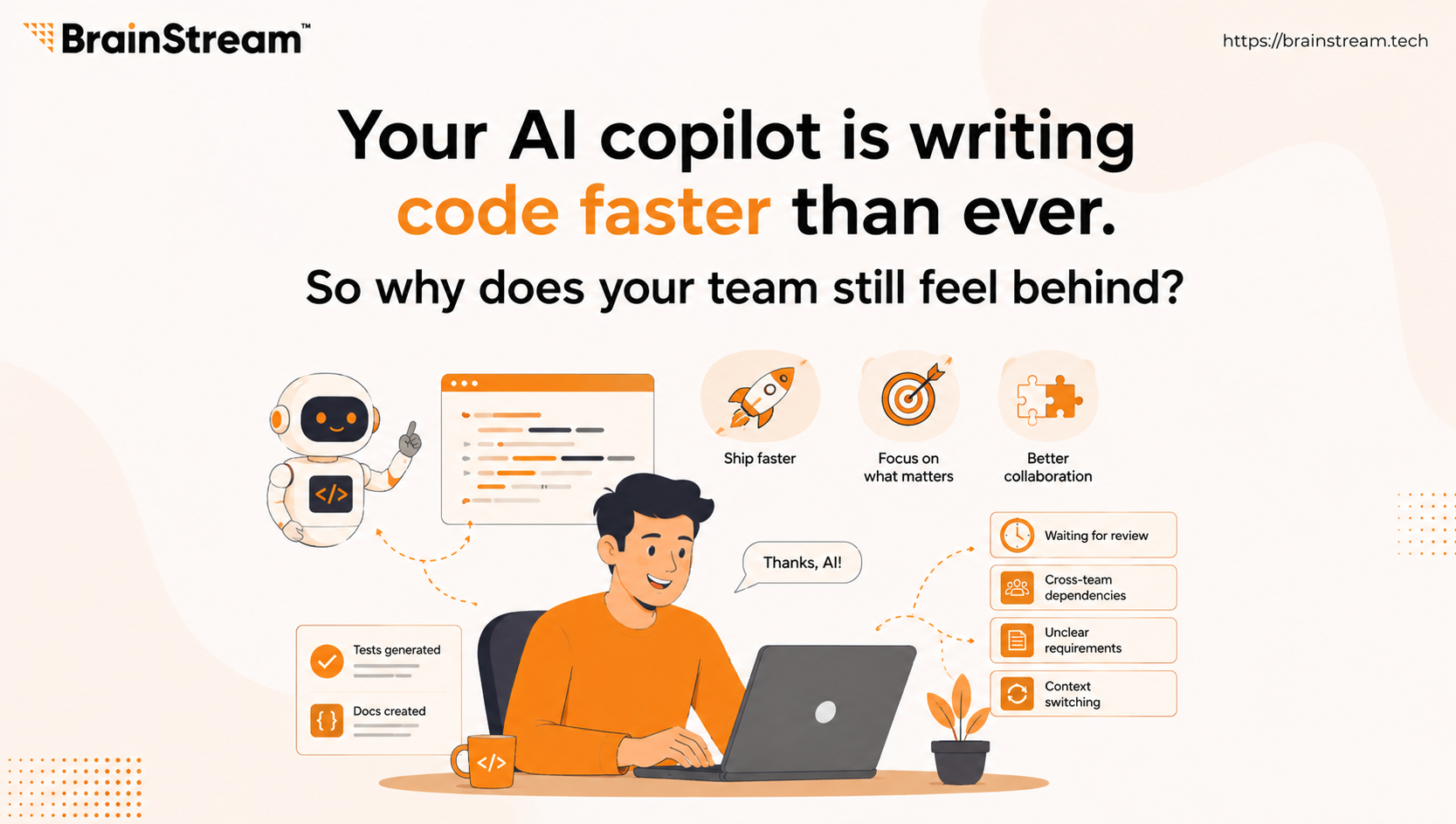
Your AI Copilot is Writing Code Faster Than Ever
AI Copilot is accelerating code production. But software delivery was never just a code-writing problem.
We’ve handed developers the most powerful code-generation tools in history, and somehow, delivery pressure hasn’t disappeared.
That tension isn’t accidental. It points to something many engineering organizations still avoid discussing openly.
A Conversation That Keeps Repeating
Last quarter, I spoke with a senior developer at a product company that had adopted GitHub Copilot nearly eight months earlier.
He genuinely liked it.
“Boilerplate takes a fraction of the time now. Repetitive functions, test scaffolding, documentation drafts, it’s excellent for that.”
Then he paused.
“But we still missed our last three sprint targets. And honestly, I’m not entirely sure why.”
That conversation has repeated itself across dozens of engineering teams over the past eighteen months.
Not frustration with AI. Most developers genuinely enjoy using Copilot.
Instead, there’s a quieter realization emerging:
The tools delivered what they promised. The real bottleneck just turned out to be somewhere else.
The Gap Nobody Talks About
Here’s the reality many teams are discovering:
The code is getting written faster.
The product is still being shipped slowly.
Both statements are true at the same time.
And the gap between them is where most engineering friction actually lives.
AI Copilot is genuinely good at what they do. Tools like GitHub Copilot, Cursor, and Amazon CodeWhisperer reduce repetitive work, accelerate implementation, and improve developer flow for many day-to-day tasks.
For individual velocity, they’re impressive.
But software development inside a team is a systems problem, not just a typing-speed problem.
The layers above code generation, coordination, architecture, communication, review quality, ownership, and operational alignment still determine whether software ships successfully.
And those layers remain deeply human.
What AI Still Doesn’t Solve
A developer’s day involves far more than writing syntax.
Understanding historical context
- Why was this architecture chosen six months ago?
- Why was a dependency avoided?
- Why does this workflow exist?
The code rarely explains all of that.
Navigating ambiguous requirements
A ticket saying “improve checkout flow” can mean radically different things depending on product context, stakeholder expectations, and technical constraints.
Waiting
PR reviews. Environment access. Product approvals. Dependency merges. Meetings that could have been comments.
Large portions of engineering time are still coordination overhead.
Debugging AI-generated edge cases
Generated code often looks correct, passes obvious tests, and still breaks under production complexity.
That last 10% still requires domain understanding and engineering judgment.
Managing cross-team dependencies
A feature can be technically complete and still blocked for days because another team owns a required service, review, or deployment sequence.
AI Copilot doesn’t operate at this layer.
They live inside the code-generation moment.
Most delivery friction exists outside of it.
Faster Code Can Also Create Faster Debt
There’s another pattern quietly emerging across AI-accelerated teams.
A developer under sprint pressure uses AI to generate a working implementation. The code compiles. Tests pass. The ticket closes.
On paper, everything looks efficient.
Three weeks later, another developer revisits that module and discovers something subtle:
The implementation technically works, but structurally, it doesn’t align with the rest of the system.
Naming conventions differ. Abstractions feel awkward. Extension paths are unclear. Small inconsistencies begin accumulating across the codebase.
Individually, none of these issues seems serious.
Collectively, they become maintenance friction.
This is how teams can paradoxically accumulate technical debt faster with AI assistance:
Not because the tools are bad, but because velocity without strong engineering discipline compounds small architectural mistakes more quickly than teams can absorb them.
AI accelerates output.
It does not accelerate judgment.
And judgment is still what determines whether code remains maintainable six months later.
What High-Performing AI Teams Do Differently
The teams seeing meaningful productivity gains from AI adoption usually share one characteristic:
Strong engineering habits existed before AI arrived.
The tools amplified healthy systems rather than compensating for weak ones.
What Doesn’t Work
- Treating AI-generated code as “probably fine”
- Measuring productivity primarily through PR volume or lines of code
- Weak or inconsistent review culture
- Documentation is being skipped because “we moved fast”
- Architectural decisions without clear ownership
- Context living inside individuals instead of systems
What Actually Works
- Faster and stronger code reviews
- Measuring delivery quality instead of raw velocity
- Using AI for repetition while humans make decisions
- Documentation included in the definition of done
- Explicit architectural accountability
- Context shared intentionally and written down clearly
The strongest AI-enabled engineering teams aren’t replacing engineering fundamentals.
They’re reinforcing them.
- Data security
- Access control
- Compliance management
- Infrastructure monitoring
The Real Bottleneck Was Never Writing Code
This is the harder conversation many engineering leaders eventually confront:
Most software delivery friction isn’t fundamentally a coding problem.
It’s a communication problem.
- Prioritization problem.
- Process design problem.
- Decision-making problem.
AI made code production dramatically cheaper.
That’s valuable.
But it also exposed the parts of software delivery that were always slowing teams down.
When implementation accelerates, unresolved operational inefficiencies become impossible to ignore.
For many organizations, those bottlenecks look familiar:
01 – Requirements shifting mid-sprint
Not because stakeholders are unreasonable, but because the scope definition was never operationally mature.
02 – Review culture that’s either too slow or too shallow
PRs either sit untouched for days or get approved without meaningful scrutiny.
03 – Knowledge trapped inside individuals
Critical context exists in conversations, not systems.
04 – Architecture decisions made under delivery pressure
Temporary compromises become permanent infrastructure.
05 – Cross-functional dependencies without ownership
Features stall across invisible handoff chains nobody mapped ahead of time.
None of these are solved by better autocomplete.
They’re solved by stronger engineering leadership and healthier operational systems.
So What’s the Actual Opportunity?
The opportunity isn’t slowing AI adoption.
The tools are real. The productivity gains are real. And they’ll continue improving rapidly.
The opportunity is changing how teams measure success.
Instead of asking:
“Are developers writing code faster?”
Engineering leaders should ask:
- Are we shipping more reliably?
- Is maintainability improving or deteriorating?
- Are reviews getting better or becoming superficial?
- Is technical debt decreasing or quietly accelerating?
- Are developers spending more time on architecture, quality, and collaboration?
- Is the overall system healthier than it was before AI adoption?
Those answers matter far more than commit volume or sprint charts.
Because ultimately, successful engineering organizations aren’t defined by how quickly they generate code.
They’re defined by how effectively they build, maintain, and evolve systems over time.
Final Thought
AI Copilot is a genuine leap forward for software development.
They reduce repetitive effort, improve developer flow, and lower the cost of implementation work.
That’s meaningful progress.
But the developers and engineering teams that create durable products still rely on something AI cannot automate:
- Good judgment.
- Clear communication.
- System thinking.
- Ownership.
- Collaboration under uncertainty.
AI can enhance those capabilities.
It cannot replace them.
And the gap between those two realities is still where the most important engineering work happens.

Manish Khilwani
Author
Co-Founder at BrainStream Technolabs, he focuses on building people-first, scalable eCommerce and digital products that help brands grow with clarity and innovation.
Table of contents
BLOGS
Learn & Grow with Us
Get the latest updates on trends and strategies that shape the business world. Our insights are here to keep you informed and inspired.
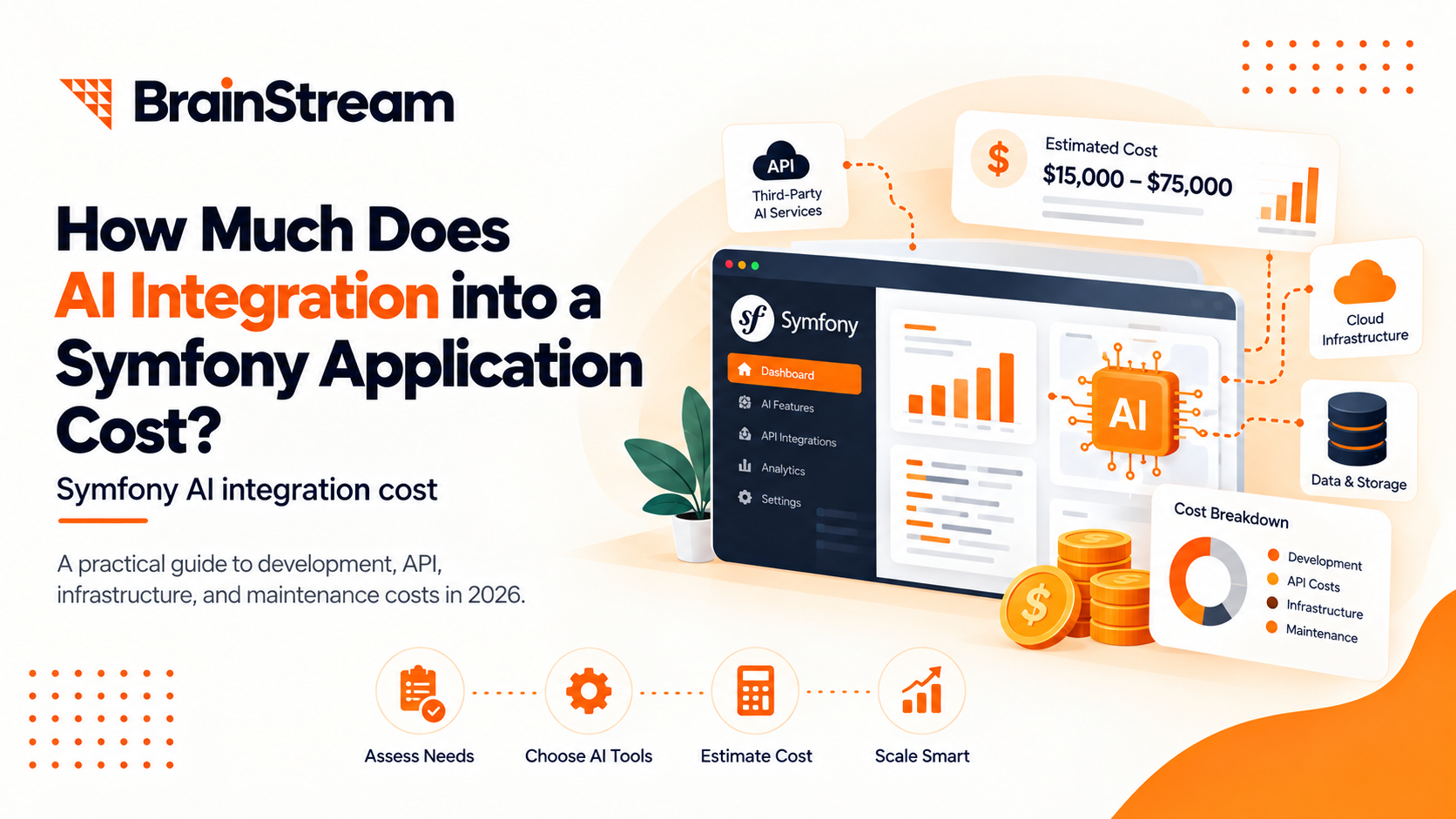
How Much Does AI Integration into a Symfony Application Cost in 2026?
Adding artificial intelligence to your Symfony application can improve customer…
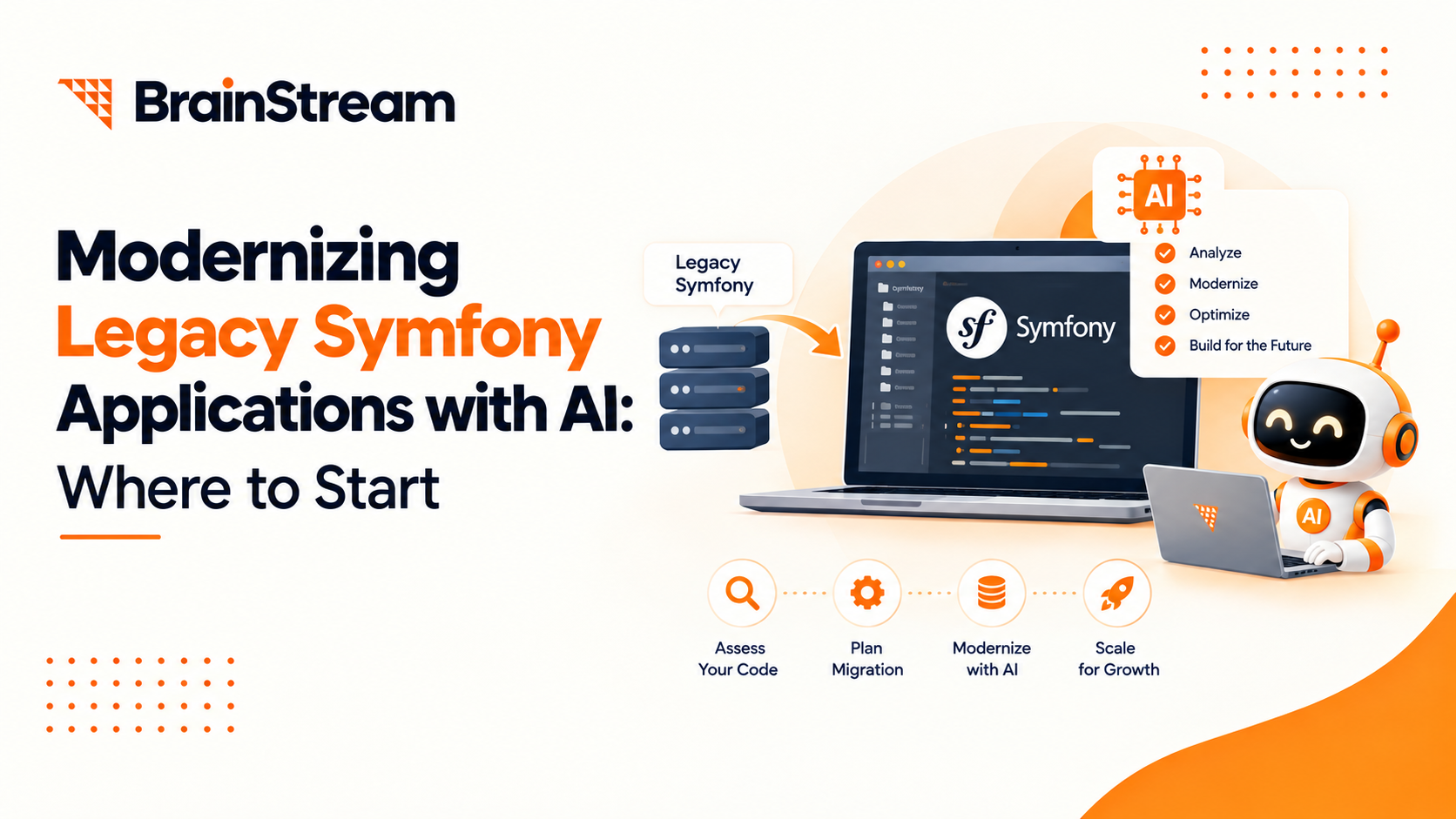
Modernizing Legacy Symfony Applications with AI: Where to Start
Your Symfony application still runs your business. However, adding features…

Agentic Commerce in 2026: How AI Agents Are Changing Online Shopping
Online shopping is entering a new phase. For years, shoppers…

Top 7 Must-Have Bagisto Extensions to Improve Your eCommerce Store in 2026
Running an online store takes more than adding products and…