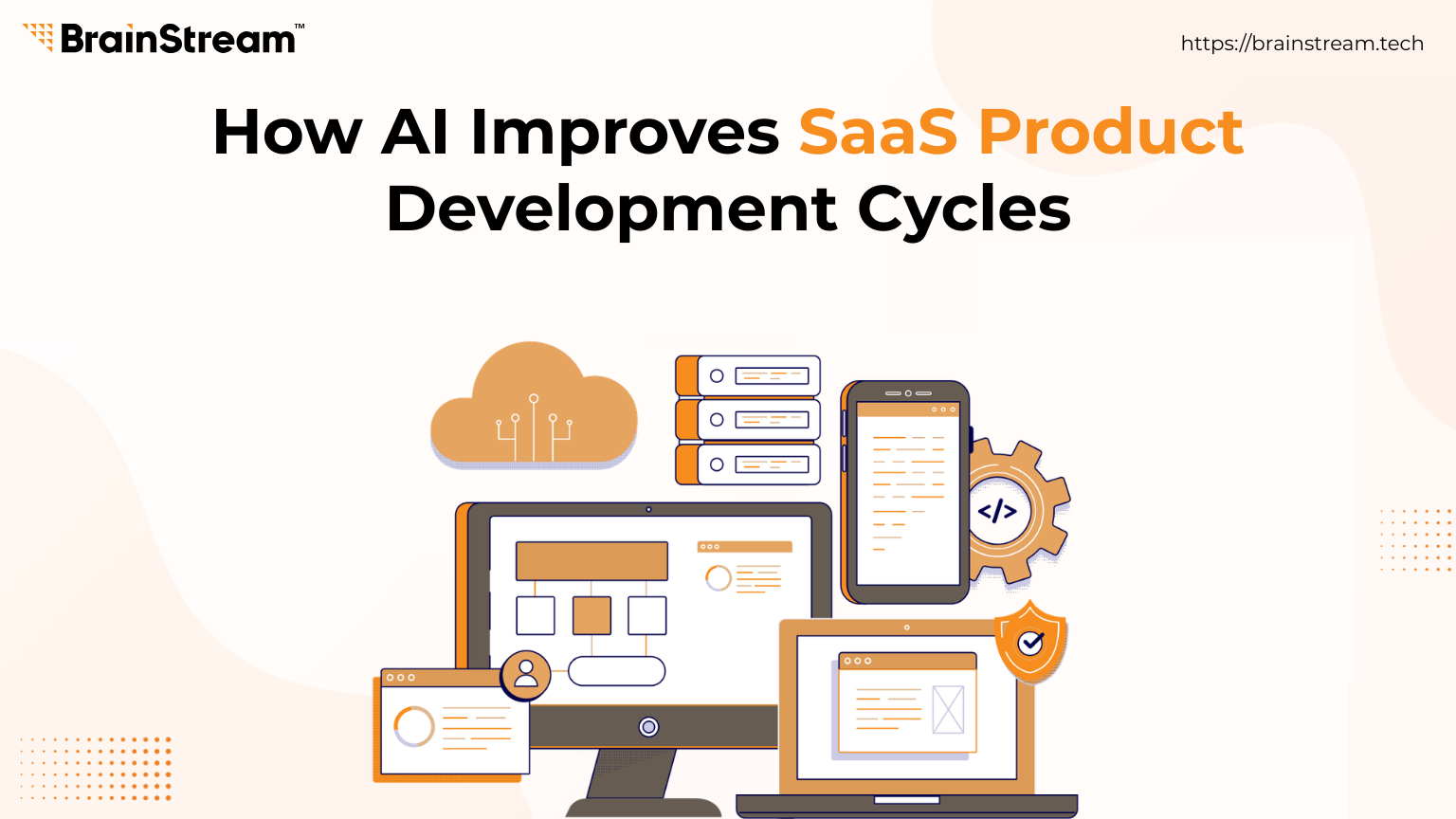
How AI Improves SaaS Product Development Cycles?
Building a successful SaaS product is no longer just about writing code and launching features. Today, SaaS companies must release updates faster, improve customer experience continuously, and adapt quickly to changing market demands.
However, traditional product development cycles often slow businesses down.
Teams spend weeks analyzing user feedback, testing features, fixing bugs, and managing repetitive workflows. Meanwhile, competitors continue launching new features and improving their platforms.
This is exactly why many SaaS companies are adopting artificial intelligence.
AI is transforming how modern SaaS products are designed, developed, tested, and optimized. Instead of relying only on manual processes, businesses now use AI-powered tools to automate workflows, improve decision-making, and accelerate development cycles.
As a result, SaaS companies build products faster while improving quality and customer experience.
In this guide, you will learn:
- How AI improves SaaS product development
- Key AI use cases in SaaS engineering
- Benefits of AI-powered development workflows
- Common implementation challenges
- Best practices for AI adoption
Let’s begin.
Why SaaS Product Development Is Becoming More Complex?
Modern SaaS applications are far more advanced than traditional software platforms.
Today, businesses must manage:
- Cloud infrastructure
- APIs
- User personalization
- Security
- Mobile compatibility
- Real-time analytics
- Continuous feature releases
At the same time, users expect fast updates and seamless experiences.
Because of this, SaaS development teams often face:
- Longer release cycles
- High operational workloads
- Increasing development costs
- Difficult testing processes
Traditional workflows can no longer keep up with growing product demands.
AI helps solve these challenges by improving speed, automation, and operational efficiency.
How AI Improves SaaS Product Development Cycles?
Artificial intelligence supports multiple stages of SaaS development.
Let’s explore the most important areas.
Faster Product Planning and Research
Product planning takes significant time for many SaaS businesses.
Teams must analyze:
- Market trends
- Customer behavior
- Feature requests
- Competitor strategies
AI-powered analytics tools help businesses process this information much faster.
For example, AI can identify:
- Popular feature requests
- User pain points
- Engagement patterns
- Market opportunities
As a result, product teams make better decisions and prioritize features more effectively.
Improving Software Development Efficiency
AI-powered development tools now help engineers write cleaner and faster code.
Modern AI coding assistants support:
- Code generation
- Error detection
- Code optimization
- Documentation creation
Because of this, developers spend less time on repetitive tasks and more time solving complex problems.
Meanwhile, AI also improves collaboration between engineering teams.
Companies building scalable SaaS platforms often integrate AI-driven workflows with cloud-native development solutions from Brainstream Technolabs to improve development speed and infrastructure scalability.
Automating Software Testing
Software testing is one of the most time-consuming parts of SaaS development.
Traditional testing processes often require:
- Manual testing
- Repetitive workflows
- Large QA teams
AI improves testing by automating:
- Bug detection
- Regression testing
- Performance monitoring
- UI testing
AI systems can also identify potential issues before deployment.
As a result, SaaS companies reduce testing time while improving software quality.
Faster Bug Detection and Issue Resolution
Finding and fixing bugs quickly is critical for SaaS businesses.
AI-powered monitoring tools continuously analyze:
- System logs
- User behavior
- Infrastructure performance
- Application errors
These systems detect anomalies faster than manual monitoring processes.
For example, AI can identify unusual API behavior before it impacts customers.
Because of this, businesses improve reliability and reduce downtime.
Smarter Product Personalization
Modern SaaS users expect personalized experiences.
AI helps businesses analyze customer behavior and deliver:
- Personalized dashboards
- Smart recommendations
- Custom workflows
- Automated suggestions
As a result, companies improve user engagement and customer retention.
Meanwhile, product teams gain better insights into feature performance and customer needs.
Improving DevOps and Deployment Processes
DevOps teams manage complex deployment pipelines and cloud infrastructure.
AI helps automate:
- Deployment monitoring
- Resource optimization
- Performance tracking
- Incident detection
Additionally, AI-powered analytics improve infrastructure management and scalability.
This allows businesses to release updates faster and more reliably.
Benefits of AI in SaaS Product Development
AI provides several major advantages for SaaS businesses.
Faster Development Cycles
Automation reduces repetitive engineering tasks.
As a result, teams release features faster.
Better Product Quality
AI-powered testing improves bug detection and software reliability.
Improved Customer Experience
Personalization and predictive analytics create smarter user experiences.
Reduced Operational Costs
Automation lowers manual workloads and improves efficiency.
Better Decision-Making
AI-driven analytics help product teams prioritize features more effectively.
Common Challenges Businesses Face
Although AI improves SaaS development significantly, businesses still face challenges during implementation.
Integration Complexity
Many SaaS platforms rely on legacy systems and complex architectures.
Integrating AI tools into existing workflows can become technically difficult.
Data Quality Issues
AI systems depend heavily on high-quality data.
Poor or incomplete data may reduce AI accuracy and performance.
Security and Compliance Concerns
AI-powered SaaS platforms often process sensitive customer information.
Therefore, businesses must prioritize:
- Data security
- Access control
- Compliance management
- Infrastructure monitoring
Best Practices for AI Adoption in SaaS Development
Businesses should follow a strategic approach when implementing AI.
Start With High-Impact Areas
Begin with workflows like:
- Automated testing
- Analytics
- Monitoring
- Customer personalization
This improves implementation success.
Use Scalable Cloud Infrastructure
AI-powered SaaS applications require scalable cloud-native environments.
Cloud infrastructure improves:
- Performance
- Reliability
- Scalability
Continuously Optimize AI Systems
AI models require regular monitoring and updates.
Businesses should track:
- Accuracy
- User engagement
- Operational efficiency
- Infrastructure performance
The Future of AI in SaaS Product Development
AI will continue transforming SaaS product engineering over the next few years.
Future SaaS platforms will likely become:
- More automated
- More intelligent
- More personalized
- More scalable
Meanwhile, technologies like generative AI and AI agents are evolving rapidly.
Because of this, businesses that adopt AI-powered development workflows early will gain a strong competitive advantage.
Conclusion
AI is transforming how SaaS products are built and managed.
From automated testing and smarter analytics to personalized experiences and faster deployments, AI helps SaaS companies improve efficiency and accelerate product development cycles.
As a result, businesses release features faster, improve software quality, and create better customer experiences.
However, successful AI adoption requires scalable infrastructure, strong security practices, and continuous optimization.
Companies that invest in AI-powered SaaS development today will be better prepared for the future of intelligent software engineering.
FAQs
How does AI improve SaaS product development?
AI automates testing, improves coding efficiency, enhances personalization, and accelerates development workflows.
Why are SaaS companies investing in AI?
SaaS businesses use AI to improve operational efficiency, reduce development time, and create better customer experiences.
Can AI improve software testing?
Yes. AI automates bug detection, regression testing, and performance monitoring.
Is AI useful for DevOps workflows?
Absolutely. AI helps automate deployment monitoring, infrastructure optimization, and operational management.

Manish Khilwani
Author
Co-Founder at BrainStream Technolabs, he focuses on building people-first, scalable eCommerce and digital products that help brands grow with clarity and innovation.
Table of contents
BLOGS
Learn & Grow with Us
Get the latest updates on trends and strategies that shape the business world. Our insights are here to keep you informed and inspired.
How Much Does AI Integration into a Symfony Application Cost in 2026?
Adding artificial intelligence to your Symfony application can improve customer…
Modernizing Legacy Symfony Applications with AI: Where to Start
Your Symfony application still runs your business. However, adding features…
Agentic Commerce in 2026: How AI Agents Are Changing Online Shopping
Online shopping is entering a new phase. For years, shoppers…
Top 7 Must-Have Bagisto Extensions to Improve Your eCommerce Store in 2026
Running an online store takes more than adding products and…