Why Modern eCommerce Stores Need AI to Stay Competitive?
The eCommerce industry has evolved far beyond simple online shopping carts and digital catalogs. Today’s consumers expect personalized shopping experiences, instant customer support, accurate product recommendations, fast delivery updates, and seamless interactions across every device. Businesses that fail to meet these expectations are losing customers to competitors that are investing in intelligent digital experiences.
This is where AI ecommerce development is changing the game.
Artificial Intelligence is no longer limited to enterprise giants like Amazon or Alibaba. Modern AI technologies are now accessible to startups, mid-sized brands, D2C companies, and large-scale retailers alike. From automating operations to improving customer engagement, AI is becoming one of the most important technologies shaping the future of online retail.
For businesses looking to scale faster, reduce operational inefficiencies, and improve customer retention, investing in ecommerce AI services is no longer optional; it is becoming a competitive necessity.
The Growing Expectations of Modern Online Shoppers
Consumer behavior has changed dramatically in recent years. Shoppers now expect online stores to understand their preferences, predict their needs, and deliver highly relevant experiences in real time.
Modern customers expect:
- Personalized product recommendations
- Intelligent product search
- Instant customer support
- Faster checkout experiences
- Accurate inventory availability
- Relevant offers and promotions
- Consistent omnichannel shopping experiences
Traditional eCommerce systems struggle to deliver these experiences at scale. Manual workflows, static product recommendations, and generic marketing campaigns are no longer enough in a highly competitive market.
AI helps bridge this gap by enabling online stores to analyze customer behavior, automate decision-making, and optimize shopping experiences continuously.
The AI Industry Before OpenAI Changed Everything
Before OpenAI captured global attention, artificial intelligence was already being used across industries for analytics, recommendation engines, fraud detection, and process automation. However, most AI systems remained highly technical, expensive to implement, and inaccessible to everyday users.
What is AI in eCommerce?
AI in eCommerce refers to the use of artificial intelligence technologies such as machine learning, natural language processing, predictive analytics, and automation to improve online retail operations and customer experiences.
AI-powered eCommerce platforms can:
- Understand customer behavior
- Recommend products intelligently
- Predict buying patterns
- Automate repetitive tasks
- Improve inventory management
- Optimize pricing strategies
- Deliver personalized shopping journeys
Instead of relying on assumptions, AI systems make data-driven decisions based on customer interactions, browsing behavior, purchase history, and real-time analytics.
Why AI Has Become Essential for Modern eCommerce Businesses?
1. Personalized Shopping Experiences Increase Conversions
One of the biggest advantages of AI ecommerce development is personalization.
Modern shoppers do not want generic shopping experiences. They expect brands to understand what they like and recommend products relevant to their interests.
AI-powered recommendation systems analyze:
- Purchase history
- Browsing behavior
- Search queries
- Cart activity
- Product preferences
- Customer demographics
Using this data, AI can display highly personalized product suggestions that improve:
- Conversion rates
- Average order value
- Customer engagement
- Repeat purchases
This is one of the reasons why platforms like Amazon generate a significant percentage of revenue through AI-driven product recommendations.
2. AI Improves Product Search Accuracy
Traditional search systems often fail when users type incomplete, conversational, or misspelled queries.
AI-powered search engines use natural language processing and semantic understanding to interpret customer intent more accurately.
For example, instead of searching for exact keywords, users can type:
- “comfortable black running shoes”
- “minimalist office desk for small rooms”
- “wireless headphones under $100”
AI search systems understand the meaning behind these queries and deliver more relevant results.
This improves:
- User experience
- Product discoverability
- Customer satisfaction
- Conversion rates
For large online stores with thousands of SKUs, intelligent search functionality can significantly improve sales performance.
3. Retail Automation Reduces Operational Costs
Managing an eCommerce business involves repetitive tasks that consume time and resources.
AI-powered retail automation helps businesses streamline operations by automating:
- Customer support
- Inventory updates
- Order processing
- Fraud detection
- Email marketing
- Product categorization
- Demand forecasting
Automation reduces human errors while improving efficiency and scalability.
Instead of manually handling routine operations, teams can focus on strategic growth initiatives like customer acquisition, branding, and product innovation.
AI Chatbots Are Changing Customer Support
Modern customers expect immediate responses.
Waiting several hours for support emails is no longer acceptable in competitive online retail environments.
AI-powered chatbots can:
- Answer customer queries instantly
- Track orders
- Recommend products
- Resolve common issues
- Assist during checkout
- Handle multilingual conversations
Unlike traditional support systems, AI chatbots work 24/7 without downtime.
This improves customer satisfaction while reducing support costs significantly.
For growing eCommerce brands, AI-driven customer support creates a scalable way to manage high volumes of inquiries without expanding support teams aggressively.
Predictive Analytics Helps Businesses Make Smarter Decisions
AI systems can analyze large amounts of historical and real-time data to predict future outcomes.
Predictive analytics helps retailers understand:
- Which products are likely to sell
- Seasonal buying trends
- Customer churn risks
- Inventory demand forecasts
- Pricing opportunities
- Marketing campaign performance
This enables businesses to make proactive decisions instead of reactive ones.
For example:
- Retailers can stock inventory before demand spikes
- Marketing teams can target high-value customers
- Businesses can reduce overstocking and dead inventory
This level of intelligence gives AI-powered eCommerce businesses a strong competitive advantage.
Dynamic Pricing Helps Maximize Revenue
Pricing plays a major role in online shopping decisions.
AI-powered pricing systems can automatically adjust product prices based on:
- Market demand
- Competitor pricing
- Customer behavior
- Inventory levels
- Seasonal trends
This strategy helps businesses remain competitive while maximizing profitability.
For example, airlines and hotel platforms have used dynamic pricing for years. Modern eCommerce stores are now adopting similar AI-driven pricing models to improve revenue performance.
AI Improves Inventory Management
Inventory management remains one of the biggest challenges for retailers.
Poor inventory planning leads to:
- Overstocking
- Stock shortages
- Delayed deliveries
- Lost sales
- Increased operational costs
AI-powered inventory systems use predictive forecasting to estimate future demand more accurately.
This helps businesses maintain optimal stock levels while improving supply chain efficiency.
For fast-growing online retailers, smart inventory management can directly impact profitability and customer satisfaction.
AI Enhances Marketing Performance
Digital marketing has become increasingly competitive and expensive.
AI helps eCommerce businesses improve marketing ROI through:
- Customer segmentation
- Predictive targeting
- Personalized email campaigns
- Automated ad optimization
- Behavioral analytics
- Product recommendation ads
Instead of running generic campaigns, AI enables highly targeted marketing strategies that improve engagement and conversions.
AI can also identify high-intent customers who are more likely to purchase, helping businesses allocate marketing budgets more effectively.
Fraud Detection and Security Improvements
As online transactions increase, fraud prevention becomes critical.
AI systems can detect suspicious activities by analyzing transaction patterns and customer behavior in real time.
AI-based fraud detection helps identify:
- Unusual purchasing behavior
- Fake accounts
- Payment fraud
- Account takeover attempts
- Bot activity
This reduces financial losses while improving platform security and customer trust.
AI Helps eCommerce Businesses Scale Faster
Scaling an eCommerce business manually becomes difficult as operations grow.
AI enables scalability by automating core processes while improving operational efficiency.
Businesses can handle:
- Higher traffic volumes
- Larger product catalogs
- More customer interactions
- Complex inventory systems
- Global customer bases
without proportionally increasing operational costs.
This makes AI one of the most valuable long-term investments for modern online retailers.
The Competitive Risk of Ignoring AI
Many businesses still treat AI as a future investment rather than a present necessity.
However, competitors are already using AI to:
- Deliver better customer experiences
- Reduce operational costs
- Improve personalization
- Increase conversion rates
- Optimize marketing campaigns
- Scale faster
Brands that delay AI adoption risk falling behind in customer expectations and operational efficiency.
As AI technologies continue to evolve, the gap between AI-powered retailers and traditional stores will widen further.
How to Start Implementing AI in eCommerce?
Businesses do not need to implement every AI feature at once.
A practical approach is to start with high-impact areas such as:
Step 1: AI-Powered Product Recommendations
Improve conversions and upselling opportunities.
Step 2: AI Chatbots
Automate customer support and engagement.
Step 3: Intelligent Search
Improve product discoverability.
Step 4: Predictive Analytics
Use customer data for smarter decisions.
Step 5: Retail Automation
Automate repetitive operational tasks.
Working with an experienced ecommerce AI services company can help businesses choose the right AI solutions based on their goals, infrastructure, and scalability requirements.
The Future of AI in eCommerce
The future of eCommerce will be deeply driven by AI innovation.
Emerging AI technologies are expected to power:
- Hyper-personalized shopping experiences
- Voice commerce
- AI shopping assistants
- Visual product search
- Predictive customer journeys
- Autonomous retail operations
- AI-generated product content
As customer expectations continue to evolve, AI will become central to how online stores compete, grow, and retain customers.
Final Thoughts
AI is no longer an experimental technology for eCommerce businesses. It is becoming a foundational part of modern digital commerce strategies.
From personalization and intelligent search to retail automation and predictive analytics, AI enables businesses to create faster, smarter, and more engaging shopping experiences.
Companies investing in AI ecommerce development today are positioning themselves for long-term growth, operational efficiency, and stronger customer loyalty.
For modern retailers, the real question is no longer whether to adopt AI, but how quickly they can implement it before competitors move ahead.

Manish Khilwani
Author
Co-Founder at BrainStream Technolabs, he focuses on building people-first, scalable eCommerce and digital products that help brands grow with clarity and innovation.
Table of contents
BLOGS
Learn & Grow with Us
Get the latest updates on trends and strategies that shape the business world. Our insights are here to keep you informed and inspired.
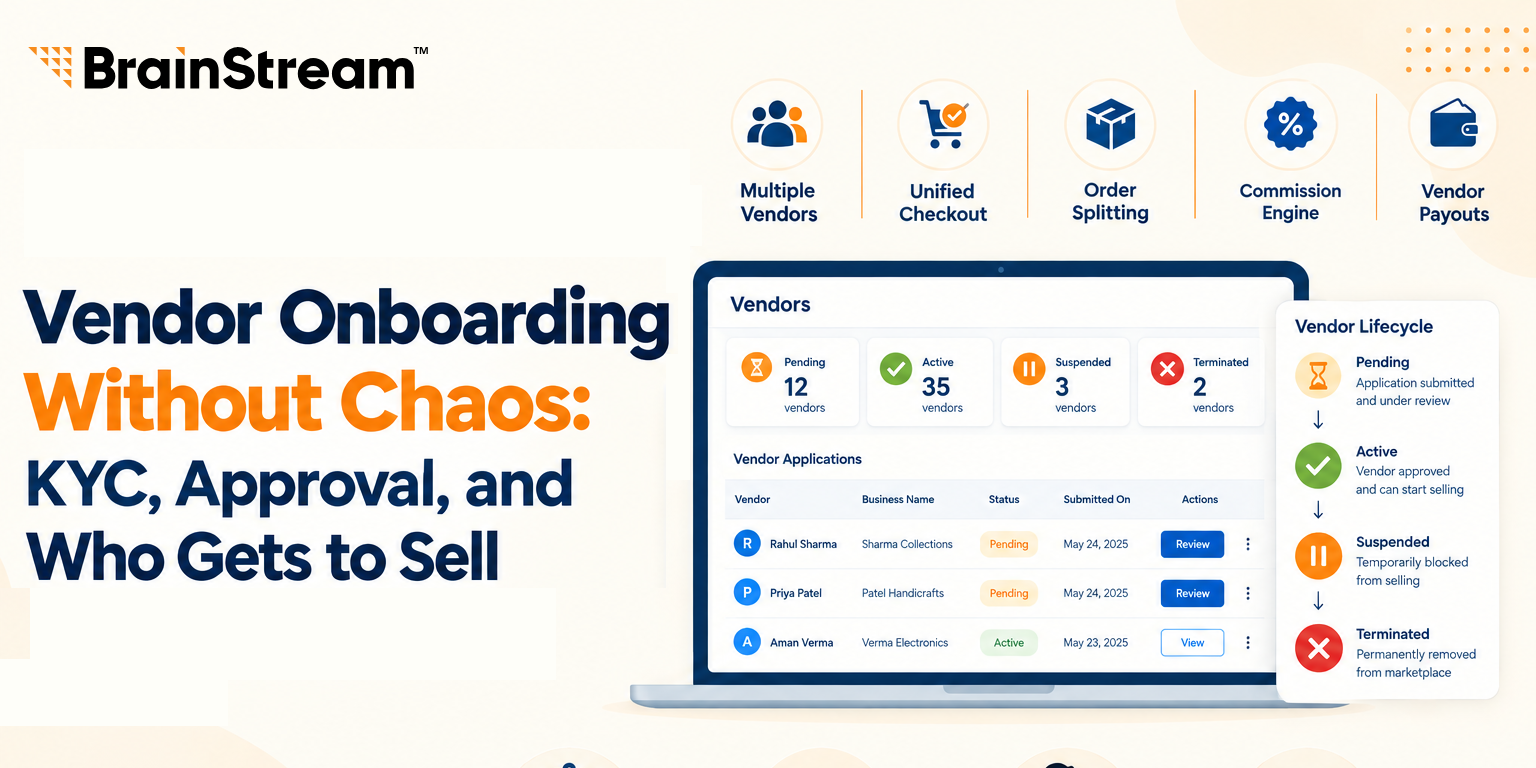
Vendor Onboarding Without Chaos: KYC, Approval, and Who Gets to Sell
Anyone can fill out a vendor signup form. That’s the…

How to Sync Shopify and Odoo Exactly When You Want Using Manual and Scheduled Sync?
A step-by-step look at the OdooStream features that put you…

Shopware 6 Migration: 10 Technical Issues That Can Break Your Store
Migrating an ecommerce store to Shopware 6 can improve performance,…
Top 10 WordPress Development Companies in India in 2026 – What Sets Them Apart
Finding the right WordPress partner can feel overwhelming. There are…