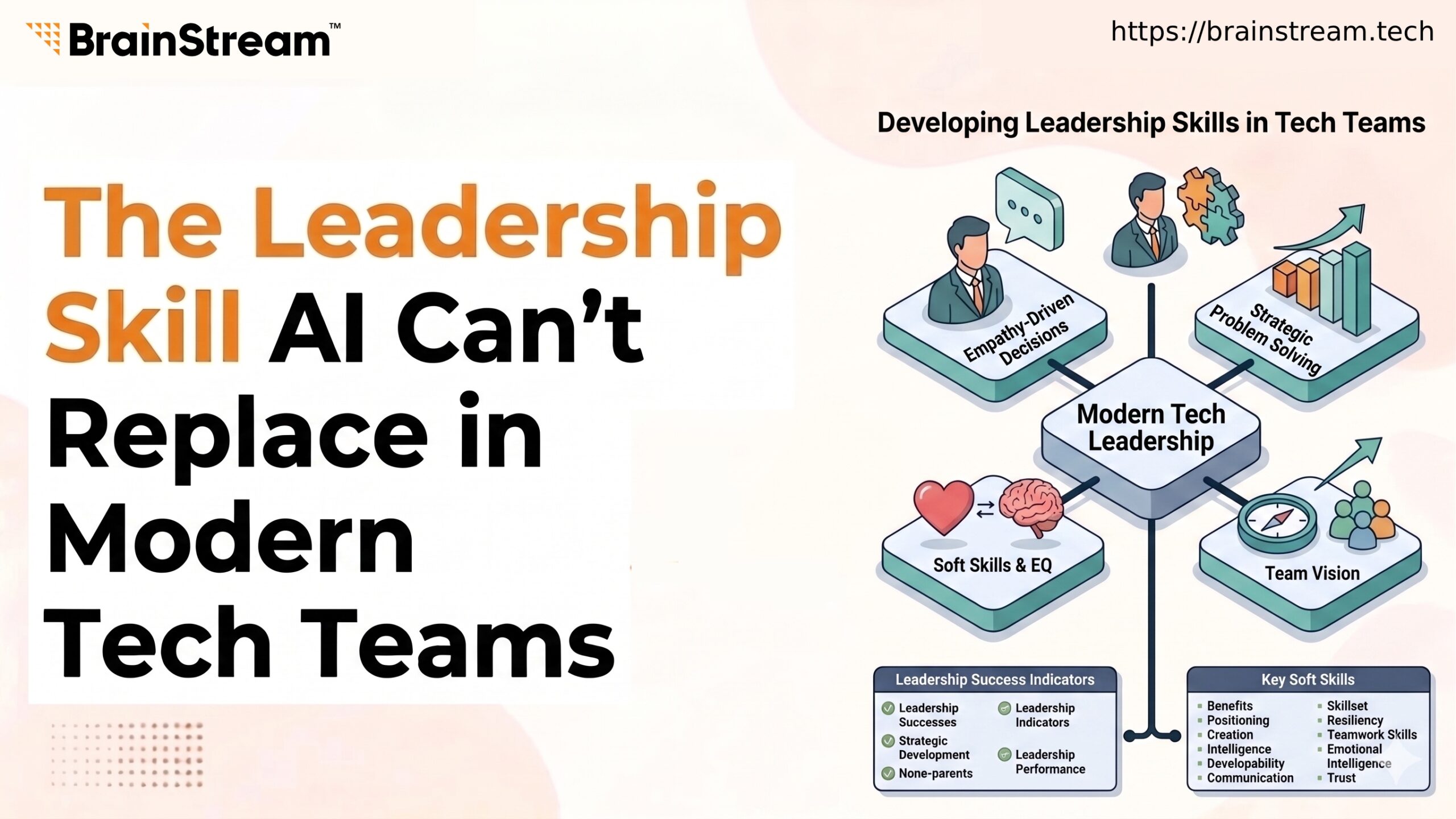
The Leadership Skill AI Can’t Replace in Modern Tech Teams
Across many growing tech teams we work with, there’s a common shift happening.
More AI tools are being introduced.
More automation is being layered in.
Visibility is being created through dashboards and reporting.
But one thing isn’t improving at the same pace:
Execution.
Projects still stretch longer than expected.
Priorities keep shifting.
Decisions take more time than they should.
Which brings up a practical question:
If the systems are getting smarter, why isn’t the output improving proportionately?
The Problem Isn’t AI. It’s How It’s Being Used
In most cases, expectations of AI are misaligned.
It’s treated as something that will:
- Simplify decisions
- Reduce uncertainty
- Accelerate outcomes automatically
But in real delivery environments, that’s not how things work.
Because delays are rarely caused by:
- Lack of tools
- Lack of data
- Lack of technical capability
Unclear or delayed decisions cause them.
And that layer still depends entirely on leadership.
Where Execution Actually Slows Down?
When we step into ongoing projects, especially during modernization or scaling phases, the gaps are rarely technical.
They show up in patterns like:
- Features are being discussed repeatedly without closure
- Priorities changing mid-cycle without a clear direction
- Teams are waiting for confirmation before moving forward
None of these is a major issue individually.
But together, they create:
- Slower releases
- Increased rework
- Reduced team confidence
AI can provide recommendations.
But it doesn’t step in and define:
What moves forward now and what doesn’t.
Why Decision-Making Is Becoming a Bottleneck?
With AI in the mix, teams now have:
- More data points
- More analysis
- More possible approaches
Which sounds like progress.
But often leads to:
Decision fatigue.
Instead of moving faster, teams start:
- validating decisions repeatedly
- comparing multiple “right” options
- delaying calls in search of certainty
From a delivery standpoint, this is where momentum is lost. Not because teams lack capability, but because the direction isn’t firm.
What Strong Tech Leadership Looks Like in Practice?
In high-performing teams, the difference is very clear.
Leaders don’t depend on AI to make decisions.
They use it to:
- Support thinking
- Validate direction
- Reduce blind spots
But they still:
- Take calls when information is incomplete
- Prioritise progress over perfection
- Maintain clarity across teams
- Keep execution moving consistently
This is especially critical in:
- Legacy modernization
- Product scaling
- Multi-team environments
Where waiting for perfect inputs is not practical.
Why This Becomes Critical During Scaling & Modernization?
As systems grow and evolve:
- Dependencies increase
- Technical complexity rises
- Business impact becomes more immediate
In these environments, delayed decisions don’t just slow teams down.
They affect:
- Delivery timelines
- Cost efficiency
- Overall system stability
This is where leadership plays a direct role in outcomes. Not at a conceptual level,
but at an execution level.
What AI Still Can’t Replace?
AI can:
- Analyse large data sets
- Identify patterns
- Recommend possible actions
But it doesn’t:
- Take ownership of trade-offs
- Align decisions with business priorities
- manage real-time delivery pressure
- Move teams forward under uncertainty
That responsibility still sits with leadership.
Final Thought
As AI becomes more integrated into development and decision workflows, technical capabilities will continue to improve.
But execution will still depend on:
How quickly and clearly decisions are made.
Because in any project, at any stage, progress depends on someone defining direction.
Where does this connect to Real Delivery Challenges?
In many of the engagements we take on, especially around modernization and scaling, the core issue is not the technology itself.
It’s:
- Fragmented decision-making
- Unclear ownership
- Delayed alignment between tech and business
Once that is addressed, systems don’t just improve.
They start moving.
If This Is Something You’re Seeing
If your team is facing:
- Slow execution despite better tools
- Repeated decision cycles
- Lack of clarity during delivery
It’s worth looking beyond the tech stack.
Because in most cases, the gap is not capability.
Its direction and decision ownership.
That’s an area we actively work on alongside engineering teams, ensuring that technology decisions translate into real, measurable progress.

Manish Khilwani
Author
Co-Founder at BrainStream Technolabs, he focuses on building people-first, scalable eCommerce and digital products that help brands grow with clarity and innovation.
Table of contents
BLOGS
Learn & Grow with Us
Get the latest updates on trends and strategies that shape the business world. Our insights are here to keep you informed and inspired.
How Much Does AI Integration into a Symfony Application Cost in 2026?
Adding artificial intelligence to your Symfony application can improve customer…
Modernizing Legacy Symfony Applications with AI: Where to Start
Your Symfony application still runs your business. However, adding features…

Agentic Commerce in 2026: How AI Agents Are Changing Online Shopping
Online shopping is entering a new phase. For years, shoppers…

Top 7 Must-Have Bagisto Extensions to Improve Your eCommerce Store in 2026
Running an online store takes more than adding products and…