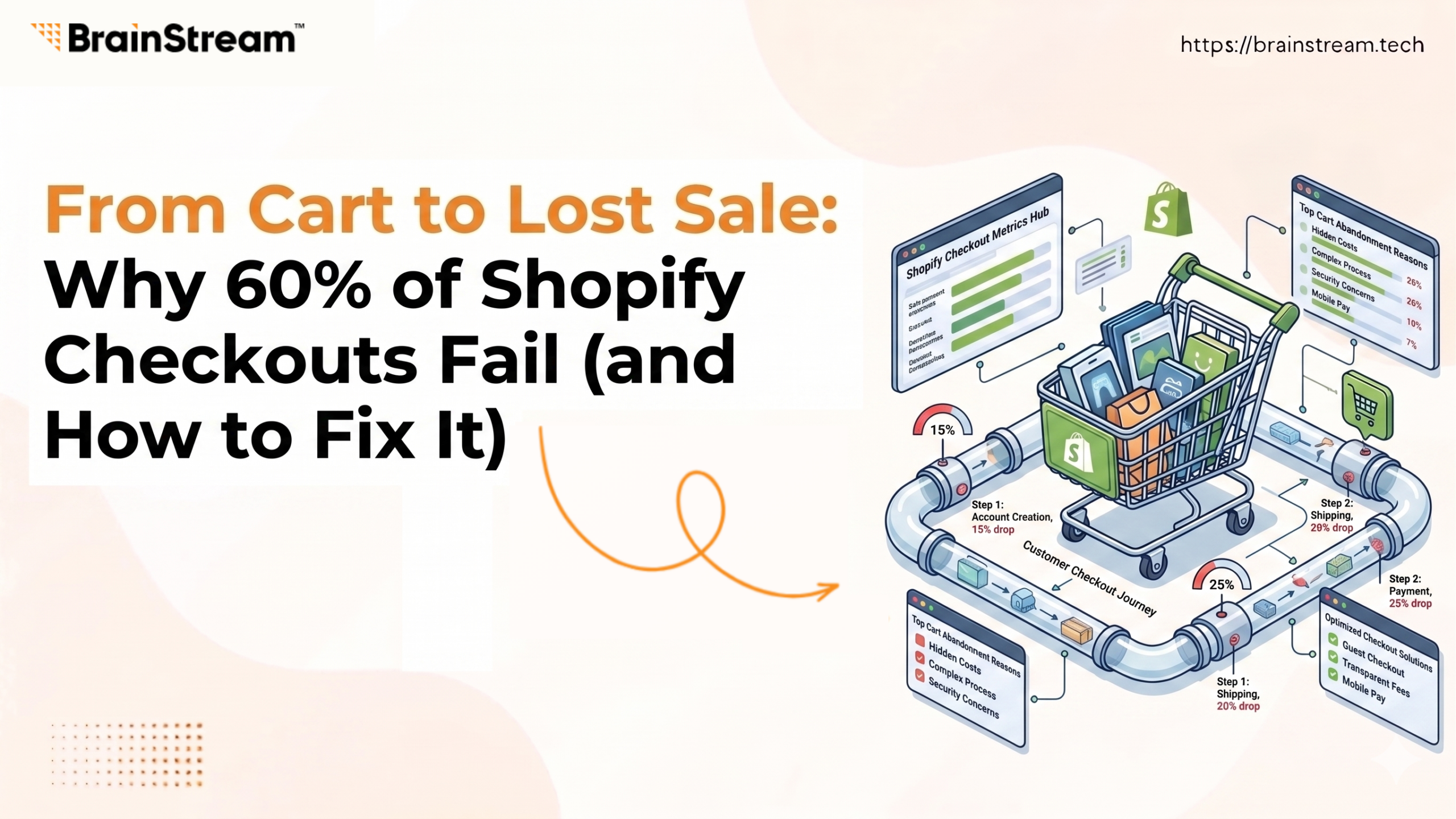
Why 60% of Shopify Checkouts Fail (and How to Fix It)
For many businesses using Shopify, the checkout process is expected to be the simplest part of the customer journey.
The user has already:
- Found the product
- Reviewed the details
- Added items to the cart
Yet, a significant percentage of these journeys never convert into actual sales.
Checkout is not just a final step; it is a critical decision point where intent is either confirmed or lost.
Why Checkout Optimization Matters More Than Ever
In today’s competitive eCommerce landscape, businesses are investing heavily in:
- Paid advertising
- SEO
- Influencer marketing
However, increasing traffic alone does not guarantee growth.
If the checkout experience is not optimized, businesses end up scaling traffic toward a system that quietly loses conversions.
In many Shopify stores, the issue is not demand; it’s friction in the conversion path.
Key Reasons Shopify Checkouts Fail
1. Lack of Pricing Transparency
Unexpected costs such as shipping fees or taxes introduced at checkout, can disrupt user expectations.
This often leads to hesitation and drop-offs.
What this means for businesses:
- Reduced trust
- Increased cart abandonment
- Lower conversion rates
2. Complex Checkout Flow
Long forms, multiple steps, and mandatory account creation add unnecessary friction.
Users today expect speed and simplicity.
Impact:
- Higher abandonment rates
- Reduced checkout completion
3. Limited Payment Options
User preferences vary widely, especially across regions.
In markets like India, flexibility in payment methods plays a major role in conversions.
Common expectations include:
- UPI
- Wallets
- Net banking
- Buy Now, Pay Later
Business impact:
- Missed revenue opportunities
- Reduced accessibility
4. Slow Checkout Performance
Speed directly affects user behavior.
Even small delays can interrupt momentum and lead to drop-offs.
Why it matters:
A fast checkout experience keeps users engaged and reduces hesitation.
5. Lack of Trust Signals
At checkout, users are required to share sensitive information.
If trust is not clearly established, users may not proceed.
Key elements to include:
- Secure payment indicators
- Clear return/refund policies
- Transparent delivery timelines
A Practical Note on Shopify Checkout Limitations
One important consideration for businesses:
Standard Shopify plans offer limited control over the checkout interface. Full customization is typically available only with Shopify Plus.
This means most high-impact improvements happen before users reach checkout, such as:
- Optimizing the cart experience
- Ensuring pricing clarity earlier
- Reducing friction in the transition from cart to checkout
Understanding this helps businesses focus efforts where they create the most impact.
A Real-World Scenario: Where Conversions Were Being Lost
In one of our Shopify engagements, the business was experiencing:
- Strong traffic from paid campaigns
- High add-to-cart rates
- But lower-than-expected conversions
After analyzing the flow, key issues identified included:
- Additional costs are revealed only at checkout
- Limited payment options
- Minor delays during the payment step
What changed:
- Pricing clarity was introduced earlier in the journey
- Payment options were expanded
- Performance bottlenecks were reduced
Result:
- Improved checkout completion rates
- Better ROI from existing marketing efforts
This pattern is more common than most businesses expect.
How High-Performing Shopify Stores Approach Checkout
Businesses that consistently achieve higher conversions treat checkout as a strategic layer, not just a system step.
They focus on:
Simplified User Flow
Reducing steps and enabling guest checkout improves usability.
Transparent Pricing
Providing clear cost visibility builds trust early.
Flexible Payment Options
Adapting to user preferences increases accessibility.
Performance Optimization
Ensuring a fast, responsive experience across devices.
Trust Reinforcement
Using visual cues and clear communication to reduce hesitation.
The Business Impact of Fixing Checkout
Optimizing checkout does not just improve conversions; it strengthens overall business performance.
It leads to:
- Higher revenue from existing traffic
- Improved marketing ROI
- Lower customer acquisition cost
- Better user experience
In many cases, this is one of the most cost-effective ways to drive growth.
Looking Ahead: The Future of Checkout
Checkout experiences are evolving with advancements in technology.
Key trends include:
- One-click and express checkout
- AI-driven personalization
- Mobile-first optimization
- Seamless payment integrations
Businesses that adapt early will be better positioned to compete.
Conclusion
Checkout remains one of the most critical yet under-optimized stages in the eCommerce journey.
For Shopify stores, even small improvements in this stage can result in significant gains in conversions and revenue.
The focus should not only be on attracting users, but on ensuring they complete the journey.
Let’s Improve Your Checkout Experience
If your store is seeing strong traffic but inconsistent conversions, the issue may not be visibility; it may be friction in the conversion journey.
At BrainStream Technolabs, we help businesses identify these friction points, optimize user flow, and improve conversion performance with a practical, data-driven approach.
Growth doesn’t always come from more traffic; sometimes it comes from fixing what’s already there.

Manish Khilwani
Author
Co-Founder at BrainStream Technolabs, he focuses on building people-first, scalable eCommerce and digital products that help brands grow with clarity and innovation.
Table of contents
BLOGS
Learn & Grow with Us
Get the latest updates on trends and strategies that shape the business world. Our insights are here to keep you informed and inspired.
How Much Does AI Integration into a Symfony Application Cost in 2026?
Adding artificial intelligence to your Symfony application can improve customer…
Modernizing Legacy Symfony Applications with AI: Where to Start
Your Symfony application still runs your business. However, adding features…
Agentic Commerce in 2026: How AI Agents Are Changing Online Shopping
Online shopping is entering a new phase. For years, shoppers…
Top 7 Must-Have Bagisto Extensions to Improve Your eCommerce Store in 2026
Running an online store takes more than adding products and…