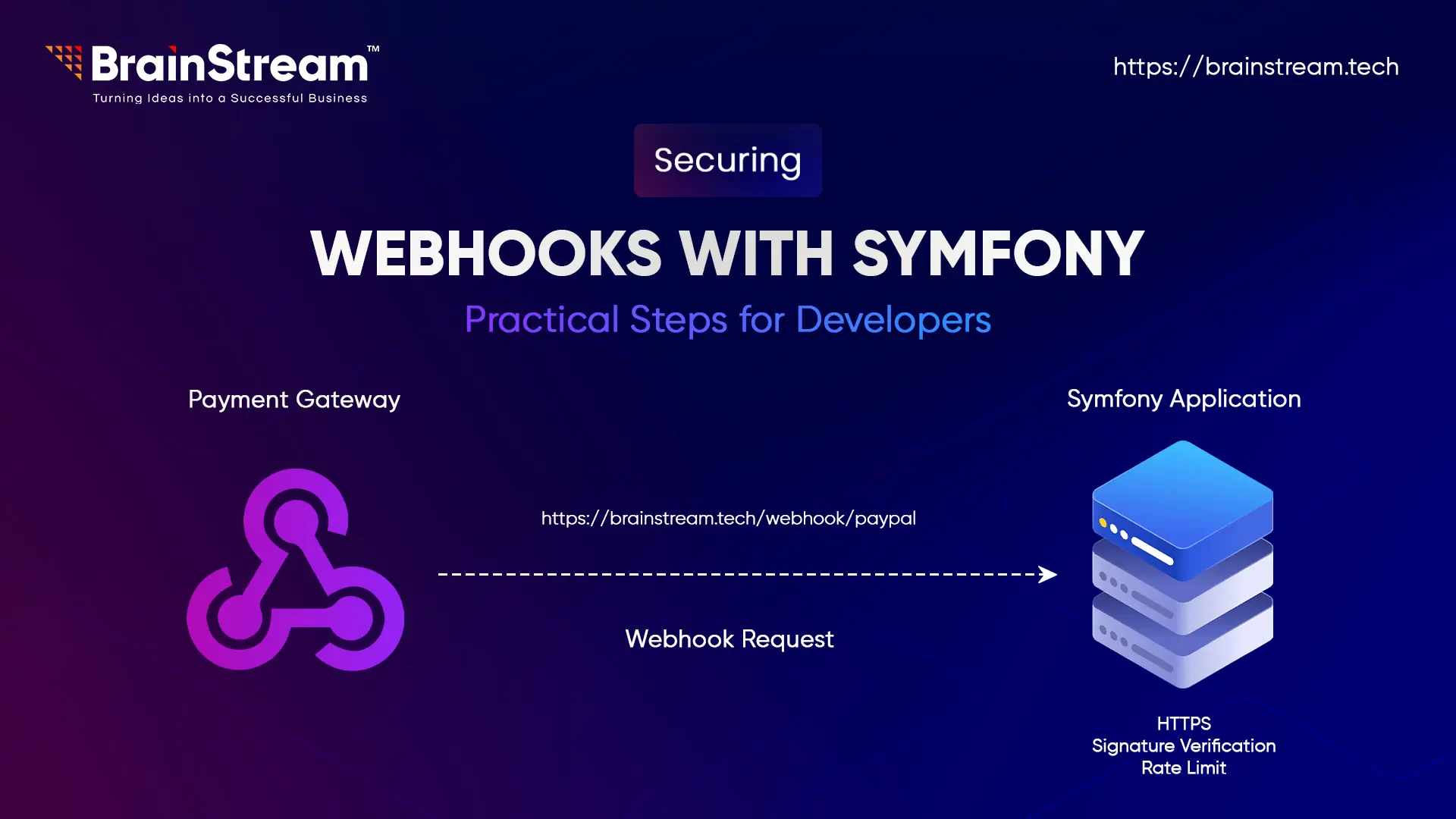
Secure Payment Gateway Integration with Symfony Webhooks
At BrainStream, we secure payment gateway webhooks for seamless integration with leading payment gateways using advanced Symfony techniques. This guide shares practical steps for safe, reliable payment processing.
1. Enforce HTTPS
Always use HTTPS for webhook endpoints to encrypt data in transit. Configure your web server to redirect HTTP URLS to HTTPS URLS and use an SSL certificate. This ensures secure communication and maintains the integrity of transmitted data.
2. Validate Signatures
We ensure webhook authenticity by validating signatures, critical for our payment integrations with platforms like PayPal, Stripe, etc. We use a secure HMAC-SHA256 hash to verify payloads, preventing unauthorized access. Here’s how we implemented signature validation in a recent Symfony project for a client’s e-commerce platform:
$payload = $request->getContent();
$secret = 'your_webhook_secret';
$signature = $request->headers->get('X-Webhook-Signature');
$expected = hash_hmac('sha256', $payload, $secret);
if (!hash_equals($expected, $signature)) {
    return new Response('Invalid signature', 401);
}
This stops unauthorized requests dead in their tracks.
3. Implement Rate Limiting
Protect against abuse by limiting request frequency. Symfony’s Rate Limiter Component makes this easy. Below is an example of rate-limiting a webhook endpoint to 100 requests per minute:
use Symfony\Component\HttpFoundation\Request;
use Symfony\Component\HttpFoundation\Response;
use Symfony\Component\RateLimiter\RateLimiterFactory;
public function webhook(Request $request, RateLimiterFactory $webhookLimiter): Response{
    $limiter = $webhookLimiter->create($request->getClientIp());
    if (!$limiter->consume(1)->isAccepted()) {
        return new Response('Too Many Requests', 429);
    }
    // Process webhook
    return new Response('Webhook received', 200);
}

Configure the limiter in config/packages/rate_limiter.yaml:
framework:
    rate_limiter:
        webhook:
            policy: token_bucket
            limit: 100
            rate: { interval: '1 minute' }
4. Log Webhook Activity
Log webhook requests to monitor activity and debug issues. Symfony’s Monolog bundle simplifies this. Inject a logger into your controller to record payloads and response statuses. Here’s an example:
use Psr\Log\LoggerInterface;
public function webhook(Request $request, RateLimiterFactory $webhookLimiter, LoggerInterface $logger): Response {
    $payload = $request->getContent();
    $logger->info('Webhook received', ['payload' => $payload]);
    // Validate and process webhook
    $response = new Response('Webhook received', 200);
    $logger->info('Webhook processed', ['status' => $response->getStatusCode()]);
    return $response;
}
This aids auditing and troubleshooting.
5. Use Message Queues for Resilience
High webhook volumes can strain endpoints, increasing DoS risks. Symfony Messenger can queue payloads for async processing, reducing load. Dispatch a message to a handler:
use Symfony\Component\Messenger\MessageBusInterface;
public function webhook(Request $request, MessageBusInterface $bus): Response {
    $bus->dispatch(new WebhookMessage($request->getContent()));
    return new Response('Webhook queued', 202);
}
This boosts resilience against volume-based attacks.
6. Ensure Idempotency to Prevent Duplicates
Idempotency ensures that webhook requests can be safely repeated without causing duplicate actions, such as double-charging. Use a unique ID, e.g. Stripe’s Idempotency-Key or PayPal’s PayPal-Transmission-Id, and store it in a database to track processed requests. Here’s a Symfony example for PayPal using Doctrine:>
use Doctrine\ORM\EntityManagerInterface;>
use Symfony\Component\HttpFoundation\Request;>
use Symfony\Component\HttpFoundation\Response;>
public function webhook(Request $request, EntityManagerInterface $em): Response{>
$transmissionId = $request->headers->get('Paypal-Transmission-Id');>
if (!$transmissionId) {>
    > return new Response('Missing PayPal-Transmission-Id', 400);>
}>

if ($em->getRepository(WebhookLog::class)->findOneBy(['transmissionId' => $transmissionId])) {>
    > return new Response('Webhook already processed', 200);>
}>
// Process webhook and save transmissionId>

$log = new WebhookLog($transmissionId);>
$em->persist($log);>
$em->flush();>
return new Response('Webhook processed', 200);>
}>
This prevents costly duplicates for providers like PayPal or Stripe.
7. Encrypt Sensitive Payload Data
For sensitive data (e.g., payment details), encrypt webhook payloads before storing and decrypt them for processing. Symfony’s Sodium integration offers robust encryption. A nonce (number used once) ensures unique encryption outputs. Here’s an example of encrypting and decrypting a payload with Doctrine:>
use Doctrine\ORM\EntityManagerInterface;>
use Symfony\Component\HttpFoundation\Request;>
use Symfony\Component\HttpFoundation\Response;>
public function webhook(Request $request, EntityManagerInterface $em): Response{>
    $payload = $request->getContent();>
    $key = sodium_crypto_secretbox_keygen();>
    $nonce = random_bytes(SODIUM_CRYPTO_SECRETBOX_NONCEBYTES);>
    $encrypted = sodium_crypto_secretbox($payload, $nonce, $key);>
    >
    $log = new WebhookLog($encrypted, $nonce, $key);>
    $em->persist($log);>
    $em->flush();>
    return new Response('Webhook stored', 200);>
}>
This protects sensitive data with a unique nonce per encryption.
Conclusion
Securing webhooks doesn’t have to be complex. You can safeguard your application by enforcing HTTPS, validating signatures, applying rate limits, logging activity, using message queues, ensuring idempotency, and encrypting data. Test these measures thoroughly to ensure your endpoints are secure and reliable.


Anand Dattani
Author
Anand Dattani is a Senior Developer at BrainStream Technolabs. He is an experienced developer specializing in PHP and modern MVC frameworks, with expertise in backend architecture and building scalable web solutions.
Table of contents
BLOGS
Learn & Grow with Us
Get the latest updates on trends and strategies that shape the business world. Our insights are here to keep you informed and inspired.
How Much Does AI Integration into a Symfony Application Cost in 2026?
Adding artificial intelligence to your Symfony application can improve customer…

Modernizing Legacy Symfony Applications with AI: Where to Start
Your Symfony application still runs your business. However, adding features…

Agentic Commerce in 2026: How AI Agents Are Changing Online Shopping
Online shopping is entering a new phase. For years, shoppers…

Top 7 Must-Have Bagisto Extensions to Improve Your eCommerce Store in 2026
Running an online store takes more than adding products and…